

12 min read

NetSuite vs. Sage Intacct
As they both claim that they are built for the modern business with advanced functionality, it is critical to understand the MAJOR differences separating the two.
Choosing the right ERP system can have a lasting impact on your organization's ability to grow, streamline operations, and make informed business decisions.
If you're comparing Oracle NetSuite and Sage Intacct, you're likely looking for a cloud ERP or financial management solution that can support your company's growth.
While both platforms offer strong accounting capabilities, they serve different business needs. Sage Intacct is primarily a cloud financial management platform, while NetSuite is a complete cloud ERP that combines financials, CRM, inventory, order management, manufacturing, ecommerce, warehouse management, and reporting in one unified system.
This guide compares NetSuite and Sage Intacct across features, pricing considerations, scalability, reporting, implementation, and long-term business growth to help you determine which solution is the better fit.
In This Guide
- NetSuite vs Sage Intacct at a Glance
- Feature Comparison
- Financial Management
- Inventory
- Manufacturing
- CRM
- Reporting
- Pricing
- Implementation
- Who Should Choose Sage Intacct?
- Who Should Choose NetSuite?
- Why Companies Switch
- FAQs
NetSuite vs. Sage Intacct at a Glance
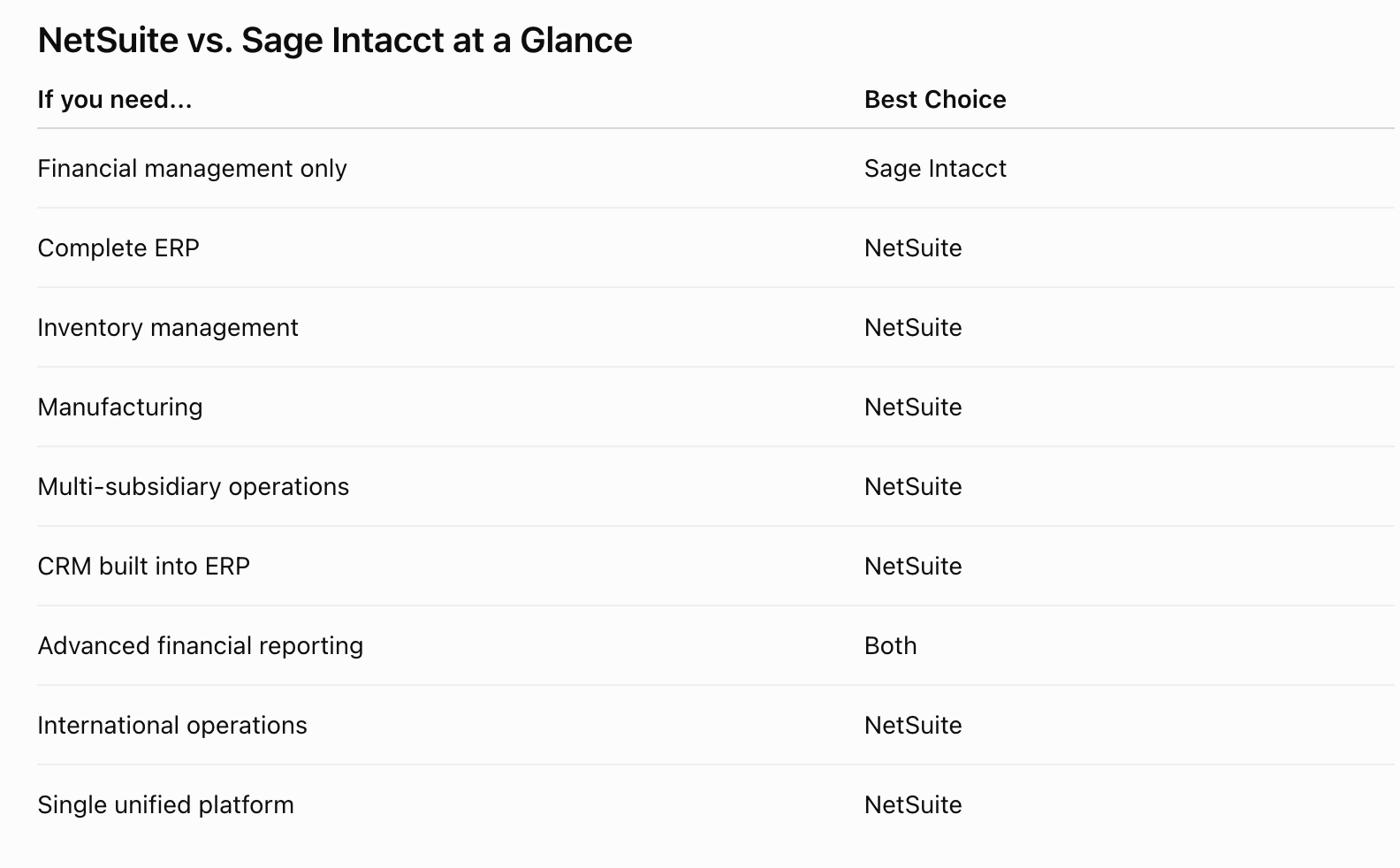
Bottom line: Sage Intacct is a strong cloud accounting platform. NetSuite is a complete ERP designed to manage both financials and business operations from a single system.
What Is Sage Intacct?
Sage Intacct is a cloud-based financial management platform designed to help organizations automate accounting processes, improve financial reporting, and support multi-entity accounting. It is commonly used by growing businesses that have outgrown entry-level accounting software and need stronger financial controls.
While Sage Intacct provides robust accounting functionality, many operational capabilities—such as CRM, ecommerce, warehouse management, manufacturing, and advanced inventory—typically require third-party applications and integrations.
What Is Oracle NetSuite?
Oracle NetSuite is a cloud ERP platform that combines accounting, financial management, CRM, inventory, procurement, manufacturing, order management, warehouse management, ecommerce, and business intelligence within a single cloud platform.
Rather than connecting multiple business systems together, NetSuite is designed to manage an organization's financial and operational processes from one unified database, helping reduce manual work and improve visibility across departments.
Side-by-Side Comparison
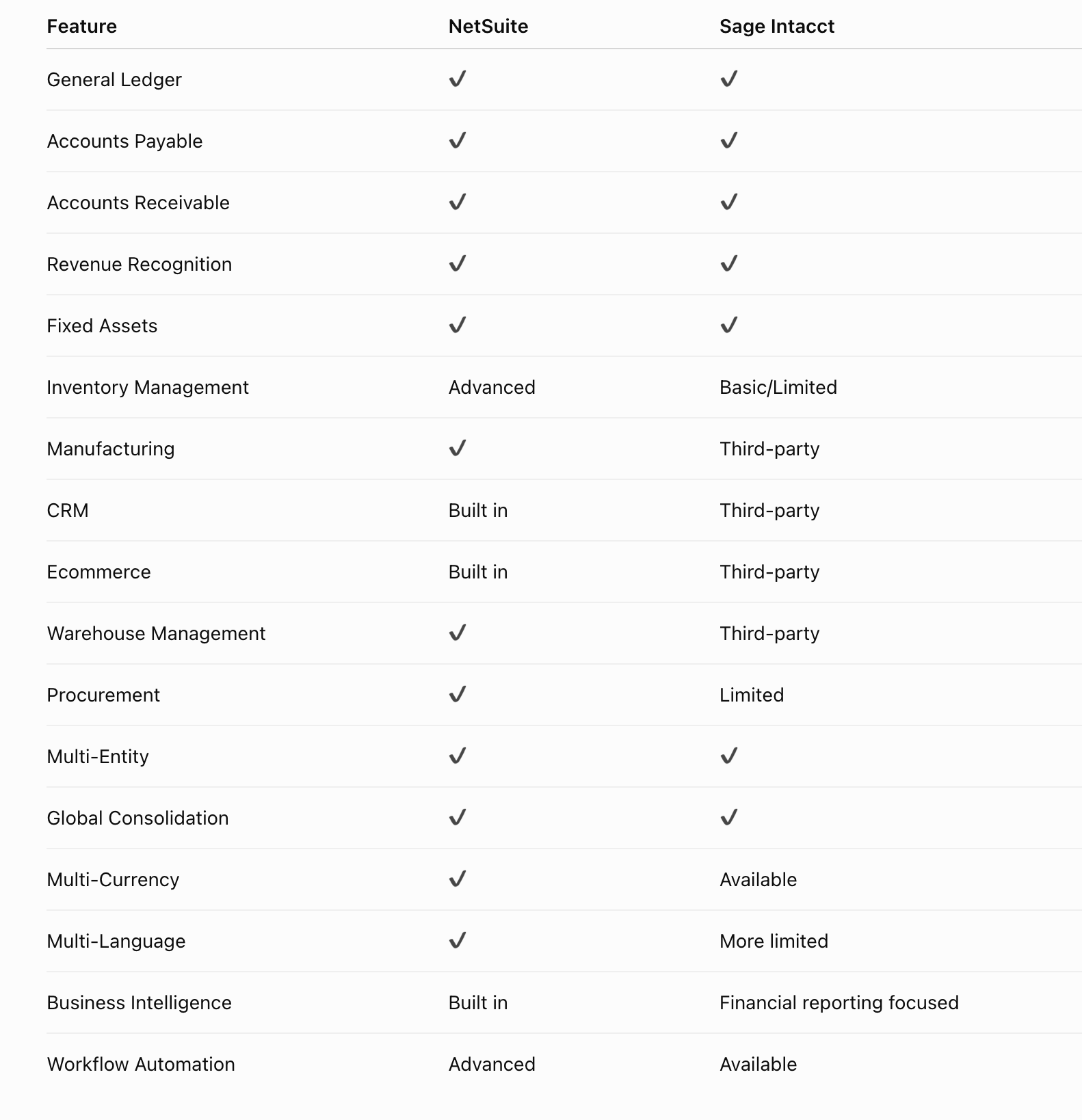
What are the Major Comparisons between Intacct and NetSuite:
Financial Management
Both NetSuite and Sage Intacct provide strong core financial management capabilities, including general ledger, accounts payable, accounts receivable, cash management, fixed assets, budgeting, and financial reporting. Both platforms are designed to automate accounting processes and improve financial visibility.
The biggest difference is scope. Sage Intacct focuses primarily on financial management, while NetSuite extends beyond accounting to manage operations across the business. Organizations that need accounting software with advanced financial controls may find Sage Intacct meets their needs, while companies looking for a unified ERP platform often choose NetSuite to manage finance and operations together.
Inventory Management
Inventory management is one of the biggest differences between the two platforms.
NetSuite includes robust inventory management as part of its ERP platform, allowing businesses to manage inventory across multiple warehouses and locations, automate replenishment, track lot and serial numbers, monitor inventory in real time, and optimize fulfillment processes from a single system.
Sage Intacct offers inventory functionality but is generally better suited for organizations with simpler inventory requirements. Companies with more advanced inventory, distribution, or warehouse management needs often rely on third-party applications to extend Sage Intacct's capabilities.
Best for inventory-intensive businesses: NetSuite
Manufacturing
Manufacturers require more than financial software—they need production planning, work orders, bill of materials (BOM), scheduling, shop floor visibility, and supply chain management.
NetSuite includes manufacturing capabilities that help businesses manage production from procurement through fulfillment within the same ERP platform.
Sage Intacct is not designed as a manufacturing ERP. Manufacturers typically integrate Sage Intacct with specialized manufacturing software to manage production processes.
Best for manufacturers: NetSuite
Customer Relationship Management (CRM)
One of NetSuite's biggest advantages is its built-in CRM.
NetSuite combines customer relationship management with financials, sales, marketing, customer service, and order management in one platform, allowing teams to access customer and financial data without switching between systems.
Sage Intacct does not include a native CRM. Organizations commonly integrate it with third-party CRM solutions such as Salesforce or HubSpot to manage customer relationships.
Best for businesses wanting CRM and ERP together: NetSuite
Reporting & Business Intelligence
Both platforms offer strong reporting capabilities, but they serve different purposes.
Sage Intacct is widely recognized for its financial reporting and customizable dashboards that help finance teams analyze performance and create detailed financial statements.
NetSuite also provides strong financial reporting while extending analytics across inventory, sales, operations, purchasing, manufacturing, and customer data. Because all business information resides in one database, organizations can generate cross-functional reports without combining data from multiple systems.
Best for financial reporting only: Both perform well.
Best for company-wide reporting: NetSuite
Multi-Entity & Global Operations
Both NetSuite and Sage Intacct support multi-entity organizations and financial consolidations, making them suitable for growing businesses with multiple legal entities.
However, NetSuite was built to support global operations at scale. It includes native multi-currency, multi-language, tax management, and global financial consolidation capabilities designed for organizations operating across multiple countries.
Sage Intacct also supports multi-entity accounting but may require additional configuration or integrations depending on international business requirements.
Best for global organizations: NetSuite
Integrations
Both platforms integrate with third-party applications, but the overall integration strategy differs.
Sage Intacct often relies on integrations to expand beyond accounting, connecting with CRM, payroll, manufacturing, ecommerce, inventory, and other operational systems.
NetSuite includes many of these capabilities natively, reducing the number of separate applications organizations need to manage. Businesses can still integrate NetSuite with third-party software when needed, but many companies find they can consolidate systems onto a single platform.
Scalability
Both NetSuite and Sage Intacct are designed for growing businesses, but they scale differently.
Sage Intacct scales well for organizations focused primarily on financial management. As operational complexity increases, businesses often add additional applications for inventory, manufacturing, CRM, ecommerce, or warehouse management.
NetSuite is designed to scale as organizations grow by supporting finance, operations, supply chain, customer management, and global expansion within one ERP platform. This can help reduce system complexity and eliminate the need to manage multiple disconnected applications over time.
Best for long-term business growth: NetSuite
Implementation & User Experience
Implementation timelines and costs vary depending on business size, complexity, and customization requirements.
NetSuite implementations often follow proven methodologies such as SuiteSuccess, which provides industry-specific best practices, predefined workflows, dashboards, reports, and KPIs to help organizations go live more efficiently.
Sage Intacct implementations are typically led by implementation partners and may require additional configuration and third-party integrations depending on the organization's operational needs.
For either platform, choosing an experienced implementation partner plays a significant role in project success, user adoption, and long-term ROI.
Pricing
Neither NetSuite nor Sage Intacct publishes standard pricing because costs depend on factors such as the number of users, required modules, implementation services, and business complexity.
Organizations comparing the two platforms should evaluate the total cost of ownership, including software licensing, implementation, ongoing support, customizations, and any third-party applications required to meet business needs.
While Sage Intacct may have a lower initial software investment for finance-focused organizations, businesses that require multiple integrated applications should also consider the long-term costs of maintaining those additional systems. NetSuite's unified platform can reduce complexity by consolidating many business functions into a single solution.
Thinking About Moving from Sage Intacct to NetSuite? Continue Your ERP Research
Many organizations begin evaluating NetSuite after they outgrow Sage Intacct's accounting-focused capabilities. If you're planning a migration, understanding implementation timelines, data migration, integrations, and licensing is just as important as choosing the right software. Still comparing solutions? These resources can help you make a more informed decision:
Related Resources:
NetSuite Pricing Guide – Understand licensing and implementation costs
NetSuite Implementation Guide – Learn what to expect before, during, and after implementation
NetSuite ERP Buyer's Guide – Evaluate if NetSuite is right for your business
NetSuite vs. Sage Intacct Whitepaper – Download the complete side-by-side guide comparison
Customer Success Stories – See how growing companies successfully migrated to NetSuite.
Who Should Choose Sage Intacct?
Sage Intacct is a strong choice for organizations whose primary focus is financial management and accounting. It is well suited for businesses that have outgrown entry-level accounting software but do not require a complete ERP platform.
Sage Intacct may be the right fit if your business:
- Primarily needs advanced accounting and financial management
- Wants strong financial reporting and multi-entity accounting
- Has relatively simple inventory or operational requirements
- Already relies on third-party software for CRM, inventory, payroll, or manufacturing
- Is not planning significant operational expansion in the near future
For finance-focused organizations, Sage Intacct provides a modern cloud accounting platform that can improve financial visibility and automate core accounting processes.
Who Should Choose NetSuite?
NetSuite is designed for organizations that need more than accounting software. As a unified cloud ERP, it helps businesses manage financials, operations, inventory, customer relationships, and business growth from a single platform.
NetSuite is often the better choice for businesses that:
- Need accounting and operational processes in one system
- Manage inventory across multiple warehouses or locations
- Manufacture products or manage complex supply chains
- Operate multiple subsidiaries or international entities
- Want built-in CRM, order management, and ecommerce capabilities
- Are looking to reduce reliance on multiple disconnected applications
- Expect continued growth and need software that can scale with the business
For organizations planning long-term growth, NetSuite's unified platform can improve visibility, streamline workflows, and reduce manual processes across departments.
Here are a few reasons why NetSuite stands out:
1. Best in class financial solution: NetSuite delivers a suite that was “born in the cloud” with complete finance and accounting, billing, revenue recognition, governance, risk and compliance (GRC), global financial consolidation, and more.
2. NetSuite is engineered to scale with your business as you grow: NetSuite ERP gives companies the tools they need to accelerate growth and drive innovation.
3. Insight and automation: NetSuite provides the clarity your business needs for business performance with All of the data and metrics that exist in NetSuite’s unified data model, accessible from anywhere, anytime, on any device.
4. NetSuite is Secure and compliant creating higher business performance: NetSuite is committed to achieving GRC objectives for your business by delivering audit-ready financial solutions and robust IT controls to run with more transparency in risk-savvy organizations.
5. NetSuite is the #1 platform for business growth: NetSuite's fast-growing popularity is not just limited to a certain region or industry, but it has a global reach with thousands of companies utilizing its cloud-based ERP system. This vast customer base includes companies of all sizes, from small startups to large enterprises, across 203 countries and supporting 27 languages, making it a truly global solution. NetSuite has become a trusted partner for companies in diverse industries such as retail, manufacturing, services, and more, helping them accelerate growth, streamline operations, and achieve better business performance. With NetSuite, businesses have the flexibility to expand their operations globally without worrying about the limitations of their software.
6. NetSuite is simple and easy to use on day one: SuiteSuccess was created with more than 20 years of industry experience placed right into the system. SuiteSuccess offers pre-defined roles, KPIs, reports, alerts, and value-driven dashboards.
Final Verdict: NetSuite vs. Sage Intacct
If your business primarily needs financial management, Sage Intacct is a capable cloud accounting solution.
If you're looking for a scalable ERP that combines accounting, inventory, CRM, manufacturing, reporting, and operations within a single platform, NetSuite offers a more comprehensive solution.
The best choice depends on your business processes, growth plans, and operational complexity. An experienced ERP advisor can help you evaluate both solutions based on your specific requirements.
Frequently Asked Questions
What is the difference between NetSuite and Sage Intacct?
The primary difference is that Sage Intacct is a cloud financial management platform, while Oracle NetSuite is a complete cloud ERP system.
Both solutions offer strong accounting capabilities, but NetSuite extends beyond finance to include inventory management, CRM, order management, procurement, manufacturing, warehouse management, ecommerce, and business intelligence in a single platform. Sage Intacct often relies on third-party integrations for many of these operational functions.
Is Sage Intacct an ERP?
Sage Intacct is often referred to as an ERP solution because it supports core financial management functions. However, it is more accurately described as a cloud financial management platform.
Organizations that require capabilities such as manufacturing, warehouse management, CRM, or advanced inventory typically integrate Sage Intacct with additional software. NetSuite includes many of these capabilities within its ERP platform.
Is NetSuite better than Sage Intacct?
There is no one-size-fits-all answer. The better solution depends on your business requirements.
If your organization primarily needs accounting and financial management, Sage Intacct may be a good fit. If you need a unified platform to manage finance, inventory, operations, customer relationships, manufacturing, and future growth, NetSuite generally provides a more comprehensive solution.
Which platform is more scalable?
Both NetSuite and Sage Intacct are designed for growing businesses, but they scale differently.
Sage Intacct scales well for organizations focused primarily on financial management. NetSuite is designed to support business growth across finance, operations, inventory, manufacturing, ecommerce, CRM, and international expansion, making it a strong choice for organizations expecting increasing operational complexity.
Is NetSuite more expensive than Sage Intacct?
Pricing depends on several factors, including the number of users, required modules, implementation scope, and business complexity.
Rather than comparing subscription costs alone, organizations should evaluate the total cost of ownership, including implementation, integrations, ongoing support, customizations, and future scalability. Businesses requiring multiple third-party applications with Sage Intacct may find that overall costs become comparable over time.
Why do companies move from Sage Intacct to NetSuite?
Many organizations begin evaluating NetSuite as their business grows and operational requirements become more complex.
Common reasons include:
• Managing multiple disconnected business systems
• Growing inventory or warehouse operations
• Expanding into manufacturing
• International growth and multi-subsidiary management
• Desire for a single source of truth across departments
R• educing manual processes and duplicate data entry
NetSuite's unified ERP platform can help consolidate business processes into one system.
How long does it take to migrate from Sage Intacct to NetSuite?
Implementation timelines vary depending on the size of your organization, the complexity of your business processes, data migration requirements, integrations, and customizations.
Many implementations take several months, though timelines can vary significantly. Working with an experienced NetSuite implementation partner can help reduce risk, improve user adoption, and keep the project on schedule.
Why Companies Compare NetSuite and Sage Intacct
Organizations typically compare NetSuite and Sage Intacct when they've outgrown entry-level accounting software and need a more robust cloud solution. While both platforms offer advanced financial management capabilities, businesses often evaluate them when expanding into inventory management, manufacturing, multi-entity operations, ecommerce, or international markets. Understanding your long-term business goals—not just your current accounting needs—is one of the most important factors in choosing the right platform.
Why Businesses Trust Protelo
Choosing the right ERP is about more than selecting software—it's about selecting the right implementation partner.
For more than two decades, Protelo has helped organizations evaluate, implement, optimize, and support NetSuite. Our team works with companies across manufacturing, distribution, software, healthcare, professional services, nonprofit, and more. Whether you're comparing NetSuite to Sage Intacct or planning a migration, our consultants help you:
• Evaluate your business requirements
• Compare ERP platforms objectively
• Estimate implementation costs
• Plan data migration
• Optimize existing NetSuite environments
• Train users and provide ongoing support
Request A Personalized NetSuite Price Quote
Ready to Compare NetSuite and Sage Intacct for Your Business?
Every organization has different requirements, which is why there isn't a one-size-fits-all ERP solution. Our NetSuite consultants can help you evaluate your current systems, compare functionality, estimate costs, and determine whether NetSuite is the right fit for your business.
Get:
- Personalized ERP recommendations
- NetSuite pricing estimate
- Implementation timeline
- Migration guidance
- Live product demonstration