

21 min read

Choosing between NetSuite and Infor CloudSuite has a direct impact on how your company wants to run finance, operations, supply chain, CRM, analytics, billing, project management, and future expansion inside one ERP system. Both platforms are strong cloud-based ERP options, but they approach resource planning, customization, automation, industry fit, and integration very differently.
The differences between NetSuite and Infor matter most when operational complexity, process specialization, and long-term architecture shape daily execution.
This guide covers:
-
How NetSuite and Infor CloudSuite differ across ERP scope, operations, cost, and scalability
-
Which platform better supports manufacturing, wholesale distribution, financial management, and professional services requirements
-
What buyers should weigh around customization, integration, implementation, analytics, and long-term business fit
P.S. The ERP choice is only half the work; the rollout has to protect the data, systems, and workflows your team already depends on. Protelo’s NetSuite Implementation Services help teams migrate clean data, connect CRM, ecommerce, and supply chain tools, and transition to NetSuite with less disruption.
Schedule a call to map migration scope and data requirements.
Where NetSuite and Infor CloudSuite Differ Most
What Separates NetSuite and Infor CloudSuite at a High Level?
NetSuite and Infor are both serious enterprise resource planning platforms, but they solve different problems best. NetSuite offers a unified suite that helps organizations unify finance, CRM, commerce, order management, billing, and reporting with real-time visibility.
Infor CloudSuite, by contrast, is more often positioned around industry-specific depth, especially for industrial manufacturing, process manufacturing, and wholesale distribution environments that need specialized workflows and operational nuance. The right ERP choice depends on operating model, complexity, and future-state architecture.
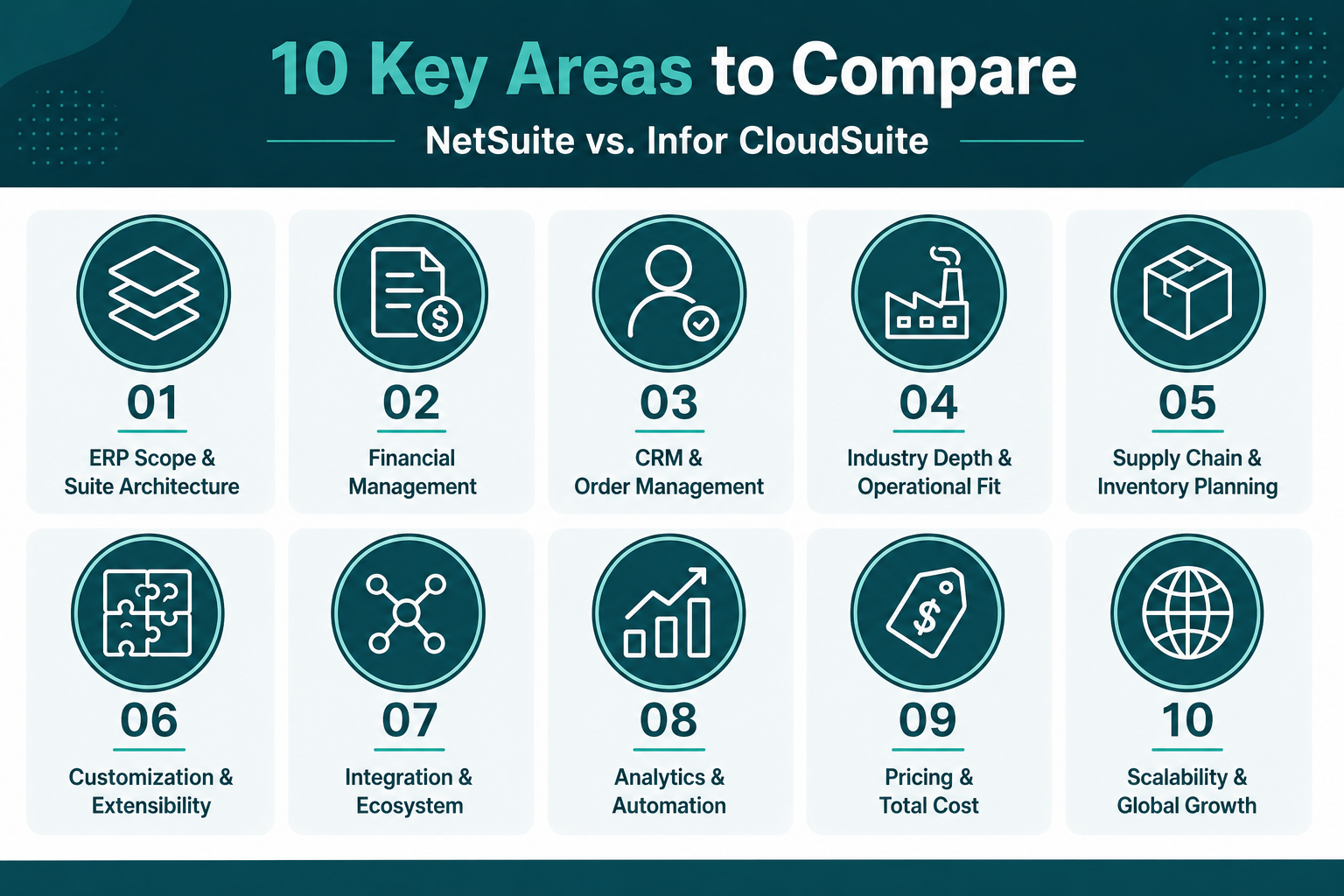
ERP Scope and Suite Architecture
This is the clearest top-level difference. NetSuite provides a more visibly unified suite structure, while Infor offers multiple CloudSuite paths aligned to industries and operating models.
Read Next: NetSuite vs Competitors: A Comparison Guide to Top Alternatives
Financial Management, Billing, and Financials
Financial management is a core strength for both platforms, but the execution differs. NetSuite provides a comprehensive financial suite that connects directly to CRM, order management, inventory, and project accounting in one environment. This makes close processes, reporting, billing, and multi-entity control easier to manage when finance needs visibility across the entire business.
Infor CloudSuite also delivers strong financials, but the platform is often more compelling when finance must connect closely with supply chain or industry workflows. For example, process manufacturing firms may value how Infor handles cost accounting, traceability, and compliance within specialized operational contexts.
NetSuite is ideal for companies that want one scalable ERP system where financials, analytics, workflow, and real-time visibility are tightly unified. Infor provides a better fit when financial processes are inseparable from complex operational execution.
Read Next: IDC MarketScape Names NetSuite a SaaS and Cloud Finance Leader in 2024
CRM, Customer Lifecycle, and Order Management
CRM architecture determines whether sales, service, and operations teams work from the same data or reconcile records across disconnected systems. The difference matters most when customer experience, order accuracy, and cross-functional visibility depend on unified data rather than integrated systems.
NetSuite:
-
Native CRM connected to opportunities, quotes, orders, fulfillment, renewals, and support: Sales teams can track leads, convert opportunities to quotes, generate orders, and monitor fulfillment without leaving the ERP system.
-
Better fit for teams wanting fewer handoffs between front-office and back-office workflows: When CRM functions sit in the same database as financials and inventory, customer experience improves, and data accuracy increases.
-
Stronger option when sales, finance, and operations need shared real-time data: NetSuite eliminates the need to reconcile customer records across separate systems.
-
Useful for companies trying to unify customer and transaction records in one ERP software environment: This reduces integration complexity and makes reporting more reliable.
Infor CloudSuite:
-
Can support CRM needs, but the experience may depend on the CloudSuite path and adjacent products: Infor offers CRM capabilities, but they may not be as tightly embedded in the core ERP experience as NetSuite.
-
Often, more compelling when operational depth matters more than having CRM as the suite centerpiece: Companies prioritizing manufacturing or distribution workflows may accept a less unified CRM experience.
-
Better for organizations prioritizing manufacturing, service, or distribution process fit over native CRM breadth: If operational execution is the primary concern, Infor's industry-specific strengths may outweigh CRM limitations.
-
Buyers should confirm whether customer-facing workflows will be handled natively, through Infor OS, or through other tools: Understanding the CRM architecture upfront prevents surprises during implementation.
Read Next: Simplifying the Suite: NetSuite Integrations
Industry-Specific Depth and Operational Fit
Infor CloudSuite offers stronger industry-specific depth for manufacturers and distributors, especially where workflows are complex, regulated, or micro-vertical. CloudSuite Industrial and CloudSuite Distribution are built around operational nuances that generic ERP platforms struggle to match. For example, process manufacturing firms benefit from Infor's traceability, formula management, and compliance tools. Wholesale distribution companies appreciate Infor's rebate management, pricing complexity, and warehouse execution capabilities.
In contrast, NetSuite is ideal for businesses that want one scalable business management platform without starting from a heavily verticalized framework. NetSuite serves professional services, retail, software, and distribution companies that value standardization and cross-functional visibility over deep vertical specialization.
The choice depends on whether the business model demands industry-specific workflows or benefits more from a unified, adaptable ERP solution that supports multiple business needs across a modern business environment.
Read Next:
- Outlook for Wholesale Distribution: Strategies for 2025
- Solving Manufacturing Challenges with NetSuite
Supply Chain, Inventory, and Resource Planning
Supply chain execution separates platforms that describe capabilities from platforms that deliver them under operational pressure. The better fit depends on whether the business benefits more from cross-functional simplicity or operational precision.
Read Next: NetSuite WMS: Smarter Inventory & Fulfillment
Customization, Module Strategy, and Extensibility
How each platform handles customization, module selection, and adaptability shapes long-term flexibility. The tradeoff is between controlled extensibility in a unified suite and specialized depth that may require less configuration but more upfront design.
NetSuite:
-
NetSuite modules expand the suite across finance, manufacturing, commerce, and project management: Buyers can start with core financials and add modules like Advanced Manufacturing, WMS, or SuiteCommerce as business needs evolve.
-
Strong when buyers want controlled extensibility without fragmenting the stack: NetSuite offers customization through configuration, workflows, scripting, and a mature NetSuite partner ecosystem.
-
NetSuite offers customization through configuration, workflows, scripting, and a mature partner ecosystem: SuiteScript, SuiteFlow, and SuiteBuilder provide powerful tools for tailoring the platform without breaking upgrades.
-
Easier to position as a scalable ERP for companies that want gradual expansion by module: This modular approach reduces upfront cost and implementation risk.
Infor CloudSuite:
-
Often reduces the need for heavy customization by delivering deeper industry-specific workflows: Infor CloudSuite Industrial and CloudSuite Distribution include specialized features that generic ERP platforms require customization to achieve.
-
Can still require architecture decisions across Infor products, add-ons, and process-specific capabilities: Buyers may need to evaluate how different Infor modules, Infor OS, and third-party integrations fit together.
-
Better for companies whose operations are too specialized for a generic cloud-based ERP solution: If the business depends on unique manufacturing, distribution, or services workflows, Infor provides better out-of-the-box alignment.
-
Buyers should test whether "less customization" is actually true for their exact business model: Industry-specific depth does not always eliminate the need for configuration, especially in complex environments.
Read Next:
Integration, Third-Party Applications, and Ecosystem
Integration strategy determines how easily the ERP system connects to other enterprise software. The better approach depends on whether the business values fewer moving parts or orchestration flexibility across a broader application landscape.
NetSuite:
-
Strong unified-data argument, especially when finance, CRM, and operations stay in one suite: When most business processes run inside NetSuite, integration complexity decreases.
-
Supports extensions and third-party connections for ecommerce, payments, logistics, and other tools: NetSuite's SuiteApp marketplace and API capabilities enable connections to Shopify, Salesforce, shipping carriers, and accounting software.
-
Often easier to explain to buyers seeking fewer moving parts in the ERP system: A unified suite reduces the number of integrations required to run the business.
Infor CloudSuite:
-
Infor emphasizes Infor OS and ION for integration across Infor and third-party systems: Infor OS provides a platform layer for connecting CloudSuite modules, external applications, and data sources.
-
Can be powerful for large environments with many connected applications and process orchestration needs: ION middleware supports complex workflows, event-driven automation, and real-time data synchronization.
-
May appeal more to enterprises that already run a broader Infor footprint or complex middleware strategy: Companies with existing Infor investments may find CloudSuite easier to integrate into their architecture.
Read Next: Big News for NetSuite Users: New Connectors, Major Upgrades & What's Coming Next
Analytics, Workflow, and Automation
Both platforms support analytics, workflow, and automation, but with different strengths. NetSuite provides real-time visibility through native dashboards, saved searches, and SuiteAnalytics that connect directly to transactional data across finance, CRM, inventory, and projects. This unified approach makes it easier to build cross-functional reports without middleware or data warehousing.
Infor CloudSuite pairs intelligence and analytics with industry process context and enterprise automation. Infor Birst delivers embedded analytics tailored to manufacturing, distribution, and services workflows, while Infor OS enables workflow orchestration across modules and third-party systems.
NetSuite is a true cloud ERP that excels when buyers want one platform for operational visibility and decision-making. On the other hand, Infor offers a powerful ERP option when analytics must align closely with specialized operational execution and advanced features like predictive planning or process optimization.
Read Next:
- Generate Multi-Level NetSuite Reports Instantly with RightInsight AI
- NetSuite Comparison Series: Managing Projects & Analytics Tools
Pricing, Total Cost of Ownership, and Implementation Effort
Pricing transparency and implementation complexity vary significantly between NetSuite and Infor CloudSuite. NetSuite uses edition-based pricing with predictable module add-ons, while Infor CloudSuite pricing is quote-based and less transparent.
Note: All pricing figures are directional estimates, not fixed rates. Total cost depends on factors such as modules, number of users or employees, integrations, and implementation complexity. Both NetSuite and Infor CloudSuite typically require custom pricing based on business requirements.
Read Next: NetSuite Licensing Guide 2026: What Every Buyer Needs to Know
Scalability, Global Growth, and Long-Term Fit
Both platforms are scalable, but they scale differently. NetSuite is a strong option for companies standardizing on one suite as they grow across entities, channels, or geographies. NetSuite's multi-subsidiary management, multi-currency support, and unified reporting make it easier to add new business units without re-platforming.
Oracle NetSuite vs Infor becomes a question of whether the business values suite simplicity or operational specialization as it scales. Infor CloudSuite is especially compelling when scale includes manufacturing complexity, process variation, and operational specialization. For example, a manufacturer expanding into new product lines or distribution channels may benefit from Infor's advanced planning and scheduling, traceability, and industry-specific workflows.
Choosing the right ERP system depends on whether future growth demands more standardization or more operational depth. NetSuite is ideal for companies that want one scalable, adaptable platform. Infor provides a better long-term fit when growth requires deeper vertical capabilities and specialized execution.
Read Next:
- NetSuite ERP: Tailored Solutions for Every Business Size
- NetSuite for Large Businesses & Enterprises
Industry Fit Matters More Than Feature Count
A company in wholesale distribution may care more about pricing complexity, rebates, warehouse depth, and supply chain management than headline CRM breadth. A process manufacturing firm may care more about traceability, planning, and industry workflows than generic suite simplicity. A services-led company may prioritize project management, resource management, billing, and margin visibility.
The true decision is not "which platform has more features and capabilities," but which platform aligns better with the business model, operating risk, and future growth plan. NetSuite vs Infor CloudSuite becomes clearer when buyers map platform strengths to actual operational priorities.
Compare NetSuite when the business benefits from unified visibility, cross-functional automation, and scalable standardization. Compare Infor when operational execution depends on specialized workflows, industry-specific logic, and deep process alignment. The right ERP system is the one that reduces friction in daily operations, not the one with the longest feature list.
When You Should Go With NetSuite
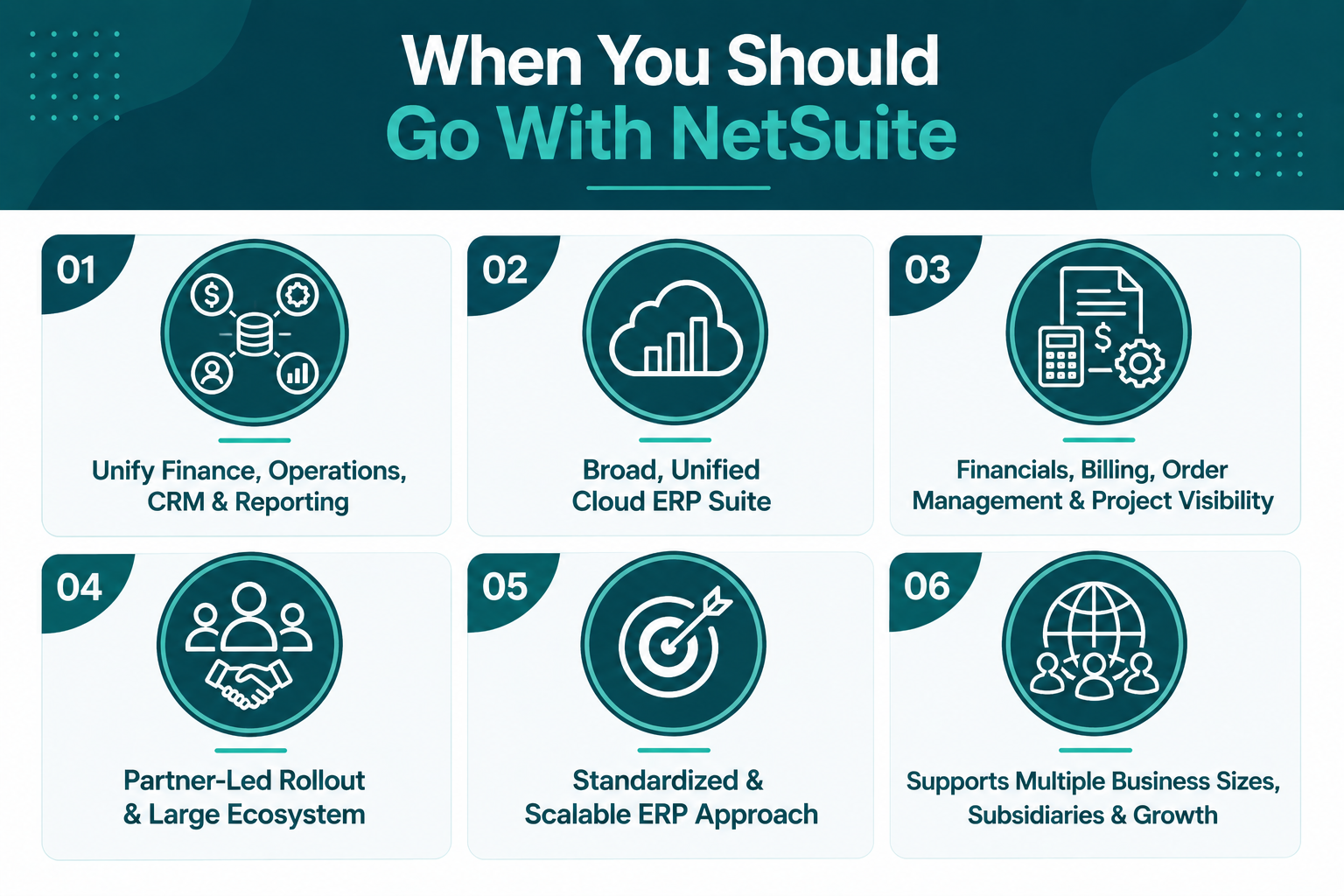
NetSuite is the stronger fit when:
-
The business wants to unify finance, operations, CRM, and reporting in one ERP system: NetSuite eliminates the need to reconcile data across separate platforms.
-
The buyer values a broad, unified cloud-based ERP suite: NetSuite provides a comprehensive platform that scales across business sizes and industries.
-
The company needs solid financial management, billing, order management, and project visibility in one place: NetSuite offers integrated modules that connect financials, operations, and customer-facing workflows.
-
The organization prefers a partner-led rollout with a large ecosystem: NetSuite's mature partner network and SuiteApp marketplace provide extensive support and extensibility.
-
The business is considering NetSuite because it needs a more standardized and scalable ERP approach: NetSuite reduces complexity by consolidating business processes into one platform.
-
The company wants an ERP solution that can support multiple business sizes, subsidiaries, and evolving business needs: NetSuite's multi-entity management and global capabilities make it easier to scale without re-platforming.
Read Next:
- Gartner Analysis: Why Companies Choose NetSuite
- How to Choose the Best NetSuite Partner for a Successful ERP Implementation
When Infor CloudSuite Might Be a Better Fit
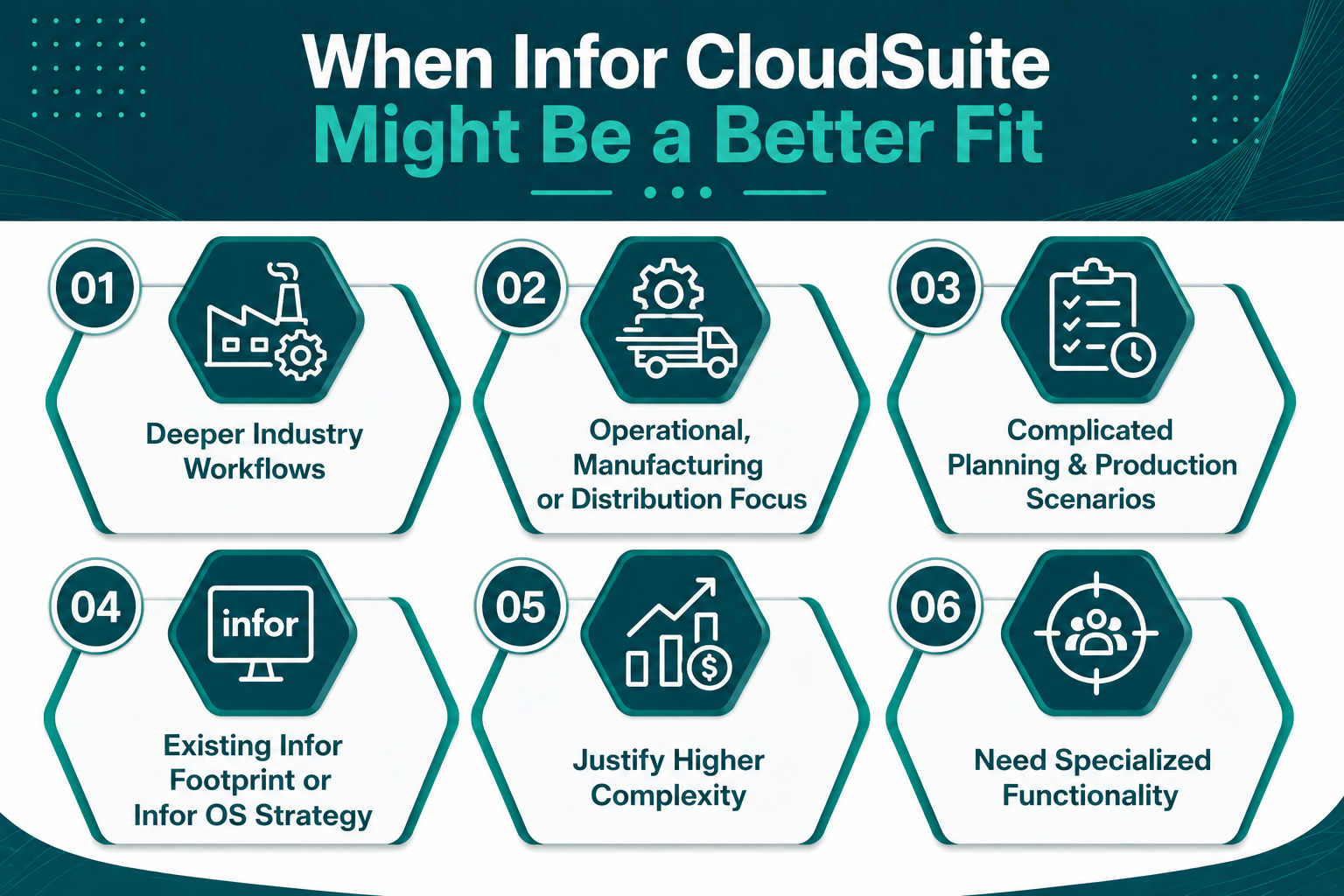
Infor CloudSuite is the stronger fit when:
-
The company needs deeper industry-specific workflows out of the box: Infor CloudSuite offers specialized capabilities for manufacturing, distribution, and professional services that generic ERP platforms require heavy customization to achieve.
-
The environment is heavily operational, manufacturing-led, or distribution-centric: Infor CloudSuite Industrial and CloudSuite Distribution provide operational depth that aligns with complex production, warehouse, and supply chain requirements.
-
The organization has complicated planning, service, or production scenarios: Infor's advanced planning and scheduling, traceability, and resource management features support specialized execution.
-
There is already an Infor footprint or architecture strategy around Infor OS: Companies with existing Infor investments may find CloudSuite easier to integrate into their enterprise software landscape.
-
The business can justify potentially higher complexity for better process alignment: Infor implementation may require more upfront investment, but the operational fit can deliver stronger long-term ROI.
-
Teams need specialized functionality more than a single generalized suite: If operational execution is the primary concern, Infor's industry-specific strengths may outweigh the benefits of a unified suite.
The Better ERP Choice Depends on How Your Business Actually Runs
The in-depth comparison reveals that both platforms serve modern business needs, but they solve different problems best. Oracle NetSuite vs Infor comes down to whether the organization prioritizes suite unification or operational specialization.
Key Takeaways:
-
NetSuite usually wins on suite unification, cross-functional visibility, and standardized scalability: NetSuite is a true cloud ERP that includes features for finance, CRM, commerce, and operations in one platform.
-
Infor CloudSuite often wins on specialized manufacturing and distribution process depth: Infor CloudSuite offers industry-specific workflows that reduce customization and improve operational alignment.
-
The right decision depends on operational complexity, implementation scope, and future-state architecture: Compared to NetSuite, Infor provides a better fit for companies with specialized operational requirements, while NetSuite serves businesses seeking a unified, scalable ERP solution.
P.S. Your ERP decision should account for what happens after selection. Protelo’s NetSuite Implementation Services help teams migrate clean data, connect key business systems, and move into NetSuite with less disruption.
Schedule a call to clarify migration scope before implementation costs escalate.
FAQs
What is the main difference between NetSuite and Infor CloudSuite?
NetSuite is a unified cloud-based ERP suite that integrates financials, CRM, commerce, and operations in one platform. Infor CloudSuite is more industry-focused, offering specialized editions like CloudSuite Industrial and CloudSuite Distribution that provide deeper operational workflows for manufacturing and distribution environments. The main difference is whether the business prioritizes suite unification or industry-specific depth.
Which ERP is better for manufacturing: NetSuite or Infor CloudSuite?
Infor CloudSuite Industrial is generally stronger for complex manufacturing environments that require advanced planning and scheduling, traceability, and process-specific workflows. NetSuite offers solid manufacturing capabilities and is better suited for companies that want one scalable ERP system covering finance, operations, and CRM without heavy vertical specialization.
How does pricing compare between NetSuite and Infor CloudSuite?
NetSuite pricing is more transparent, with annual investments ranging from $30,000 to $300,000+, depending on business size and modules, plus implementation services from $25,000 to $200,000+. Infor CloudSuite pricing is quote-based and less transparent, with licensing often starting around $150,000 annually and implementation commonly falling in the $250,000 to $1,000,000+ range. Total cost of ownership depends on customization, integration, and implementation complexity.
Does NetSuite or Infor CloudSuite have better CRM capabilities?
NetSuite has native CRM integrated directly into the ERP system, supporting lead-to-cash continuity, customer service, and order management in one platform. Infor CloudSuite can support CRM needs, but the experience may depend on the CloudSuite path and adjacent products. NetSuite is the stronger choice when unified CRM and ERP are priorities, while Infor is better when operational depth matters more than native CRM breadth.
Which platform is easier to implement: NetSuite or Infor CloudSuite?
NetSuite implementations are generally more standardized and predictable, with timelines ranging from a few months to a year, depending on scope. Infor CloudSuite implementations often become heavier when deep industry workflows, multiple modules, and complex process design are involved, with timelines extending into multi-year programs for large enterprises.
Can NetSuite and Infor CloudSuite both support global operations?
Yes, both platforms support global operations. NetSuite offers multi-subsidiary management, multi-currency support, and unified reporting that make it easier to scale across entities and geographies. Infor CloudSuite also supports global operations with multi-site manufacturing, distribution, and financial consolidation capabilities.