

25 min read

The right ERP should not hold growth back; it should make growth easier to manage. NetSuite and SAP S/4HANA are both proven ERP platforms, but they serve different kinds of businesses and operating models.
NetSuite is a strong fit for companies that want a cloud-native ERP with faster deployment, lower IT overhead, and simpler day-to-day management. SAP S/4HANA is often better suited to larger or more complex enterprises that need deeper process control, advanced customization, and flexible deployment options.
The best choice is not about which platform is “better”; it is about which one matches your growth stage, complexity, and long-term operating strategy.
This guide covers:
-
How NetSuite and SAP S/4HANA differ across ERP scope, cloud model, and implementation
-
Where HANA, SAP BTP, analytics, supply chain, and enterprise depth affect the decision
-
What buyers should compare around cost, integrations, business fit, and long-term ownership
P.S. Successful ERP transitions depend on accurate data migration and seamless integration with existing business systems. Protelo offers NetSuite Implementation Services to help companies move to NetSuite by managing data transfers, connecting CRM platforms, linking ecommerce channels, and integrating supply chain applications while keeping operations running smoothly.
Schedule a consultation with Protelo to plan a smoother NetSuite implementation and integration strategy.
TL;DR: NetSuite And SAP S/4HANA
SAP Business One Vs SAP S/4HANA: What Buyers Should Clarify First
SAP offers multiple ERP products. Understanding which SAP solution fits your business prevents misaligned evaluations and wasted discovery time.
| Product | Best Fit | Core Strength | Main Limitation |
|---|---|---|---|
| SAP Business One | Small businesses and smaller subsidiaries that need core ERP functionality without the complexity of a full enterprise SAP system | Affordable entry point into the SAP ecosystem with financials, inventory, purchasing, sales, customer relationship management, reporting, and analytics | Not designed for the same scale, process depth, or global complexity as SAP S/4HANA; multi-entity operations, advanced manufacturing, or complex business processes may require add-ons, integrations, or a larger SAP ERP platform |
| SAP S/4HANA | Mid-market to large enterprises with complex business operations, global entities, advanced finance, supply chain, manufacturing, or industry-specific requirements | Enterprise-grade ERP depth powered by the SAP HANA database, strong integration across SAP products, and broad support for complex business functions | Higher total cost of ownership, longer implementation timelines, and significant business process redesign, ERP consultant involvement, and change management |
| SAP S/4HANA Cloud | Mid-market to enterprise companies that want SAP functionality delivered on-premise or in the cloud, with reduced infrastructure ownership depending on the edition selected | Cloud ERP deployment options reduce infrastructure burden while preserving access to SAP S/4HANA capabilities, SAP’s HANA database, and the broader SAP ecosystem | Public cloud offers less customization flexibility than on-premise or private cloud; private cloud gives more control but can still involve higher implementation effort, SAP consultant dependency, and integration complexity |
Read Next: NetSuite vs SAP Business One
NetSuite Vs SAP S/4HANA: What Actually Changes The ERP Decision?
Deciding between NetSuite and SAP S/4HANA requires evaluating how each platform handles core business functions, deployment models, and long-term ownership. The following sections compare the platforms across architecture, company fit, cloud models, database performance, financial management, supply chain capabilities, CRM coverage, and more to help you make the right decision.
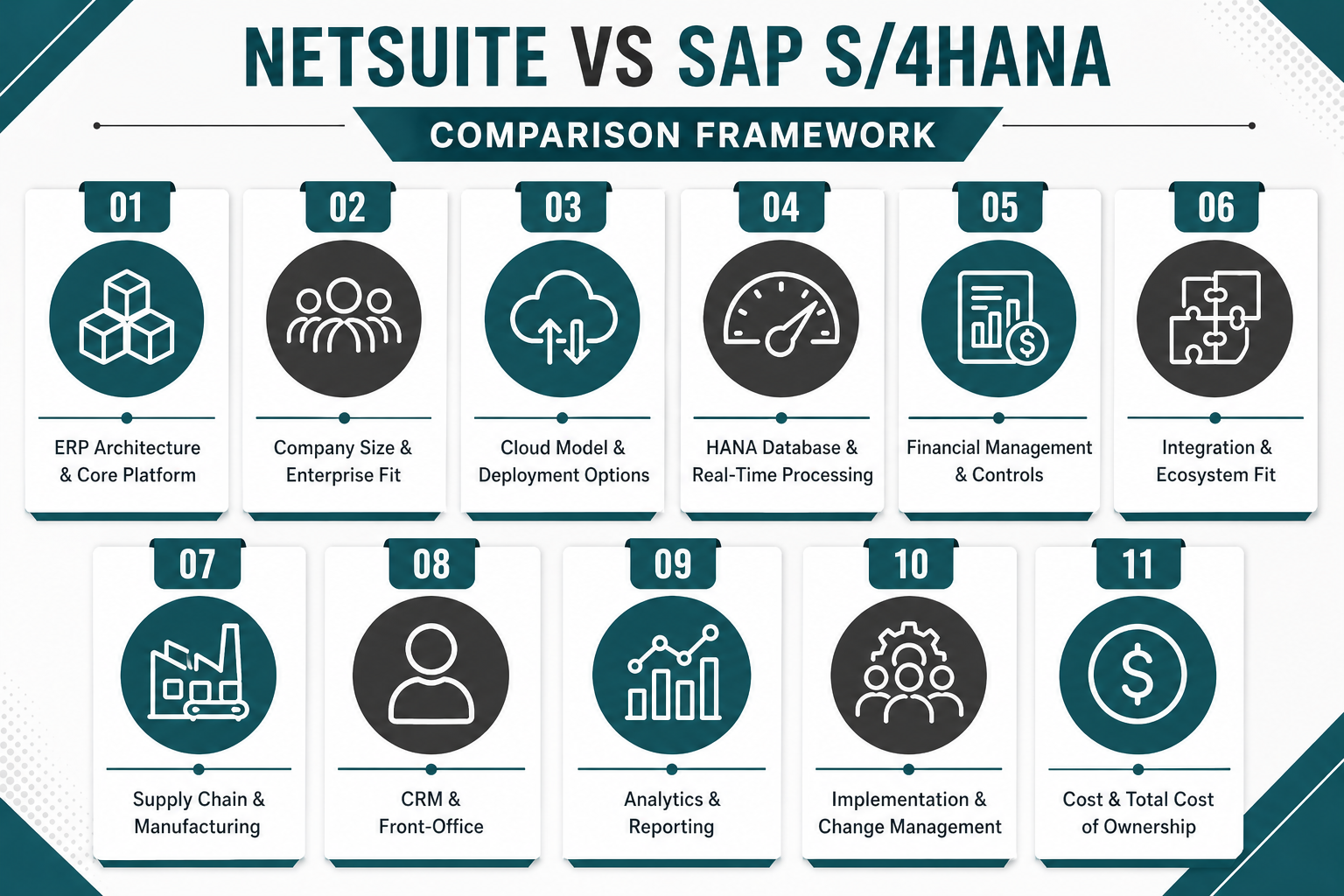
ERP Architecture And Core Platform Design
Platform architecture determines how an ERP system scales, upgrades, integrates, and supports future business operations. When evaluating ERP solutions, buyers should understand how each ERP platform handles cloud infrastructure, customization, data management, and long-term ownership.
NetSuite Architecture:
-
Multi-Tenant Cloud Solution: NetSuite operates as a multi-tenant cloud solution where all customers run on the same version. This cloud-native ERP solution eliminates version lock and ensures every customer benefits from automatic bi-annual upgrades without managing infrastructure.
-
Oracle Cloud Infrastructure: The platform runs entirely on Oracle Cloud Infrastructure with an integrated database optimized for cloud ERP performance. This next-generation ERP system delivers real-time visibility across business functions without requiring on-premise hardware.
-
Upgrade-Safe Customizations: Customizations are built through SuiteCloud tools, SuiteScript, and SuiteFlow. These configurations are designed to remain compatible during automatic upgrades, reducing technical debt and long-term maintenance costs.
-
Unified Data Model: Because NetSuite ERP unifies finance, CRM, inventory, and operations in one platform, integrations connect to a single system rather than multiple modules or separate applications.
SAP S/4HANA Architecture:
-
Single-Tenant Architecture: Each company manages its own instance in a single-tenant model. This gives enterprises full control over their environment, which matters when deep customization or regulatory requirements demand version stability.
-
HANA Database Foundation: Built on SAP's HANA database, an in-memory platform designed for real-time data processing and analytics. The SAP HANA database eliminates the need for separate data warehouses by running reports directly on transactional data.
-
ABAP-Based Customization: Customizations are developed using ABAP programming, SAP Fiori apps, and extensions. These customizations may require testing and adjustment during version upgrades, which increases long-term maintenance complexity.
-
Version Control Flexibility: Customers control their version and upgrade schedule. While this provides flexibility, it can lead to delayed upgrades and compatibility challenges when integrating with newer SAP products or third-party systems.
Company Size, Enterprise Fit, And Operating Complexity
Company size and operational complexity determine which ERP platform delivers the right balance of functionality and implementation effort.
| Business Profile | NetSuite Fit | SAP S/4HANA Fit |
|---|---|---|
| Mid-Market Companies | Strong fit for growing companies that want unified ERP, CRM, financials, inventory, and operations in one cloud-based ERP system. | Possible fit when complexity justifies the cost, timeline, and SAP consultant involvement. |
| Enterprise Companies | Strong fit for enterprises prioritizing cloud-native operations, faster deployment, and standardized business processes. | Strong fit for companies needing deeper process control, governance, and SAP ecosystem alignment. |
| Global Enterprise / Multi-Region Operations | Works well when companies want standardized processes across subsidiaries, currencies, and regions. | Often preferred for highly localized processes, complex compliance needs, and customized global operations. |
| Complex Manufacturing Or Supply Chain | Strong fit for many discrete manufacturers needing work orders, BOMs, inventory, and fulfillment. | Strong fit for advanced manufacturing, process industries, complex planning, and SAP-specific industry functionality. |
SAP S/4HANA is built for large enterprises managing complexity that smaller ERP systems can't support. NetSuite is built for companies that want enterprise capabilities without enterprise-level implementation overhead. When selecting an ERP, company size and operating complexity determine which platform delivers the right balance of functionality and implementation effort.
Cloud Model, Deployment Options, And Upgrade Ownership
NetSuite runs entirely in the cloud. Every customer operates on Oracle Cloud Infrastructure with automatic updates twice per year. There's no on-premise option, no version control, and no infrastructure to manage. This cloud-based ERP solution reduces IT overhead and ensures every customer operates on the latest version.
SAP S/4HANA offers three deployment models: on-premise, private cloud, and SAP S/4HANA Cloud. On-premise deployments give companies full control over infrastructure, customization, and upgrade timing. SAP S/4HANA Cloud reduces infrastructure burden but still requires SAP consultant involvement for configuration, integration, and change management.
Companies already managing on-premise SAP ERP systems often choose SAP S/4HANA to preserve existing investments in SAP products, SAP's Business Technology Platform, and SAP-trained teams. Companies moving away from on-premise infrastructure often choose NetSuite over SAP to eliminate version management and reduce IT overhead.
HANA Database, Performance, And Real-Time Processing
SAP S/4HANA is built on SAP HANA, an in-memory platform that processes transactions and analytics in real time. SAP HANA eliminates the need for separate data warehouses by running reports directly on transactional data. For enterprises managing millions of transactions, complex supply chains, or real-time analytics requirements, SAP HANA delivers performance that traditional databases can't match.
NetSuite runs on Oracle Cloud Infrastructure with a database optimized for cloud ERP performance. It handles real-time reporting, dashboards, and transactional processing for mid-market and enterprise companies without requiring in-memory architecture. NetSuite's performance works well for most businesses, but companies with extreme data volumes or SAP-specific analytics needs may find the SAP HANA database more aligned with their requirements.
SAP HANA matters most when the business depends on real-time analytics across massive datasets, complex supply chain simulations, or SAP Analytics Cloud integration. For companies that don't need in-memory processing, NetSuite's cloud-native architecture delivers the performance required without HANA's cost and complexity. When evaluating ERP solutions, understanding whether the business needs HANA-backed performance helps clarify which platform is right for your business.
Financial Management And Enterprise Controls
Financial management capabilities determine how well an ERP system handles accounting, compliance, consolidation, and multi-entity operations. NetSuite and SAP S/4HANA both support core finance needs, but they differ in depth, complexity, and enterprise control.
| Capability | NetSuite | SAP S/4HANA |
|---|---|---|
| Core Financials | General ledger, accounts payable, accounts receivable, cash management, multi-currency, tax management, and financial reporting. | General ledger, accounts payable, accounts receivable, asset accounting, treasury, group reporting, and advanced financial controls. |
| Multi-Entity Management | NetSuite OneWorld supports multi-subsidiary, multi-currency, intercompany accounting, and real-time financial consolidation. | SAP S/4HANA supports complex legal entities, organizational structures, intercompany processes, and global financial consolidation. |
| Revenue Recognition | Built-in revenue management supports deferred revenue, subscription models, and ASC 606 / IFRS 15 compliance needs. | SAP Revenue Accounting and Reporting supports complex contract-based revenue recognition, performance obligations, and compliance requirements. |
| Budgeting And Planning | NetSuite Planning and Budgeting supports financial planning, budgeting, forecasting, and reporting connected to NetSuite ERP data. | SAP Analytics Cloud supports enterprise planning, budgeting, forecasting, predictive analytics, and reporting across SAP environments. |
| Audit And Compliance | Role-based permissions, audit trails, approval workflows, and reporting support SOX, GAAP, IFRS, and internal controls. | Enterprise-grade audit controls, segregation of duties, governance workflows, and compliance frameworks for complex or regulated industries. |
Integration, SAP BTP, Oracle Infrastructure, And Ecosystem Fit
Integration strategy determines how easily the ERP connects to other business systems.
NetSuite Integration:
-
SuiteCloud Platform: NetSuite uses SuiteCloud for integrations, customizations, and extensions. SuiteTalk (web services), SuiteScript (JavaScript-based scripting), and SuiteFlow (workflow automation) provide tools for connecting NetSuite to third-party applications.
-
Oracle Ecosystem: Oracle NetSuite and SAP differ in ecosystem alignment. NetSuite integrates natively with Oracle Cloud Infrastructure, Oracle Analytics, and other Oracle products, which matters for companies already using Oracle solutions.
-
Third-Party Connectors: NetSuite supports integrations with Salesforce, Shopify, Amazon, and other business applications through pre-built connectors and middleware platforms.
-
Unified Data Model: Because NetSuite is a single cloud-based ERP, integrations connect to one system rather than multiple SAP modules.
SAP S/4HANA Integration:
-
SAP Business Technology Platform (BTP): SAP's Business Technology Platform provides integration, data management, analytics, and application development tools for connecting SAP S/4HANA to other SAP products and third-party systems.
-
SAP Ecosystem Fit: SAP S/4HANA integrates deeply with SAP SuccessFactors (HR), SAP Ariba (procurement), SAP Concur (expense management), and SAP Analytics Cloud, creating a comprehensive SAP ecosystem.
-
Complex Integration Requirements: Integrating SAP S/4HANA with non-SAP systems often requires SAP consultants, middleware, and custom development, which increases cost and implementation time.
-
API and Extension Framework: SAP provides APIs and extension points for integrating S/4HANA with external applications, but integration complexity is higher than NetSuite's cloud-native approach.
Companies already using SAP products benefit from SAP BTP and SAP ecosystem alignment. Companies using non-SAP applications often find NetSuite's integration model simpler and faster to implement. When implementing the right ERP, the integration strategy affects how quickly the business can connect existing systems and scale operations.
Supply Chain, Inventory, Manufacturing, And Order Management
Supply chain depth is a major difference in a NetSuite vs SAP S/4HANA evaluation. Both ERP platforms support inventory, manufacturing, order management, warehouse management, and supply chain planning, but they are built for different levels of operational complexity.
| Function | NetSuite | SAP S/4HANA |
|---|---|---|
| Inventory Management | Supports multi-location inventory, lot and serial tracking, replenishment, cycle counting, and demand planning within a unified cloud ERP platform. | Supports enterprise inventory management across complex plants, warehouses, legal entities, and global supply chain networks. |
| Manufacturing | Supports work orders, bills of materials, assemblies, routings, work centers, and shop floor activity for many discrete manufacturers and product-based companies. | Supports advanced production planning, discrete manufacturing, process manufacturing, and complex plant-level operations across enterprise environments. |
| Order Management | Connects sales orders, inventory availability, fulfillment, billing, and financials in one ERP system with real-time operational visibility. | Supports enterprise order management, advanced available-to-promise, allocation logic, and global order fulfillment across complex supply networks. |
| Supply Chain Planning | Supports demand planning, replenishment, supply planning, and MRP for companies managing standard planning needs across locations. | Supports advanced planning through SAP Integrated Business Planning, including demand planning, supply planning, scenario modeling, and global supply chain coordination. |
| Warehouse Management | NetSuite WMS supports mobile barcode scanning, inventory counts, bin management, picking, packing, and warehouse execution workflows. | SAP Extended Warehouse Management supports complex warehouse operations, high-volume distribution, production integration, labor planning, and advanced logistics processes. |
Read Next:
CRM, Customer Relationship Management, And Front-Office Coverage
NetSuite and SAP S/4HANA take different approaches to CRM and front-office operations.
NetSuite CRM:
-
Unified ERP and CRM: NetSuite includes CRM inside the ERP suite, which means sales, finance, and operations work from shared customer and transaction data. Sales teams see real-time inventory, order status, and customer history without switching systems.
-
Sales Force Automation: Lead tracking, opportunity management, quote-to-order automation, and sales forecasting integrate directly with financial and fulfillment workflows.
-
Customer Self-Service: NetSuite provides customer portals for order tracking, invoice access, and case management, reducing support overhead.
-
Marketing Automation: Built-in campaign management, email marketing, and lead nurturing tools connect marketing activity to revenue and customer data.
SAP S/4HANA CRM:
-
SAP Customer Experience (CX) Suite: SAP S/4HANA integrates with SAP CX products, including SAP Sales Cloud and SAP Service Cloud, for enterprise CRM functionality. These are separate products that require integration with S/4HANA.
-
Deep Customer Data: SAP S/4HANA stores customer master data, order history, and transactional records, but front-office CRM functionality typically comes from SAP CX or third-party CRM systems like Salesforce.
-
Enterprise Sales Processes: SAP CRM supports complex sales cycles, partner management, and multi-channel customer engagement for large enterprises.
NetSuite's CRM advantage is integration. Sales, finance, and operations share the same database, eliminating data silos and reducing integration complexity. SAP S/4HANA's CRM strength is enterprise depth, but it requires additional SAP products or third-party CRM integration to match NetSuite's unified approach.
Read Next: Simplifying the Suite: NetSuite Integrations
Analytics, SAP Analytics Cloud, Reporting, And Business Intelligence
SAP S/4HANA delivers enterprise-grade analytics through SAP Analytics Cloud, which integrates with HANA for real-time reporting, predictive analytics, and scenario planning. SAP Analytics Cloud supports advanced use cases like supply chain simulations, financial forecasting, and multi-dimensional analysis across global operations. For enterprises managing complex analytics requirements, SAP's analytics stack provides depth that few ERP systems can match.
NetSuite provides built-in reporting and analytics through SuiteAnalytics, role-based dashboards, and saved searches. NetSuite's reporting tools handle financial reporting, operational KPIs, and custom reports without requiring separate business intelligence software. For companies that need real-time visibility into financials, inventory, and customer data, NetSuite's analytics work well without the cost and complexity of SAP Analytics Cloud.
The analytics decision depends on how much depth the business needs. SAP S/4HANA and SAP Analytics Cloud deliver advanced analytics for enterprises managing complex data models and predictive planning. NetSuite delivers integrated reporting for companies that want visibility without building a separate analytics infrastructure.
Read Next: Generate Multi-Level NetSuite Reports Instantly with RightInsight AI
Implementation Scope, Change Management, And ERP Consultant Dependency
Implementation timelines and consultant dependency differ significantly between NetSuite and SAP S/4HANA.
NetSuite Implementation:
-
Typical Timeline: NetSuite implementations typically take 3–6 months for mid-market companies, depending on data migration, integrations, and customization requirements.
-
SuiteSuccess Methodology: NetSuite's SuiteSuccess approach provides pre-configured industry editions that reduce implementation time and deliver faster time-to-value.
-
Consultant Dependency: NetSuite implementations require certified NetSuite consultants, but the scope is smaller than SAP S/4HANA projects. Post-implementation support is available through NetSuite partners or internal administrators.
-
Change Management: NetSuite's user interface is designed for ease of use, which reduces training time and accelerates user adoption.
SAP S/4HANA Implementation:
-
Typical Timeline: SAP S/4HANA implementations often span 12–24 months or longer, depending on deployment model, customization, integration, and organizational complexity.
-
SAP Activate Methodology: SAP Activate provides a structured implementation framework, but the scope and complexity of S/4HANA projects require significant project management and change management resources.
-
Consultant Dependency: SAP S/4HANA implementations require experienced SAP consultants with expertise in ABAP, SAP Fiori, and SAP BTP. Post-implementation support often requires ongoing SAP consultant involvement.
-
Change Management: SAP S/4HANA implementations require extensive training, process redesign, and organizational change management to ensure user adoption and system utilization.
NetSuite implementations are faster and less resource-intensive, which matters for companies that need to go live quickly. SAP S/4HANA implementations deliver enterprise depth but require long timelines, dedicated project teams, and significant change management investment.
Read Next: How to Choose the Best NetSuite Partner for a Successful ERP Implementation
Cost, Licensing, And Total Cost Of Ownership
Total cost of ownership includes software licensing, implementation services, integrations, training, support, and long-term maintenance. When evaluating the ERP market, understanding pricing models helps buyers budget accurately and avoid unexpected costs.
| Cost Component | NetSuite | SAP S/4HANA |
|---|---|---|
| Small Business (1–10 users) | Annual Investment: $30,000 – $55,000Implementation: $25,000 – $45,000 | Not typically recommended for small businesses. SAP Business One is usually a better fit for this company size. |
| Mid-Market (10–100 users) | Annual Investment: $60,000 – $150,000+Implementation: $50,000 – $100,000 | Estimated Annual Investment: $150,000 – $500,000+Estimated Implementation: $250,000 – $1,500,000+ |
| Enterprise (100+ users, multi-entity/global) | Annual Investment: $150,000 – $300,000+Implementation: $100,000 – $200,000+ | Estimated Annual Investment: $500,000 – $3,000,000+Estimated Implementation: $1,000,000 – $10,000,000+ |
| Licensing Model | Subscription-based with predictable annual costs including software, upgrades, and cloud infrastructure. | Quote-based pricing dependent on deployment model, user types, modules, cloud subscription, or perpetual licensing, and enterprise agreements. |
| Ongoing Costs | Annual subscription renewal with optional support services, add-on modules, integrations, and third-party applications. | Cloud subscriptions or annual maintenance for perpetual licenses, plus SAP BTP, SAP Analytics Cloud, integration tools, support, upgrades, and SAP consultant involvement. |
NetSuite pricing is subscription-based and includes software licensing, automatic upgrades, and cloud infrastructure. Implementation costs depend on data migration, integrations, customizations, and business complexity. NetSuite's total cost of ownership is predictable, with annual subscription fees and optional support services.
SAP S/4HANA on-premise licensing can range from hundreds of thousands to several million dollars, depending on users, modules, infrastructure, and enterprise agreements. SAP S/4HANA Cloud subscriptions are also quote-based, though public market estimates often place cloud subscription costs in the hundreds of dollars per user per month, with annual costs scaling based on users, modules, scope, and contract terms
SAP S/4HANA delivers enterprise depth, but the total cost of ownership is substantially higher than NetSuite. Companies choosing SAP S/4HANA should budget for long-term consultant dependency, integration costs, and ongoing SAP product subscriptions.
Read Next: NetSuite Price in 2026: Oracle NetSuite Pricing Guide, Implementation Cost & Cost Breakdown
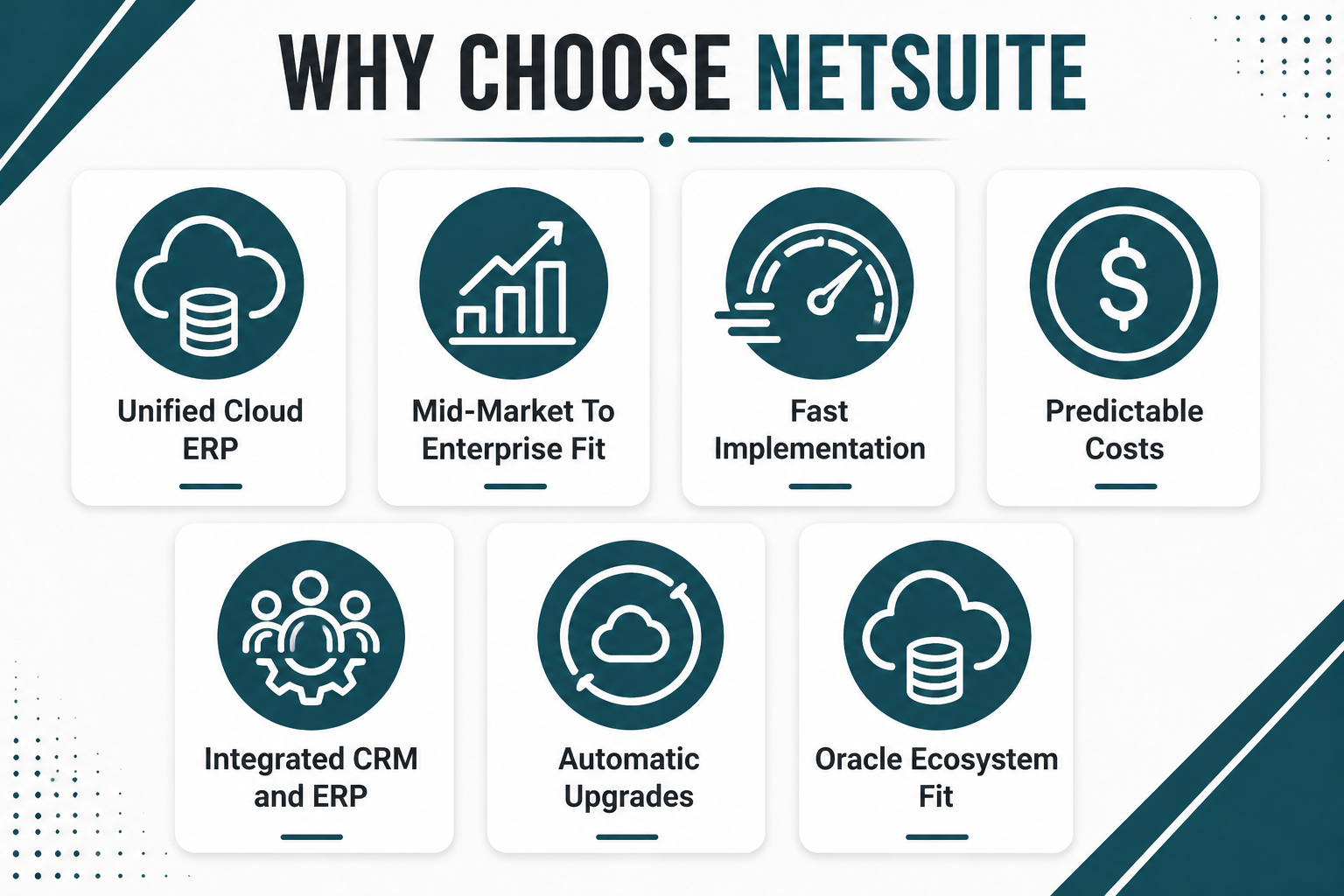
Go With NetSuite If:
-
Unified Cloud ERP: Finance, CRM, inventory, order management, procurement, reporting, and operations need to run in one cloud-based ERP system with less infrastructure ownership and lower integration complexity.
-
Mid-Market To Enterprise Fit: A growing organization needs scalable ERP capabilities without the same implementation overhead often associated with larger, highly customized enterprise ERP projects.
-
Fast Implementation: Faster deployment matters, and a cloud ERP solution that can often go live in months rather than years is preferred. A 3–6 month timeline is realistic for many standard or mid-market NetSuite implementations, while complex multi-entity, highly customized, or heavily integrated projects may take longer.
-
Predictable Costs: Subscription-based pricing with more predictable annual costs for software, cloud infrastructure, and upgrades is preferred over highly variable quote-based licensing, infrastructure costs, and long-term enterprise contracts.
-
Integrated CRM and ERP: Sales, finance, inventory, fulfillment, and operations need shared customer, transaction, and order data in one ERP platform, reducing the need to connect separate systems for core business processes.
-
Automatic Upgrades: Automatic bi-annual upgrades and a SaaS model are priorities for reducing application version management. NetSuite delivers two major product releases per year, and customers can use Release Preview to test new features, business processes, and customizations before upgrading.
-
Oracle Ecosystem Fit: Existing Oracle products, Oracle Cloud Infrastructure, or related systems need to align with an ERP solution that still operates as a cloud-native ERP platform.
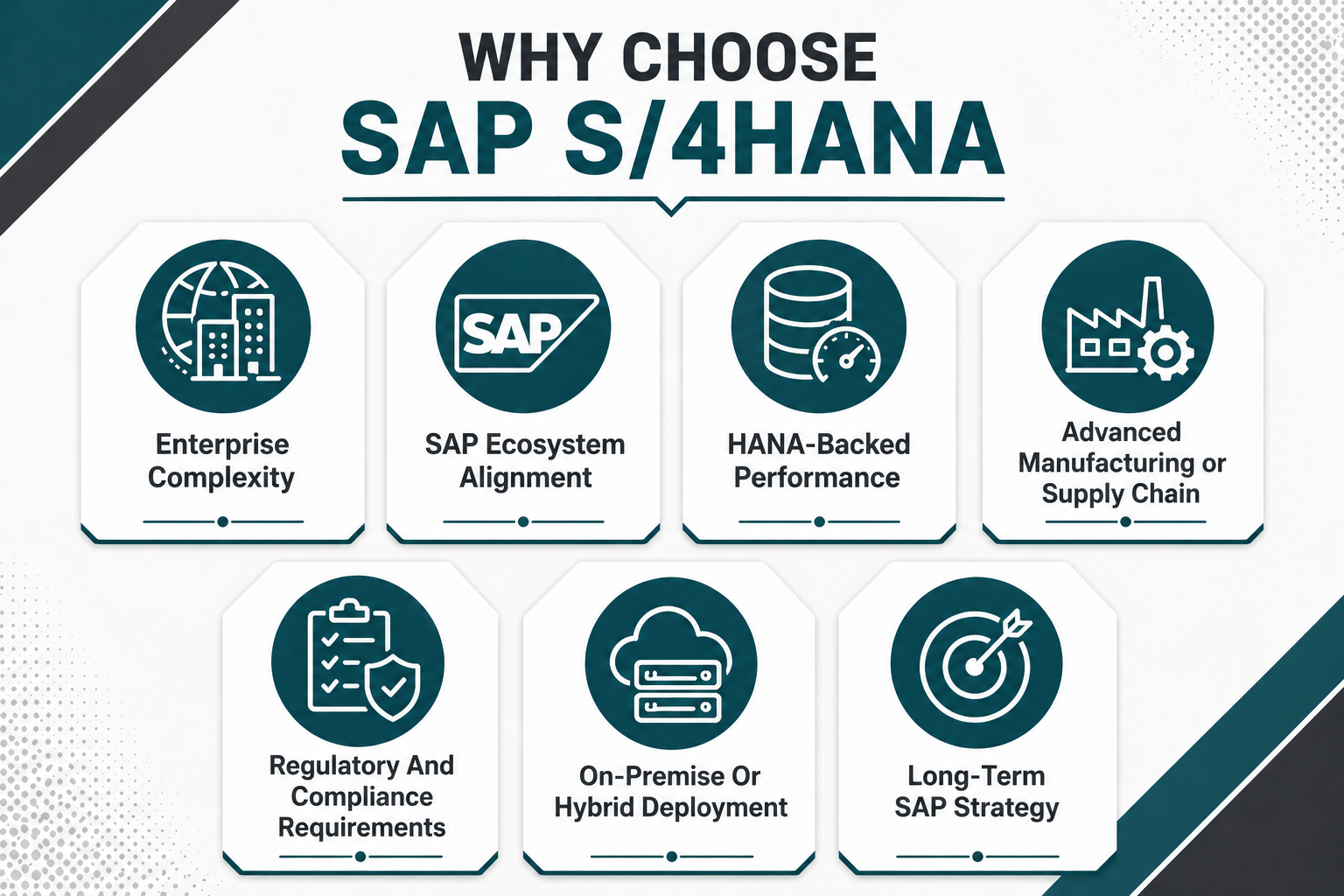
Go With SAP S/4HANA If:
-
Enterprise Complexity: Operations span multiple regions, entities, business units, or regulatory environments and require deep process control, advanced governance, and highly structured workflows.
-
SAP Ecosystem Alignment: Existing investments in SAP products, SAP BTP, SAP Analytics Cloud, SAP SuccessFactors, SAP Ariba, or other SAP solutions need to be preserved and extended.
-
HANA-Backed Performance: High transaction volumes, complex reporting, real-time analytics, or advanced supply chain scenarios require the performance of SAP’s HANA database.
-
Advanced Manufacturing or Supply Chain: Process industries, advanced manufacturing, global logistics, or complex supply chain operations depend on SAP-specific functionality.
-
Regulatory And Compliance Requirements: Highly regulated environments require enterprise-grade audit controls, segregation of duties, governance workflows, and compliance frameworks.
-
On-Premise Or Hybrid Deployment: Data sovereignty, security, operational control, or regulatory requirements call for on-premise ERP infrastructure, private cloud, or hybrid deployment options.
-
Long-Term SAP Strategy: Dedicated SAP teams, established SAP processes, SAP consultants, or long-term SAP partnerships are already in place to support S/4HANA implementation, optimization, and maintenance.
Read Next:
- What is ERP, and how can it improve Business Operations
- Top 14 NetSuite Competitors for ERP Buyers in 2026
The Better ERP Choice Depends On How Much Complexity You Need To Own
Selecting the right ERP system between NetSuite and SAP S/4HANA depends on business complexity, implementation capacity, and total cost of ownership. The choice comes down to what the company needs most: a unified cloud ERP that brings core operations together, or an enterprise platform built for deeper process control.
NetSuite is a strong fit for mid-market and enterprise companies that want finance, CRM, inventory, order management, and operations in one cloud-based ERP system without managing infrastructure or long implementation cycles. SAP S/4HANA is a strong fit for large enterprises with complex processes, SAP ecosystem investments, and performance requirements tied to SAP’s HANA database.
Key Takeaways:
-
NetSuite Fit: NetSuite works best when the business wants one cloud ERP suite across finance, CRM, inventory, orders, and operations.
-
SAP S/4HANA Fit: SAP S/4HANA works best when large enterprises need HANA-backed ERP depth, governance, and SAP ecosystem alignment.
-
Ownership Reality: The right ERP depends on implementation capacity, business complexity, integration needs, and total cost of ownership.
Companies moving from NetSuite to SAP or evaluating whether to choose NetSuite over SAP should consider their unique business requirements and ERP selection priorities. Successful ERP transitions depend on accurate data migration and seamless integration with existing business systems.
Protelo offers NetSuite Implementation Services to help companies adopt NetSuite by managing data transfers, connecting CRM platforms, linking ecommerce channels, and integrating supply chain applications while keeping operations running smoothly.
Our team handles the technical complexity of moving to a cloud software company model, ensuring your core business functions remain operational throughout the transition.
Schedule a consultation with Protelo to simplify your ERP transition and build a cleaner NetSuite roadmap.
- What is Cloud ERP Software?
- Navigating the 2026 NetSuite Landscape: How to Maximize Your ERP Investment
FAQ
What is the main difference between NetSuite and SAP S/4HANA?
NetSuite is a cloud-based ERP system that unifies finance, CRM, inventory, and operations in one platform. SAP S/4HANA is an enterprise ERP platform built on the HANA database for large enterprises managing complex processes and SAP ecosystem alignment. NetSuite prioritizes speed and simplicity, while SAP S/4HANA prioritizes enterprise depth and control.
Is SAP S/4HANA better than NetSuite for large enterprises?
SAP S/4HANA is better suited for large enterprises with 1,000+ employees managing complex, multi-region operations that require deep process control, governance, and SAP ecosystem fit. NetSuite works well for mid-market and enterprise companies that want unified cloud ERP without managing SAP implementation overhead.
How much does NetSuite cost compared to SAP S/4HANA?
NetSuite typically costs $30,000 to $300,000+ annually, depending on users, modules, and complexity. SAP S/4HANA is quote-based and usually costs more, with annual licensing or subscription costs often reaching $150,000 to $3,000,000+, plus implementation costs that can range from $250,000 to $10,000,000+.
Does NetSuite integrate with SAP products?
NetSuite can integrate with SAP products through middleware platforms and custom integrations, but the integration complexity is higher than using SAP BTP within the SAP ecosystem. Companies heavily invested in SAP products may find SAP S/4HANA easier to integrate with existing SAP solutions.
How long does it take to implement NetSuite vs SAP S/4HANA?
NetSuite implementations typically take 3–6 months for mid-market companies. SAP S/4HANA implementations often span 12–24 months or longer, depending on deployment model, customization, and organizational complexity. NetSuite delivers faster time-to-value, while SAP S/4HANA requires longer timelines for enterprise depth.