



Skip to content
26 min read

NetSuite Vs Oracle ERP Cloud: Comparing Two Powerful ERP Solutions

Featured Image

Oracle sells two different cloud ERP products, and that creates confusion before buyers even start comparing features. Oracle ERP Cloud, Oracle Cloud ERP, and Oracle Fusion Cloud ERP all refer to the same platform—Oracle's current enterprise cloud suite. NetSuite, which Oracle acquired in 2016, remains a separate product with its own architecture, pricing, and buyer profile.

The two systems don't compete on features alone. They differ in how they're scoped, sold, implemented, and maintained. NetSuite was built for mid-market companies that need unified financials, CRM, inventory, and e-commerce in one system. Oracle Fusion Cloud ERP was designed for large enterprises managing complex procurement, multi-entity consolidation, and global compliance.

Choosing between them needs determining which one matches the complexity your business actually operates at and the resources you can commit to implementation and ownership.

This guide covers:

  • How NetSuite and Oracle ERP Cloud differ across ERP scope, cost, and fit

  • Which platform better supports financial management, supply chain, CRM, and reporting

  • What buyers should evaluate around implementation, ownership, scalability, and long-term complexity

P.S. If you're evaluating NetSuite and need help with implementation, Protelo's NetSuite Implementation Services team handles data migration, ERP integrations with CRM and ecommerce platforms, and supply chain tool connections. We ensure your data moves into NetSuite securely and accurately without disrupting operations. Schedule a call to discuss your ERP evaluation.


TL;DR: NetSuite And Oracle ERP Cloud Serve Different ERP Buyers

Comparison Point What It Means For Your Decision
Target Buyer NetSuite fits mid-market companies (10–1,000 employees) that need financials, CRM, inventory, and ecommerce unified in one cloud-based ERP system. Oracle Fusion Cloud ERP targets large enterprises (1,000+ employees) managing complex procurement, multi-region operations, and deep compliance controls.
ERP Scope NetSuite is an all-in-one ERP platform that includes CRM, PSA, inventory, order management, and e-commerce. Oracle Fusion is a modular ERP suite focused on financials, procurement, supply chain management, and enterprise governance—CRM is sold separately as Oracle CX Cloud.
Implementation Timeline NetSuite implementations typically take 3–6 months for mid-market deployments. Oracle Fusion Cloud ERP implementations often run 9–18 months or longer due to enterprise complexity and integration requirements.
Cost Structure NetSuite pricing starts around $30,000 annually for small businesses and scales to $150,000–$300,000+ for enterprise deployments. Oracle Fusion pricing starts at approximately $150,000 annually (25-user minimum) and can exceed $1 million annually for large implementations with multiple modules.
CRM Integration NetSuite includes native CRM inside the ERP, so sales, service, and finance teams work from shared customer and transaction data. Oracle Fusion requires Oracle CX Cloud (separate license) or third-party CRM integration.
Best Fit Choose NetSuite if you need a unified cloud ERP solution that covers financials, operations, CRM, and ecommerce without requiring separate systems. Choose Oracle Fusion if your business operates at enterprise scale with complex procurement, global compliance needs, and existing Oracle Cloud infrastructure.


NetSuite Vs Oracle ERP Cloud: What Actually Changes The ERP Decision?

Deciding between NetSuite and Oracle Fusion Cloud ERP comes down to three factors: the complexity your business actually operates at, the resources you can dedicate to implementation and ongoing administration, and whether you need a unified suite or a modular enterprise platform. Both are cloud-based ERP systems built by Oracle, but they serve different buyer profiles and solve different operational problems.
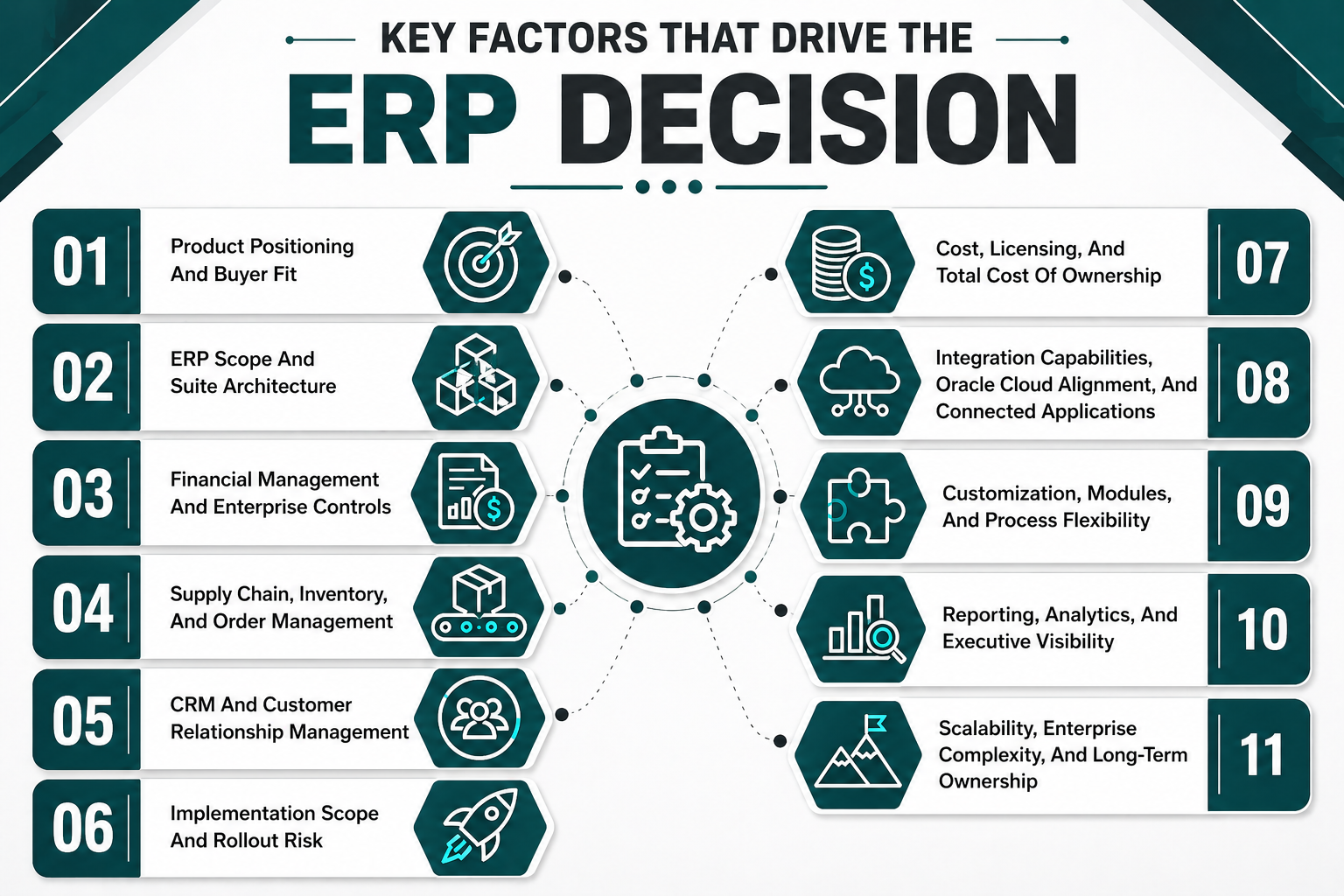
 

Product Positioning And Buyer Fit

NetSuite was designed as a complete business management suite for growing companies. It combines ERP, financials, CRM, inventory management, order management, ecommerce, and project accounting in a single cloud platform.

Oracle Fusion Cloud ERP was built for large enterprises that need deep financial controls, complex procurement workflows, and multi-entity consolidation across regions.

Factor NetSuite Oracle Fusion Cloud ERP
Primary Buyer Profile Growing small to midsize companies that want a unified cloud suite for financials, CRM, inventory, commerce, and operations. Large or complex organizations managing multi-entity, multi-region operations, procurement, compliance, and enterprise-scale finance.
ERP Approach All-in-one cloud ERP with integrated modules in a single suite A modular enterprise platform where buyers license and integrate specific applications
Implementation Complexity Moderate—standard deployments often complete in roughly 3–6 months, depending on scope and customization Higher—enterprise implementations often run 6–18+ months depending on modules, countries, integrations, and rollout strategy.
Administrative Overhead Lower—unified system reduces the need for cross-platform administration Higher—modular architecture requires coordination across multiple Oracle Cloud applications

Read Next: Top 14 NetSuite Competitors for ERP Buyers in 2026


ERP Scope And Suite Architecture

NetSuite operates as a seamless ERP solution where all core business functions, including financials, CRM, inventory, order management, warehouse management, project accounting, and e-commerce, run inside one system. Sales orders flow directly into fulfillment and invoicing. CRM opportunities convert to quotes and sales orders without integration. Inventory updates in real-time across purchasing, sales, and financial reporting. This architecture works well for businesses that want to eliminate data silos and reduce the number of systems their teams need to learn and maintain.

Oracle Fusion Cloud ERP takes a different approach. It's an enterprise resource planning platform built around modular cloud applications. Buyers license Financials Cloud for accounting and reporting, Procurement Cloud for sourcing and purchasing, Supply Chain Management Cloud for planning and logistics, and other modules based on operational needs. CRM isn't included—Oracle sells that separately as Oracle CX Cloud. This modular structure gives large enterprises more control over which applications they deploy and when, but it also means more integration work, more vendor coordination, and more administrative complexity.

The architectural difference shows up in how each ERP system handles reporting. NetSuite users can build saved searches and dashboards that pull data from financials, CRM, inventory, and e-commerce without needing middleware. Oracle Fusion users often need Oracle Analytics Cloud or third-party BI tools to consolidate reporting across multiple Oracle Cloud applications.

Read Next: NetSuite vs Competitors: A Comparison Guide to Top Alternatives


Financial Management And Enterprise Controls

Both platforms handle core accounting: general ledger, accounts payable, accounts receivable, cash management, fixed assets, and multi-currency transactions. The differences appear in how they support enterprise financial governance and global operations.

NetSuite's financial management module includes budgeting, revenue recognition (ASC 606 and IFRS 15 compliance), intercompany accounting, multi-book accounting, and consolidated financial reporting across subsidiaries.

The system supports multi-currency and multi-entity operations through NetSuite OneWorld, which allows businesses to manage multiple subsidiaries, currencies, and tax jurisdictions from one instance. Financial close processes are streamlined because all transaction data—sales orders, purchase orders, inventory movements, CRM activities—lives in the same database.

Oracle Fusion Cloud ERP provides deeper financial controls for enterprises managing complex approval hierarchies, procurement policies, and regulatory compliance across regions. The platform includes advanced budgetary control, project costing, grants management, and risk management modules.

Oracle Fusion's financial consolidation tools are stronger for organizations managing hundreds of legal entities with complex intercompany eliminations and statutory reporting requirements. The system also integrates tightly with Oracle EPM Cloud for planning, budgeting, and forecasting at an enterprise scale.

Read Next: IDC MarketScape Names NetSuite a SaaS and Cloud Finance Leader in 2024


Supply Chain Management, Inventory Management, And Order Management

Supply chain and inventory management are areas where the two ERP systems serve different operational scales.

Capability NetSuite Oracle Fusion Cloud ERP
Inventory Management Multi-location inventory tracking, lot and serial tracking, bin management, cycle counting, demand planning, and automated reorder points. Includes native warehouse management (WMS) with mobile barcode scanning. Advanced supply chain planning with demand forecasting, supply planning, inventory optimization, and distribution requirements planning. Requires Oracle Supply Chain Management Cloud (separate module).
Order Management Unified order management that connects sales orders, fulfillment, shipping, and invoicing in one workflow. Supports drop shipments, special orders, and multi-channel order processing. Enterprise order orchestration across multiple systems, channels, and fulfillment locations. Handles complex order promising, global order management, and configure-price-quote (CPQ) workflows.
Warehouse Management Native WMS included with NetSuite—supports wave planning, pick/pack/ship workflows, cartonization, and mobile RF scanning. Oracle Warehouse Management Cloud (separate module) provides advanced warehouse automation, labor management, and 3PL billing.
Supply Chain Complexity Best for businesses managing 1–20 warehouses with moderate SKU counts and standard fulfillment workflows. Built for enterprises managing global supply chains with hundreds of locations, complex sourcing rules, and multi-tier distribution networks.

Read Next: NetSuite WMS: Smarter Inventory & Fulfillment


CRM And Customer Relationship Management

CRM integration is one of the clearest differences between NetSuite and Oracle Fusion Cloud ERP.

NetSuite:

  • Native CRM Included: NetSuite includes CRM as part of the ERP platform, so sales, service, and finance teams work from shared customer and transaction data.

  • Sales-to-Finance Workflow: Opportunities convert directly to quotes and sales orders without integration, and customer service teams can see order history, invoices, and support cases in one view.

  • Marketing and Partner Management: Campaign management, marketing automation, and partner relationship management are included in the base subscription.

  • Unified Customer Data: Customer records, sales transactions, service cases, and financial data live in one database, which eliminates data sync issues and simplifies reporting.

Oracle Fusion Cloud ERP:

  • Separate CRM Licensing: Oracle Fusion does not include CRM—buyers must license Oracle CX Cloud (formerly Oracle Sales Cloud and Oracle Service Cloud) or integrate a third-party CRM like Salesforce.

  • Additional Integration Work: Connecting CRM to Oracle Fusion requires Oracle Integration Cloud or middleware, which adds implementation complexity and ongoing maintenance.

  • Higher Total Cost: Separate CRM licensing increases the total cost of ownership beyond the base ERP subscription.

  • Enterprise CRM Capabilities: Oracle CX Cloud offers advanced sales automation and AI-driven insights for large enterprises with complex sales processes, but it comes with separate licensing and integration requirements.

Read Next: Simplifying the Suite: NetSuite Integrations


Implementation Scope And Rollout Risk

Implementation timelines and complexity differ significantly between the two platforms.

NetSuite:

  • Faster Deployment: Most mid-market implementations take 3–6 months and include discovery, configuration, data migration, integration setup, user training, and go-live support.

  • Unified System Configuration: Implementation teams configure one system rather than integrating multiple applications, which reduces project complexity and creates a more consistent user experience.

  • SuiteSuccess Methodology: Industry-specific templates and best practices accelerate deployment for common use cases like wholesale distribution, manufacturing, and professional services.

  • Solution Provider Network: NetSuite has a large network of solution providers that specialize in mid-market implementations and offer fixed-bid pricing.

Oracle Fusion Cloud ERP:

  • Longer Implementation Timelines: Enterprise deployments typically take 9–18 months or longer due to the modular architecture and enterprise scope.

  • Multiple Module Coordination: Each application (Financials Cloud, Procurement Cloud, Supply Chain Management Cloud) must be configured, integrated, and tested separately.

  • Enterprise Consulting Required: Implementations typically require Oracle Consulting or major systems integrators (Deloitte, Accenture, PwC) with Oracle Cloud expertise.

  • Higher Project Risk: Longer timelines increase the need for stronger project management and increase the risk of scope creep, budget overruns, and organizational change management challenges.

Read Next: How to Choose the Best NetSuite Partner for a Successful ERP Implementation


Cost, Licensing, And Total Cost Of Ownership

Pricing structures for the two ERP systems reflect their different buyer profiles and implementation complexity.

NetSuite offers a subscription-based pricing model where annual costs depend on the number of users, modules licensed, transaction volume, and support tier. Oracle Fusion Cloud ERP uses a modular subscription model where buyers pay per user per month for each application. The table below shows typical NetSuite and Oracle ERP Cloud pricing ranges based on company size:

Cost Factor NetSuite Oracle Fusion Cloud ERP
Base Subscription $30,000 – $300,000+ annually, depending on company size and modules $150,000+ annually (25-user minimum at $500–$625/user/month)
Implementation Services $25,000 – $200,000+ depending on complexity $200,000+ for mid-sized implementations; can exceed $1 million for large enterprise deployments
Additional Modules Core ERP is included, but advanced modules such as SuiteCommerce, WMS, planning, PSA/OpenAir, payroll, and industry-specific capabilities may require add-on licensing. Additional Oracle Cloud applications—such as SCM, Procurement, EPM, CX, HCM, and Analytics/Fusion Data Intelligence—are commonly licensed separately or bundled by contract.
Annual Uplift Contract-specific; customers often plan for negotiated annual SaaS increases in the low-single-digit range, commonly around 3–5%. Contract-specific; enterprise agreements may include annual escalation clauses, with rates depending on term, discounting, and negotiated caps.
Total Cost of Ownership (Year 1) $55,000 – $500,000+, depending on company size and implementation scope $350,000 – $2 million+ depending on modules, users, and implementation complexity

Oracle Fusion's total cost of ownership is higher due to modular licensing, longer implementation timelines, and the need for enterprise consulting resources. NetSuite's all-in-one pricing model makes it easier to predict costs and reduces the risk of unexpected licensing fees as the business grows.

Read Next: NetSuite Price in 2026: Oracle NetSuite Pricing Guide, Implementation Cost & Cost Breakdown


Integration Capabilities, Oracle Cloud Alignment, And Connected Applications

NetSuite integrates with third-party applications through SuiteTalk (web services API), pre-built connectors in the SuiteApp marketplace, and middleware platforms like Celigo, Boomi, and Workato. Common integrations include Salesforce (if buyers prefer Salesforce CRM over NetSuite CRM), Shopify and BigCommerce for ecommerce, ADP and Workday for payroll and HR, and shipping carriers like UPS and FedEx. Because NetSuite includes CRM, inventory, and e-commerce natively, most mid-market companies need fewer integrations than they would with a modular ERP platform.

Oracle Fusion Cloud ERP is designed to integrate tightly with other Oracle Cloud applications—Oracle CX Cloud for CRM, Oracle HCM Cloud for human capital management, Oracle EPM Cloud for planning and budgeting, and Oracle SCM Cloud for supply chain planning. Oracle promotes this as a unified cloud applications strategy, but it requires buyers to license multiple Oracle Cloud products and manage integrations across them.

For businesses already using Oracle Database, Oracle Middleware, or other Oracle infrastructure, this alignment can simplify IT architecture. For businesses using non-Oracle systems, it adds integration complexity.

Third-party integrations for Oracle Fusion typically require Oracle Integration Cloud (OIC) or enterprise middleware platforms. Integration costs are higher because Oracle Fusion implementations often involve connecting multiple Oracle Cloud applications, legacy on-premise systems, and third-party software.
 

Customization, Modules, And Process Flexibility

Both platforms support customization, but the approach and complexity differ.

NetSuite:

  • Configuration-Based Customization: SuiteScript (JavaScript-based scripting), SuiteFlow (workflow automation), and SuiteBuilder (custom fields and records) allow customization without heavy coding.

  • Easier Maintenance: Most customizations are configuration-based rather than code-heavy, which makes them easier to maintain and less likely to break during platform upgrades.

  • Bi-Annual Updates: NetSuite releases two updates per year, and customizations built using supported tools typically carry forward without requiring rework.

  • SuiteApp Marketplace: Hundreds of pre-built extensions are available for industry-specific needs, e-commerce, advanced warehouse management, and business intelligence.

Oracle Fusion Cloud ERP:

  • Code-Heavy Customization: Customizations require Oracle Application Development Framework (ADF), Oracle Integration Cloud, and low-code tools like Oracle Visual Builder, which need Oracle-certified developers.

  • Cross-Application Complexity: The modular architecture means customizations may need to span multiple applications, which increases development and testing effort.

  • Quarterly Updates: Oracle releases quarterly updates, and custom code may require regression testing and rework after each release.

  • Enterprise-Focused Ecosystem: Oracle Fusion's extension ecosystem is oriented toward enterprise-scale applications and industry-specific solutions rather than mid-market tools.

Read Next: Creating Custom Fields in NetSuite


Reporting, Analytics, And Executive Visibility

NetSuite provides built-in reporting and analytics through SuiteAnalytics, which allows users to create saved searches, custom reports, and role-based dashboards without needing a separate BI tool. Because all business data—financials, CRM, inventory, sales, projects—lives in one database, users can build reports that combine data from multiple modules without integration.

NetSuite also offers financial reporting, KPI tracking, and drill-down capabilities that let executives click through summary reports to view underlying transactions. For businesses that need more advanced analytics, NetSuite integrates with third-party BI tools like Tableau, Power BI, and Domo.

Oracle Fusion Cloud ERP includes basic reporting within each module (Financials Cloud, Procurement Cloud, Supply Chain Management Cloud), but enterprise-wide reporting typically requires Oracle Analytics Cloud (OAC) or Oracle Enterprise Performance Management (EPM) Cloud. Oracle Analytics Cloud provides AI-driven insights, predictive analytics, and advanced visualization, but it's a separate license that adds to the total cost of ownership.

For mid-market companies, NetSuite's built-in reporting is usually sufficient. For large enterprises that need advanced analytics, predictive modeling, and AI-driven insights across multiple Oracle Cloud applications, Oracle Analytics Cloud offers more power—but at a higher cost and complexity.

Read Next: Generate Multi-Level NetSuite Reports Instantly with RightInsight AI


Scalability, Enterprise Complexity, And Long-Term Ownership

Both platforms grow with your business, but they're designed for different growth trajectories and operational scales.

Scalability Factor NetSuite Oracle Fusion Cloud ERP
User Scalability Supports 10 to 1,000+ users; pricing scales with user count and transaction volume Designed for 1,000+ users; pricing based on a per-user-per-month model with volume discounts for large deployments
Multi-Entity Management NetSuite OneWorld supports multi-subsidiary, multi-currency, and multi-country operations within one instance Handles hundreds of legal entities with complex intercompany eliminations and statutory reporting
Transaction Volume Handles moderate to high transaction volumes typical of mid-market distributors, manufacturers, and retailers Built for enterprise-scale transaction volumes across global operations
Long-Term Ownership Lower administrative overhead due to unified architecture; easier to maintain as business grows Higher administrative overhead due to modular architecture; requires a dedicated Oracle Cloud administration team

Read Next: Navigating the 2026 NetSuite Landscape: How to Maximize Your ERP Investment


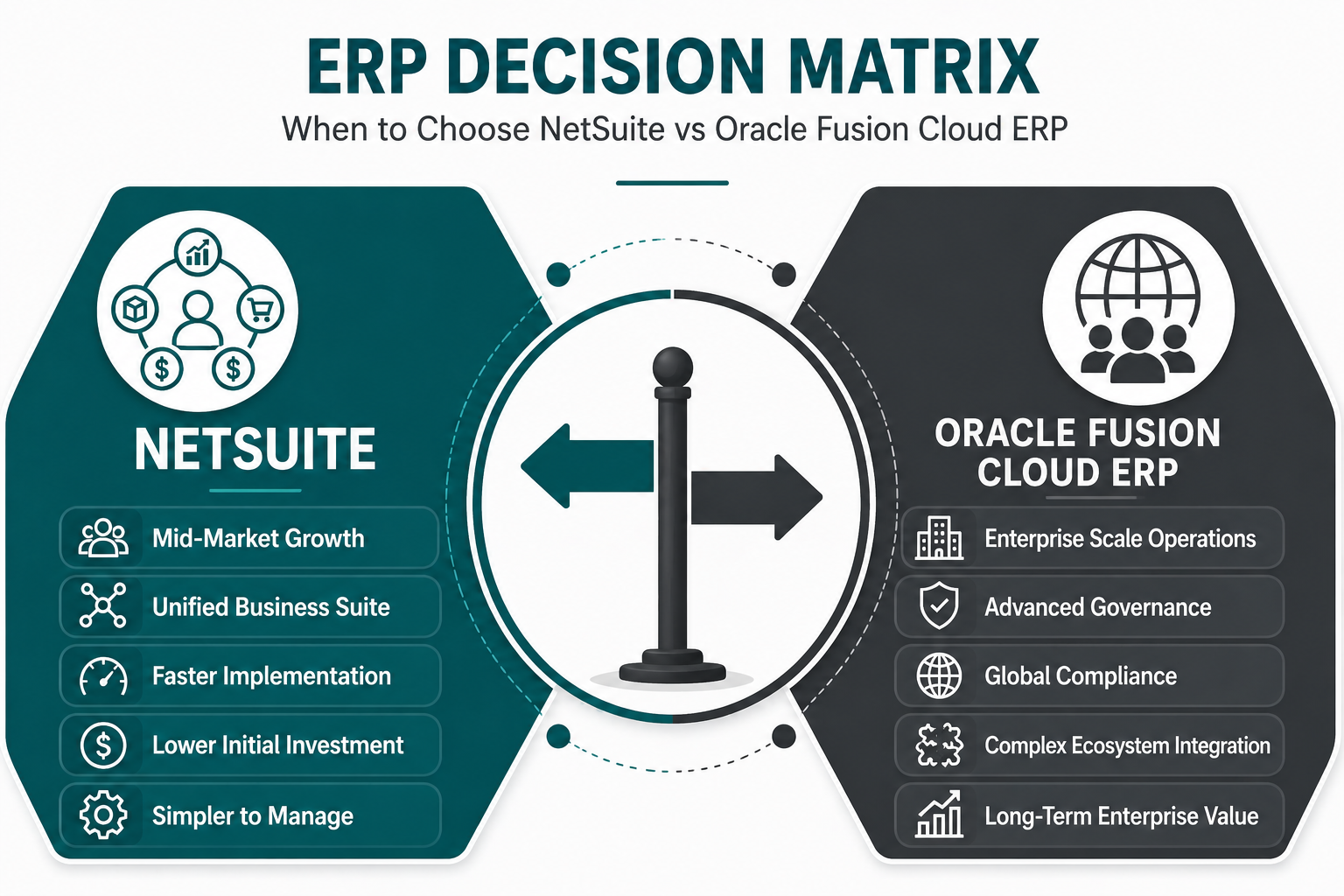
Decision Matrix: When To Choose NetSuite Or Oracle Fusion Cloud ERP

The right ERP choice depends on your company's size, operational complexity, and long-term growth trajectory.

ERP Decision Matrix

Choose NetSuite If: Choose Oracle Fusion Cloud ERP If:
Your company has 10–1,000 employees and needs a unified cloud ERP that covers financials, CRM, inventory, and e-commerce in one system. Your organization has 1,000+ employees and requires enterprise-grade financial controls, procurement governance, and multi-region compliance.
You want to replace QuickBooks, Sage, or disconnected systems with a comprehensive ERP solution that eliminates data silos. You need deep integration with other Oracle Cloud applications (Oracle HCM Cloud, Oracle CX Cloud, Oracle EPM Cloud) as part of a broader Oracle Cloud strategy.
Your business wants CRM, sales, service, finance, inventory, and order data connected in one business management suite. Your business already uses enterprise CRM, HCM, planning, procurement, or supply chain systems and needs ERP to integrate into a broader application ecosystem.
You want a comparatively faster ERP implementation, often in the 3–6 month range for standard deployments, with lower complexity than a global enterprise ERP rollout. Your organization can support a longer enterprise implementation, often 9–18+ months, depending on modules, countries, integrations, data migration, and governance needs.
Your Year 1 ERP budget is typically in the low six figures to mid-six figures, depending on users, modules, integrations, and implementation scope. Your Year 1 ERP budget is likely mid-six figures or higher, especially when licensing multiple Oracle Cloud applications, analytics, integrations, and enterprise implementation services.
You need a single ERP platform that improves team productivity by reducing the number of systems your teams need to learn, administer, and maintain. Your business operates at enterprise scale with complex procurement workflows, global trade management, and advanced supply chain planning requirements.


The Better Oracle ERP Choice Depends On How Much Complexity You Actually Need

NetSuite and Oracle Fusion Cloud ERP are both strong cloud-based ERP systems, but they solve different problems for different buyers. NetSuite works best for mid-market companies that need a unified ERP solution covering financials, CRM, inventory, order management, and e-commerce without requiring separate systems or complex integrations. Oracle Fusion Cloud ERP is built for large enterprises managing complex procurement, multi-entity consolidation, and global compliance at scale. The most suited platform matches your operational complexity, implementation resources, and long-term ownership model.

Key takeaways:

  • NetSuite is a comprehensive ERP solution that includes financials, CRM, inventory, and e-commerce in one cloud platform, which reduces integration complexity and administrative overhead for mid-market companies.

  • Oracle Fusion Cloud ERP is a modular enterprise platform designed for large organizations that need deep financial controls, advanced procurement, and tight integration with other Oracle Cloud applications.

  • Total cost of ownership differs significantly—NetSuite's all-in-one pricing model makes costs more predictable, while Oracle Fusion's modular licensing and longer implementation timelines increase Year 1 investment and ongoing administrative costs.

If you're evaluating NetSuite and need help planning your implementation, Protelo's NetSuite Implementation Services team handles data migration, system configuration, and integration with your CRM, ecommerce, and supply chain tools. We work with growing small to mid-market and enterprise buyers to deploy NetSuite environments that align with real business processes without disrupting operations. Schedule a call to discuss your ERP needs.


FAQs

What is the main difference between NetSuite and Oracle ERP Cloud?

NetSuite is an all-in-one cloud ERP that includes financials, CRM, inventory, order management, and e-commerce in one unified platform. Oracle Fusion Cloud ERP is a modular enterprise platform focused on financials, procurement, and supply chain management, with CRM sold separately as Oracle CX Cloud. NetSuite targets mid-market companies (10–1,000 employees), while Oracle Fusion is designed for large enterprises (1,000+ employees) with complex global operations.

Does Oracle Fusion Cloud ERP include CRM like NetSuite does?

No. Oracle Fusion Cloud ERP does not include CRM. Oracle sells customer relationship management separately as Oracle CX Cloud. NetSuite includes native CRM as part of the ERP platform, which allows sales, service, and finance teams to work from shared customer and transaction data without requiring separate CRM software or integration.

How much does NetSuite cost compared to Oracle Fusion Cloud ERP?

NetSuite pricing ranges from $30,000–$55,000 annually for small businesses to $150,000–$300,000+ for enterprise deployments. Implementation costs range from $25,000 to $200,000+, depending on complexity. Oracle Fusion Cloud ERP starts at approximately $150,000 annually (25-user minimum) and can exceed $1 million annually for large implementations with multiple modules. Implementation costs typically start at $200,000 and can reach over 2 million dollars for enterprise deployments.

Which ERP system is easier to implement—NetSuite or Oracle Fusion?

NetSuite implementations typically take 3–6 months for mid-market companies and involve configuring one unified system. Oracle Fusion Cloud ERP implementations often take 9–18 months or longer due to the modular architecture, which requires integrating multiple Oracle Cloud applications and managing enterprise-scale complexity. NetSuite's unified architecture reduces implementation risk and accelerates time to value.

Can NetSuite scale to enterprise size, or do I need Oracle Fusion for growth?

NetSuite scales from small businesses to enterprises with 1,000+ employees. NetSuite OneWorld supports multi-subsidiary operations, multi-currency transactions, and global compliance requirements. Most mid-market companies stay on NetSuite as they grow because the unified architecture eliminates the need for re-platforming. Oracle Fusion is better suited for organizations that start at enterprise scale (1,000+ employees) with complex procurement, global supply chains, and deep Oracle Cloud integration needs.

Is Oracle Fusion Cloud ERP better than NetSuite for financial management?

Both platforms handle core accounting, multi-currency transactions, and financial reporting. Oracle Fusion Cloud ERP provides deeper financial controls for enterprises managing complex approval hierarchies, budgetary controls, and regulatory compliance across hundreds of legal entities. NetSuite's financial management capabilities are sufficient for most mid-market companies and include budgeting, revenue recognition, intercompany accounting, and multi-entity consolidation. The choice depends on whether your business needs enterprise-grade governance or a unified financial management system integrated with CRM and operations.