

19 min read


NetSuite vs Certinia isn't a standard feature-for-feature matchup between two similar cloud ERP platforms. It's a choice between fundamentally different operating models that shape how your entire business runs.
NetSuite is a broad ERP solution that unifies CRM, financial management, billing, inventory, order workflows, and e-commerce inside one cloud suite. Certinia—formerly FinancialForce—is built natively on Salesforce and excels where businesses want to integrate finance, service delivery, customer lifecycle data, and project operations around the Salesforce platform.
That structural difference changes everything. The real decision isn't just about features. It's about whether your company needs broader ERP breadth across multiple functions or a more service-centric system designed to streamline project delivery, resource planning, automation, and real-time visibility around Salesforce. Certinia's own positioning emphasizes PSA, financial management, billing, and customer success on Salesforce, while Oracle NetSuite stresses an integrated business suite that includes ERP, CRM, and e-commerce.
This guide covers:
-
How NetSuite and Certinia differ in Salesforce alignment, CRM, ERP scope, and billing
-
Which platform better supports project management, financial management, and resource planning workflows
-
What buyers should compare are scalability, analytics, implementation, and operational fit
P.S. Before comparing platform fit in detail, implementation readiness often shapes the smarter decision. Protelo provides NetSuite Implementation Services for teams that need clean data migration, secure ERP integrations, CRM alignment, ecommerce connections, and supply chain tools connected to NetSuite without disrupting operations
Book a consultation call to reduce migration risk before platform selection gets expensive.
Quick Reference: Certinia vs NetSuite
Where NetSuite ERP and Certinia Differ Most
Understanding where these platforms diverge reveals which operating model your business actually needs. The differences below aren't minor feature variations—they're structural choices that determine how your teams work, how data flows, and what kind of growth your ERP system can support.
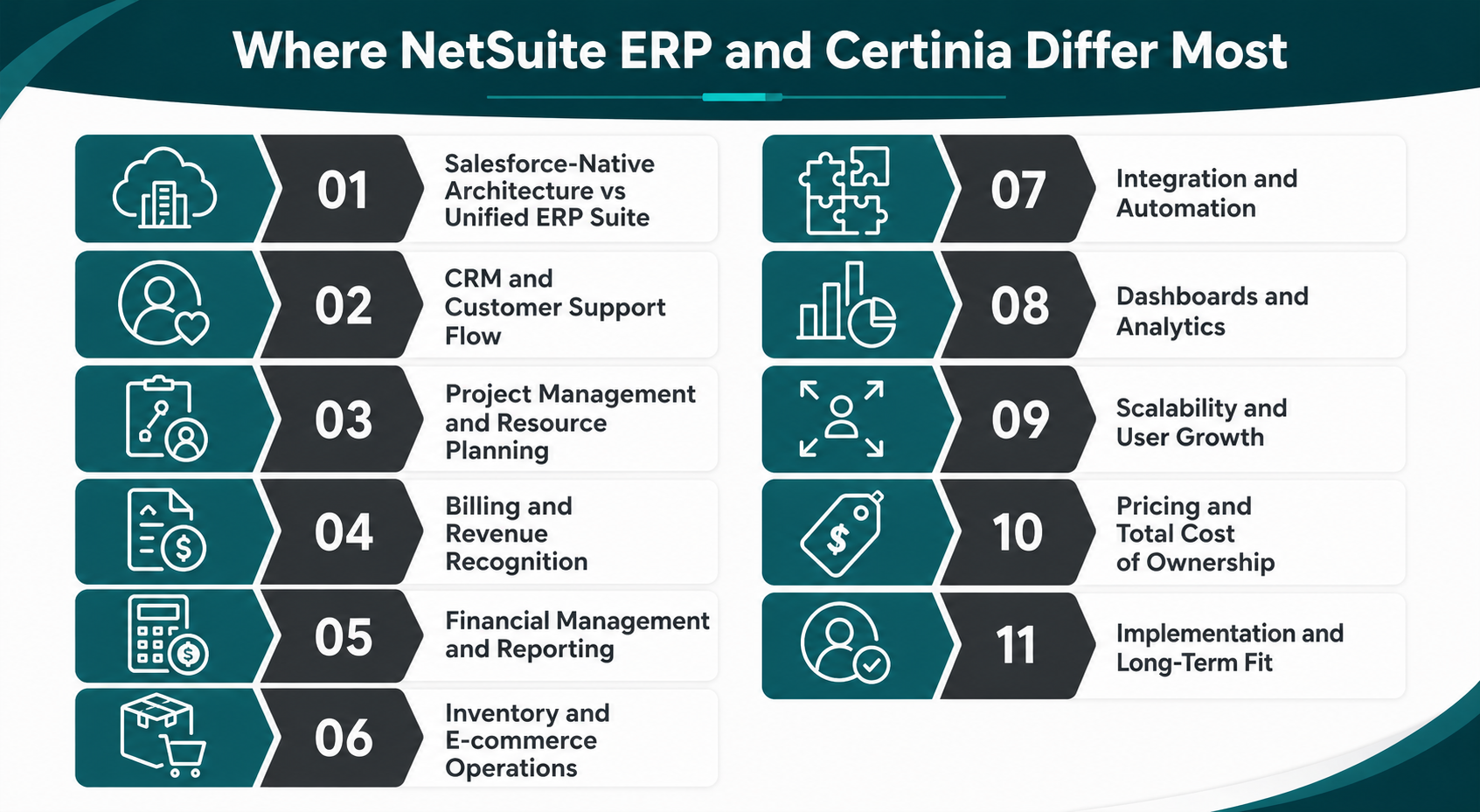
Salesforce-Native Architecture vs Unified ERP Suite
This is the foundational difference that shapes everything else. Certinia operates as a Salesforce-native application, sharing the same record model, user experience, and analytics environment as Salesforce. That means customer data, project data, and financial data live inside the Salesforce platform, using Salesforce's security model, workflow engine, and reporting tools.
NetSuite takes a different approach as a unified ERP suite that includes CRM rather than depending on Salesforce as its core platform. Oracle built NetSuite as a complete business management system where financials, inventory, order management, and customer relationship management operate within one integrated cloud platform.
Read Next: Top 14 NetSuite Competitors for ERP Buyers in 2026
CRM, Customer Support, and Customer Relationship Management Flow
How customer data moves through sales, finance, and operations reveals another critical difference between these platforms.
NetSuite's native CRM ties directly to opportunity management, order processing, fulfillment, renewal tracking, and customer support. When a sales rep closes a deal in NetSuite CRM, that customer record flows seamlessly into order management, billing, inventory allocation, and financial reporting without leaving the system. The entire customer lifecycle—from lead to cash—operates within one database, which simplifies reporting and eliminates the integration overhead that comes with connecting separate CRM and ERP systems.
Certinia operates directly inside Salesforce, which creates advantages for teams already invested in the Salesforce customer record and service lifecycle. Customer relationship management, opportunity tracking, case management, and customer support all happen in Salesforce, and Certinia extends that same environment into project delivery, billing, and financial management. There's no handoff between CRM and ERP because they share the same platform.
Read Next: Simplifying the Suite: NetSuite Integrations
Project Management, Resource Planning, and Services Delivery
Both platforms support project-based work, but they approach it from different operational contexts.
NetSuite:
-
Provides project management as part of a comprehensive ERP suite that also handles inventory, purchasing, manufacturing, and distribution
-
Strong fit when project work exists alongside product operations, requiring one platform to manage both service delivery and product fulfillment
-
Project management features integrate with broader financial management, billing, CRM, and operational workflows
-
Better when the business model includes multiple revenue streams beyond professional services
-
Supports field service management for organizations that need mobile technician dispatch, asset tracking, and service contract management
Certinia:
-
Focuses specifically on professional services automation with deep resource management and project accounting capabilities
-
Built around service delivery workflows, including resource allocation, utilization tracking, and time and expense management
-
Resource planning ties directly to Salesforce opportunity data and customer records
-
Strong fit when project profitability, consultant utilization, and delivery performance are primary operational metrics
-
Drag-and-drop resource scheduling integrates with Salesforce customer records and opportunity data
The operational difference becomes clear when you consider what happens around project work. NetSuite connects projects to inventory consumption, equipment tracking, and product fulfillment. Certinia connects projects to Salesforce customer lifecycle stages, opportunity pipelines, and services billing. Neither approach is inherently better—the right choice depends on whether your projects exist within a broader product-centric operation or within a services-centric business model.
Read Next:
- NetSuite Comparison Series: Managing Projects & Analytics Tools
- Boost Your Field Service Operations' Profitability with NetSuite
Billing, Revenue Recognition, and Invoice Complexity
Both platforms handle billing, but the context and integration model differ significantly.
NetSuite supports billing within a broader ERP and order-to-cash environment. The platform handles subscription-based billing, usage billing, milestone billing, and complex revenue recognition through SuiteBilling and native revenue management modules. Because NetSuite also manages inventory, order management, and fulfillment, billing workflows can accommodate both product sales and service delivery within the same invoice. This unified approach works well when revenue comes from multiple sources—products, services, subscriptions, and one-time sales.
Certinia emphasizes Salesforce-native subscription and usage billing tied closely to financial visibility and customer lifecycle data. Because Certinia operates inside Salesforce, billing workflows can trigger directly from opportunity closure, project milestones, or customer success events. Recurring billing, usage-based billing, and complex revenue recognition scenarios connect naturally to the same Salesforce records that sales and delivery teams already use. Automated billing processes reduce manual invoice creation and improve cash flow visibility.
Read Next:
- Mastering NetSuite SuiteBilling: Tips for Managing Billing Models
- NetSuite Price in 2026: Oracle NetSuite Pricing Guide, Implementation Cost & Cost Breakdown
Financial Management, General Ledger, and Financial Reporting
Oracle NetSuite and Certinia both provide strong financial management capabilities, but the architectural context shapes how finance teams actually use them.
NetSuite operates as a full cloud ERP financial system with comprehensive cross-functional finance coverage. The general ledger supports multi-subsidiary consolidation, intercompany transactions, and global financial management.
Financial reporting includes built-in compliance tools, customizable financial statements, and real-time dashboards that pull data from across the entire business—inventory, orders, projects, and customer transactions. Because NetSuite handles both front-office and back-office operations, financial reporting can show the complete picture from opportunity to cash without integrating separate systems.
Certinia delivers financial management on Salesforce, connecting billing, project delivery, and finance in one environment. The general ledger, accounts payable, accounts receivable, and financial reporting all operate as Salesforce objects, which means finance teams work in the same interface as sales, delivery, and customer success teams. Cash flow visibility ties directly to project milestones and customer lifecycle stages. Expense tracking and expense management connect to resource planning and project budgets without leaving Salesforce.
Inventory, E-commerce, and Product-Based Operations
This is where the platforms serve distinctly different business models. NetSuite provides native inventory management, order management, and e-commerce capabilities inside one system. The platform includes warehouse management, demand planning, inventory optimization, lot and serial tracking, and multi-location inventory control. E-commerce capabilities through SuiteCommerce connect directly to inventory, order fulfillment, and financial management without requiring third-party integration.
Certinia focuses on service delivery and financial management rather than inventory-heavy operations. While Certinia can integrate with inventory systems through the Salesforce platform, it doesn't provide the same native depth for product-centric operations that NetSuite delivers out of the box. This design choice makes sense for Certinia's target market—professional services firms, consulting organizations, and project-based businesses that don't carry significant inventory or manage complex supply chain operations.
For businesses that manufacture products, distribute goods, or run omnichannel retail operations, NetSuite's inventory and ecommerce capabilities represent core ERP functionality. For services organizations that don't carry inventory or manage complex supply chain management workflows, Certinia's focus on project delivery, resource management, and services billing aligns better with actual operational needs.
Read Next:
Integration, Workflow, and Automation Design
The integration story is fundamentally different between these platforms, and that difference shapes long-term operational flexibility.
NetSuite:
-
Operates as a broad native suite that reduces the need for external integrations across core business functions
-
Can also connect outward when needed, including through its Salesforce connector for organizations that want to maintain Salesforce CRM
-
Strong fit for teams that want to minimize cross-system handoffs or selectively integrate where business requirements demand it
-
SuiteCloud platform supports custom integrations, web services, and third-party connectors
-
Native suite breadth means fewer integration points to maintain over time
Certinia:
-
Built for deep integration with Salesforce by design, sharing the same data model and workflow engine
-
Strong fit when the organization already runs Salesforce as the operational center of gravity
-
Better choice when seamless data flow between selling, staffing, delivery, and finance matters more than native inventory or ecommerce breadth
-
Salesforce AppExchange provides access to thousands of pre-built integrations
-
Workflow automation uses Salesforce's native tools, which reduces the learning curve for Salesforce-experienced teams
Dashboard, BI, Analytics, and Real-Time Visibility
The platforms provide analytics and reporting, but the underlying data model and BI approach differ.
NetSuite provides unified suite reporting and broader business analytics across ERP, CRM, inventory, and commerce. The platform includes role-based dashboards, customizable KPIs, saved searches, and SuiteAnalytics for deeper BI capabilities.
As all operational data lives in one NetSuite database, analytics can span the entire business without requiring data warehouse integration or cross-system reporting tools. Real-time visibility extends across financial performance, inventory levels, order status, project delivery, and customer interactions within a single reporting environment.
Certinia leverages Salesforce's native analytics environment, which means dashboards and reports use Salesforce reporting tools, Einstein Analytics, and Tableau CRM. For organizations already using Salesforce, this creates immediate familiarity and reduces the training burden. Real-time visibility into project performance, resource utilization, billing status, and financial health all appear within the same Salesforce interface that teams already use for customer relationship management and opportunity tracking.
Read Next:
- Generate Multi-Level NetSuite Reports Instantly with RightInsight AI
- NetSuite Comparison Series: Managing Projects & Analytics Tools
Scalability, Number of Users, and Cross-Functional Growth
The platforms can scale, but the direction of scale differs significantly based on the business model.
NetSuite supports broader cross-functional growth across operations, finance, CRM, and product-centric workflows. As businesses add new subsidiaries, enter new markets, or expand into new product lines, NetSuite's multi-subsidiary architecture and global financial management capabilities support that growth without requiring re-platforming.
The number of users can expand across departments—finance, sales, operations, warehouse, customer support—because the platform handles all those functions natively. This scalability model works well for businesses that grow by adding operational complexity, geographic reach, or product diversity.
Certinia scales effectively when growth means more projects, more consultants, more subscription billing complexity, and deeper Salesforce-centered coordination. As services organizations grow, they typically need better resource management, more sophisticated project accounting, and tighter integration between delivery teams and finance.
Certinia's Salesforce-native architecture supports that growth path because it scales with Salesforce's proven cloud platform. This scalability model works well for businesses that grow by adding more service delivery capacity, more complex project portfolios, or more sophisticated customer lifecycle management.
Read Next:
- Navigating the 2026 NetSuite Landscape: How to Maximize Your ERP Investment
- NetSuite ERP: Tailored Solutions for Every Business Size
Pricing, Licensing, and Total Cost of Ownership
Understanding the cost structure helps frame realistic budget expectations for each platform.
NetSuite Pricing:
NetSuite uses a subscription-based licensing model with costs determined by:
-
Small Business (1–10 users): Annual investment typically ranges from $30,000 to $55,000; implementation services estimate $25,000 to $45,000
-
Mid-Market (10–100 users): Annual investment typically ranges from $60,000 to $150,000+; implementation services estimate $50,000 to $100,000
-
Enterprise (100+ users, multi-entity/global): Annual investment typically ranges from $150,000 to $300,000+; implementation services estimate $100,000 to $200,000+
Certinia Pricing:
Certinia pricing is structured around Salesforce platform requirements plus Certinia application fees:
-
Per-User Costs: Core user access starts at $150–$250 per user per month; PSA users typically range from $120–$200 per user per month
-
Salesforce Platform Fees: Required separately, typically adding $25–$75 per user per month
-
Annual Subscription Costs: Mid-market deployments (50–200 users) typically range from $180,000 to $450,000 per year for Certinia licensing alone
-
Implementation Costs: Professional services fees generally fall between $150,000 and $400,000 for mid-market implementations
-
Total First-Year Cost: For mid-market deployments, expect $400,000 to $900,000, including Certinia licenses, Salesforce fees, and implementation
Read Next: NetSuite Licensing Guide 2026: What Every Buyer Needs to Know
Implementation, Usability, and Long-Term Fit
The final comparison area focuses on practical deployment and long-term operational fit.
NetSuite:
-
Strong fit when the business wants a comprehensive, standardized cloud ERP with room to expand into multiple operational areas
-
Often preferred by buyers who want one system rather than managing a Salesforce-plus-ERP architecture
-
Good for teams prioritizing long-term ERP breadth and fewer boundaries between front-office and back-office systems
-
Implementation typically requires NetSuite-certified partners with experience across financials, inventory, and CRM
-
Usability improves as teams learn one platform for all business processes
Questions to Ask Before Choosing Between NetSuite and Certinia
The right software selection process starts with questions that reveal which operating model your business actually needs.
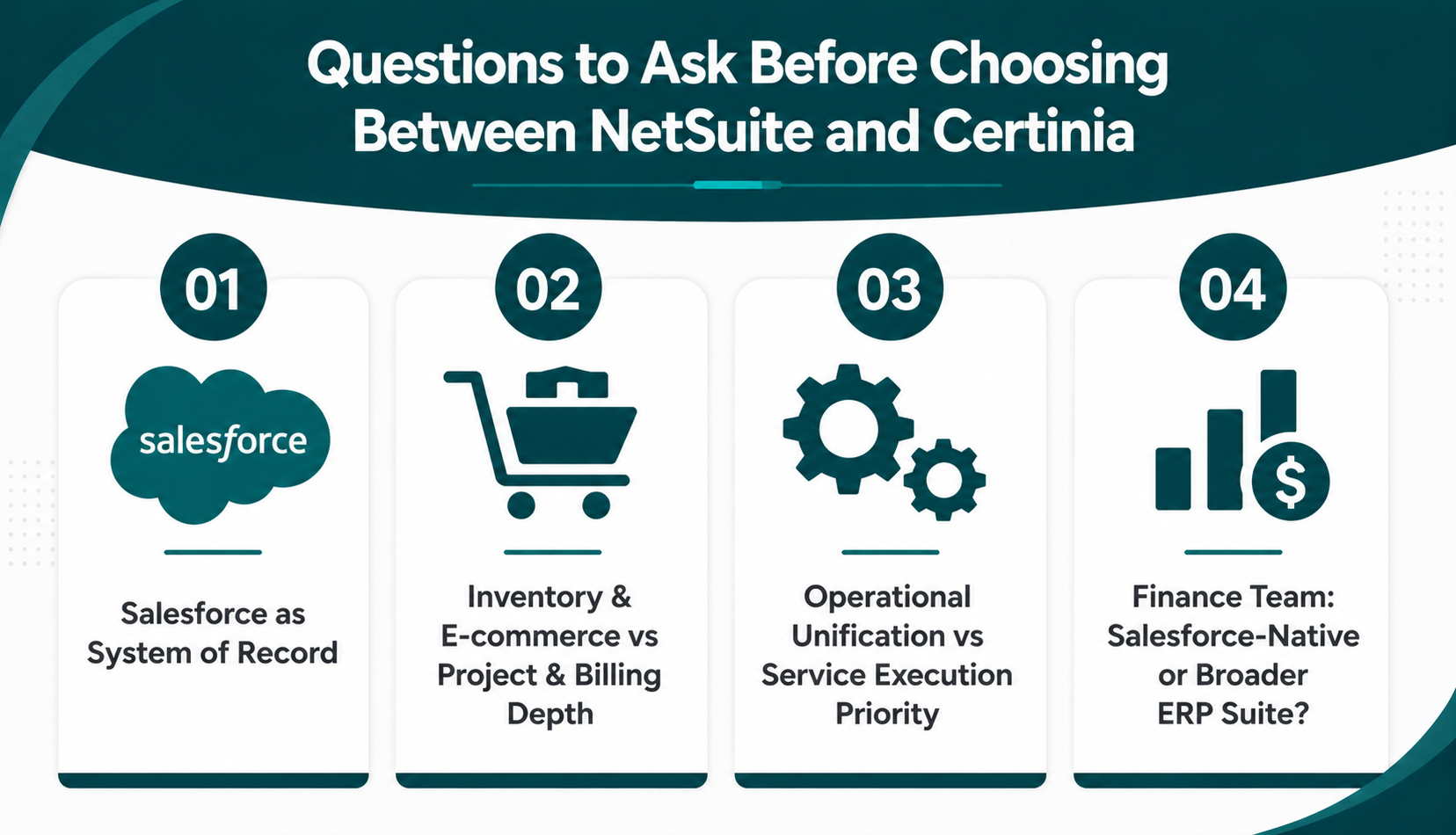
Is Salesforce already our system of record for customer relationship management and delivery coordination?
If your sales, customer support, and delivery teams already operate in Salesforce, and moving that data elsewhere would disrupt established workflows, Certinia's Salesforce-native architecture becomes a significant advantage. If Salesforce is just one tool among many, or if you're open to consolidating CRM into a broader ERP system, NetSuite's unified suite model may simplify your technology stack.
Do we need native inventory, order, and e-commerce capabilities, or mostly project and billing depth?
Product-centric businesses need inventory management, supply chain management, and e-commerce integration that NetSuite provides natively. Services-centric businesses need project management features, resource allocation tools, and billing workflows optimized for professional services delivery.
Is our ERP priority broader operational unification or better service execution?
If the goal is to unify finance, operations, CRM, and inventory into one cloud platform, NetSuite's enterprise resource planning breadth fits that objective. If the goal is to improve project delivery, resource utilization, and services billing while keeping Salesforce as the customer hub, Certinia's focused approach fits better.
Will our finance team benefit more from a Salesforce-native model or a broader ERP suite?
Finance teams that need to collaborate closely with Salesforce-based sales and delivery teams often prefer Certinia's shared data model. Finance teams that need to manage multi-subsidiary consolidation, inventory accounting, and complex order-to-cash workflows often prefer NetSuite's comprehensive financial system.
The Better ERP Choice Depends on What You Need to Unify
NetSuite and Certinia solve different problems well, and the right choice depends on which problem your business actually needs to solve.
NetSuite is the comprehensive ERP choice for organizations that want one platform for CRM, ERP, inventory, finance, billing, and e-commerce. The unified cloud platform reduces integration complexity, provides real-time visibility across all business functions, and supports growth through operational breadth. Oracle NetSuite works best for product-led businesses, companies with mixed product-service revenue models, and organizations that want to consolidate multiple systems into one customizable ERP system.
Certinia is the specialized choice for businesses that want to run finance, projects, service delivery, and customer lifecycle workflows on Salesforce. The Salesforce-native architecture preserves existing Salesforce investments, focuses on project-based operations, and provides seamless integration between customer relationship management and financial management. Certinia works best for professional services firms, staffing organizations, and services-centric businesses where Salesforce already serves as the operational hub.
The key choice is not simply feature count or comparison charts. It's which platform can best streamline operations, improve real-time visibility, and support your company's actual growth model. Product-led growth typically requires NetSuite's operational breadth across multiple business functions. Services-led growth typically requires Certinia's Salesforce-native depth in project delivery and resource management. Understanding which growth path your business is on determines which ERP solution delivers better business value.
Key Takeaways:
-
NetSuite provides broader ERP capabilities across CRM, inventory, e-commerce, and multi-functional operations
-
Certinia provides deeper Salesforce-native integration for services, project management, and billing coordination
-
The right choice depends on whether growth is product-led, project-led, or Salesforce-led
As the shortlist narrows, implementation readiness can become the deciding factor. Protelo provides NetSuite Implementation Services to help teams migrate clean data, connect key systems, and move to NetSuite without disrupting operations.
Book a consultation call to reduce migration risk before platform selection gets expensive.
Frequently Asked Questions
What is the main difference between NetSuite and Certinia?
NetSuite is a comprehensive cloud ERP suite that includes financials, CRM, inventory, ecommerce, and operations in one platform. Certinia is a Salesforce-native financial and services management solution built specifically for project-based organizations that want to extend Salesforce into finance, billing, and resource planning. The main difference is architectural: NetSuite operates as a standalone ERP system with broad cross-functional capabilities, while Certinia operates as a Salesforce application focused on service delivery.
Does NetSuite support multi-subsidiary consolidation and global financial management?
Yes, NetSuite provides robust multi-subsidiary consolidation and global financial management capabilities as part of its core ERP platform. NetSuite OneWorld supports multi-entity accounting, intercompany transactions, multi-currency management, and automated consolidation across subsidiaries in different countries. The platform handles complex global operations, including transfer pricing, currency revaluation, and consolidated financial statements across multiple legal entities. This makes NetSuite particularly strong for businesses with international operations, multiple subsidiaries, or companies planning geographic expansion.
Can NetSuite integrate with Salesforce?
Yes, NetSuite can integrate with Salesforce through Oracle's NetSuite Connector for Salesforce and other third-party integration tools. However, this creates a two-system architecture where customer data lives in Salesforce and financial/operational data lives in NetSuite. Certinia avoids this split by operating natively within Salesforce, which eliminates integration overhead for Salesforce-centric organizations.
NetSuite vs Certinia: Which is better for inventory management and e-commerce?
NetSuite provides significantly stronger capabilities for inventory management and e-commerce. The platform includes native warehouse management, multi-location inventory, demand planning, and SuiteCommerce for integrated ecommerce operations. Certinia focuses on service delivery and financial management rather than inventory-heavy operations, and typically requires third-party integrations for complex inventory and e-commerce needs.