

16 min read

ERP decisions tend to get harder as the business becomes more complex. What works for finance alone may not work for production, inventory, fulfillment, or reporting once more teams depend on the same system.
That is where NetSuite and Epicor start to separate. Both can support core business needs, but they are not built to carry the same type of operational weight. One is often evaluated for broader business standardization across departments, while the other is often considered in environments where manufacturing and distribution processes shape the system requirements more directly.
This guide covers:
-
Platform breadth versus manufacturing and distribution operational depth across financial management and production planning
-
Deployment models, module types, implementation burden, and infrastructure ownership differences that change the long-term ERP cost structure
-
Fit criteria and total cost of ownership evaluation framework for comparing NetSuite and Epicor beyond pricing
P.S. Businesses evaluating a move from Epicor to NetSuite often need structured access to historical data during the transition. Protelo provides NetSuite Implementation Services to support data extraction, preserve records during system transitions, and deliver structured exports that maintain historical visibility.
Book a strategy call to review migration scenarios and transition planning.
NetSuite vs Epicor Kinetic - A Quick Glance
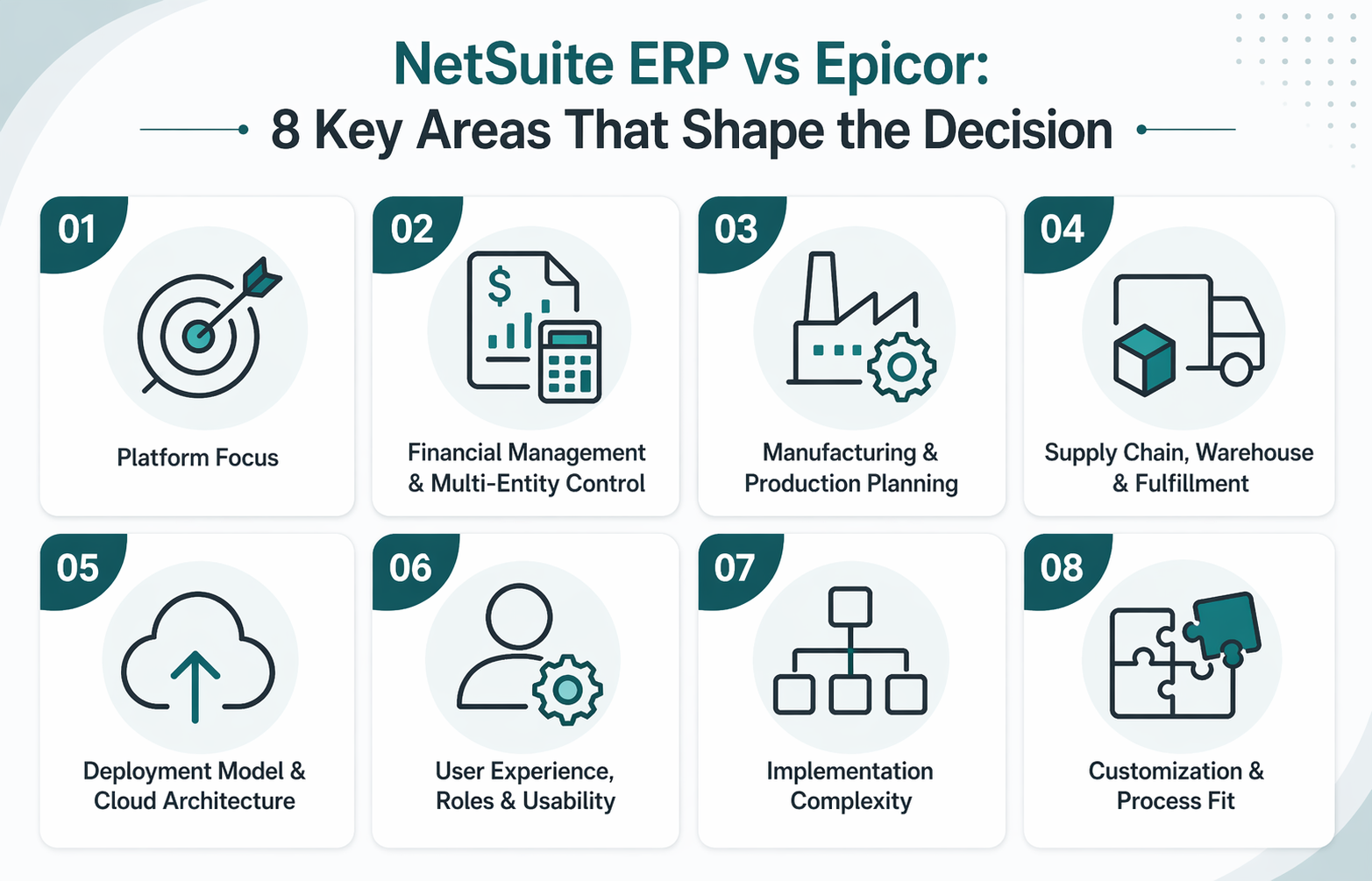
NetSuite ERP vs Epicor: The Core Differences That Actually Shape The Decision
NetSuite and Epicor are chosen for different business requirements. NetSuite is often evaluated by companies that need stronger financial control, multi-entity reporting, and one cloud-based ERP system that connects finance, inventory, CRM, and operations. Epicor is more often evaluated by businesses where manufacturing, production planning, scheduling, and shop-floor processes play a larger role in daily operations.
The difference becomes easier to evaluate once the business defines where complexity actually sits. If the bigger challenge is coordinating data and workflows across departments, NetSuite will usually align more closely with that need. If the bigger challenge is managing production activity, plant-level processes, or manufacturing-specific requirements, Epicor ERP will usually be the more relevant comparison.
Platform Focus
NetSuite and Epicor are usually evaluated for different business needs. NetSuite is more often considered by businesses that want a broader enterprise resource planning platform connecting financials, CRM, inventory, and operations in one platform. It is designed to support cross-functional visibility, shared data across departments, and cloud-based delivery without the need for internal infrastructure. Oracle positions NetSuite as an integrated ERP platform that can replace disconnected business systems with one environment.
Epicor is more often evaluated when manufacturing and distribution requirements drive the decision. Epicor Kinetic is built around production planning, shop-floor control, supply chain activity, and warehouse operations. It tends to appeal to businesses where manufacturing workflows, inventory handling, and fulfillment processes place the most pressure on the ERP system. Epicor’s positioning is strongest in environments where production and operational requirements matter more than broad suite coverage across functions like CRM and human resources.
This difference affects what buyers should prioritize during evaluation. Businesses that want one cloud platform to unify business processes across departments often focus on NetSuite. Businesses that need deeper manufacturing and operational support usually spend more time evaluating Epicor.
Read Next: Top 14 NetSuite Competitors for ERP Buyers in 2026
Financial Management & Multi-Entity Control
NetSuite and Epicor handle financial management differently based on whether the platform prioritizes multi-entity complexity or operational depth. Businesses operating globally or managing multiple legal entities often find that NetSuite reduces the manual effort required to consolidate financial data and produce accurate reports.
NetSuite:
-
Consolidated Financial Reporting: Delivers real-time data through consolidated financial reporting across entities, currencies, and business units. Unifies general ledger, accounts payable, accounts receivable, and cash management in one system, reducing the need to reconcile data across separate financial software.
-
Multi-Entity and Multi-Currency Support: Handles multi-entity structures with built-in support for intercompany eliminations, currency revaluation, and subsidiary-level reporting. Businesses expanding internationally or managing complex entity structures often find that this reduces financial management burden.
-
Unified Financial and Operational Data: Integrates financial management with inventory management, order management, and customer relationship management. Provides visibility into how operational activity affects financial performance without requiring manual data transfers between systems.
Epicor:
-
Financial Management Capabilities: Handles general ledger, accounts payable, accounts receivable, and financial reporting, but does not emphasize multi-entity consolidation as a core platform strength.
-
Operational Focus Over Financial Complexity: Prioritizes production planning, manufacturing workflows, and supply chain management over cross-border financial reporting and multi-entity control.
-
Best Fit for Single-Entity or Simpler Financial Structures: Works well for businesses where the finance structure is straightforward and operational depth matters more than consolidated reporting across multiple subsidiaries.
Manufacturing & Production Planning
Manufacturing depth is one of the clearest differences between these platforms. Epicor places much more emphasis on production planning, shop-floor visibility, and manufacturing execution. Its capabilities include work order management, bills of materials, routing, capacity planning, and manufacturing data collection. For businesses where production scheduling, plant activity, and manufacturing efficiency shape ERP requirements, Epicor often provides stronger support.
NetSuite includes manufacturing capabilities such as work orders, assemblies, and production management. It can support both discrete and process manufacturing, but manufacturing is not the center of the platform. NetSuite is better understood as a broader ERP system that includes manufacturing, rather than one built primarily around production operations.
That distinction matters because production planning is not the same as warehouse or fulfillment management. Production planning depends on capacity, labor, materials, work centers, and scheduling constraints. Warehouse management depends more on inventory movement, picking, packing, and shipping. Businesses that need deeper production support often find Epicor more aligned with those requirements. Businesses that need manufacturing as part of a broader ERP strategy often find NetSuite sufficient while gaining stronger integration across finance, CRM, and operations.
Supply Chain Management, Warehouse & Fulfillment
Inventory flow, warehouse handling, and order fulfillment create different operational demands, and both Epicor and NetSuite offer supply chain management differently based on whether the business prioritizes broader ERP integration or deeper warehouse and distribution capabilities.
Deployment Model & Cloud Architecture
The deployment model affects how a business manages infrastructure, updates, system control, and long-term administration. Those differences influence internal IT involvement, flexibility after go-live, and the total cost of ownership over time.
NetSuite:
-
Cloud-Native SaaS Delivery: Delivers automatic software updates twice per year, ensuring all customers operate on the same platform version. Eliminates version lock, reduces upgrade costs, and provides access to new features without requiring internal IT resources to manage updates.
-
No On-Premises Option: Does not offer on-premises deployment. Businesses that require on-premises infrastructure for regulatory, operational, or data control reasons cannot deploy NetSuite locally.
-
Infrastructure Ownership and Control: Removes infrastructure ownership from the business, meaning Oracle manages servers, databases, security, and platform availability. Reduces IT burden but also removes control over update timing and deployment architecture.
Epicor:
-
Broader Deployment Flexibility: Offers cloud, hybrid, and on-premises deployment options. Allows businesses to deploy ERP software on-premises, maintain control over update timing, or operate in hybrid environments where some systems remain local.
-
Infrastructure Control: Provides control over deployment architecture, update schedules, and infrastructure configuration. Increases IT involvement and infrastructure ownership but allows businesses to maintain control over deployment decisions.
-
Regulatory and Operational Flexibility: Supports businesses that need to deploy on-premises for regulatory compliance, data control policies, or operational constraints that prevent full cloud adoption.
User Experience, Roles & Operational Usability
User experience matters because ERP adoption depends on how well the system supports the people using it every day. NetSuite is designed around cross-functional, role-based access for office users in finance, sales, customer service, and operations. It provides dashboards, saved searches, and workflow tools that help users work across financial data, customer records, and order activity from one interface and optimize day-to-day coordination.
Epicor places more emphasis on operational workflows for plant, warehouse, and distribution users. Its interface priorities are more closely tied to production scheduling, shop-floor activity, inventory location, and fulfillment status. In businesses where daily ERP activity happens mainly in manufacturing or warehouse settings, Epicor often aligns better with how those teams work.
The practical question is not which platform is easier to use in general. It is which platform is better suited to the users who rely on it most? NetSuite is usually a better fit for office-based, cross-functional teams. Epicor is usually a better fit for operational users working in production and warehouse environments.
Implementation Complexity
Implementation complexity is different in NetSuite and Epicor because the work usually concentrates on different areas. NetSuite projects are more often shaped by financial structure, cross-functional process alignment, and cloud-based standardization across departments. Epicor projects are more often shaped by manufacturing workflows, production planning, operational detail, and the need to fit the system around plant or distribution processes. That makes implementation difficulty less about which platform is “easier” and more about which one matches the type of complexity your business already has.
NetSuite and Epicor:
-
Data Migration and Data Quality: NetSuite implementations focus on consolidating financial, CRM, inventory, and multi-entity data into a single unified system, creating a standardized data model that supports real-time visibility and reporting across the entire business. This approach aligns business data into one system of record, where financial and operational information is connected and consistently structured across departments.
Epicor implementations focus on migrating product, production, inventory, and operational data in a way that preserves manufacturing logic, shop-floor workflows, and plant-level operational structures.
In both cases, data quality is an important factor in project success. The difference is in focus: NetSuite centers on cross-functional data consolidation and standardization across the organization, while Epicor centers on maintaining detailed operational and manufacturing data structures within production environments. -
Integration Requirements: NetSuite can reduce some integration work when businesses want financials, CRM, inventory, and operations in one cloud platform. Epicor may require more attention to surrounding systems when manufacturing environments rely on specialized tools, plant systems, or distribution workflows outside the ERP. The better fit depends on whether your implementation burden comes more from connecting office and operational functions together or from supporting deeper manufacturing and industry-specific processes.
-
Operational Depth and Process Complexity: Epicor usually becomes more complex to implement when production scheduling, shop-floor control, warehouse activity, and manufacturing workflows need to be closely reflected in the system. NetSuite usually becomes more complex when businesses are standardizing processes across finance, inventory, CRM, and multiple entities in one environment. Epicor tends to carry more implementation weight in production-heavy environments, while NetSuite tends to carry more implementation weight in cross-functional standardization.
-
User Adoption and Training: NetSuite training often centers on office-based users across finance, sales, customer service, and operations who need consistent workflows and shared visibility. Epicor training often requires more focus on plant, warehouse, and operational users working with production, fulfillment, and inventory processes. The harder rollout is usually the one that affects the larger or more process-sensitive user base.
-
Testing and Validation: NetSuite projects often require more validation around financial reporting, role permissions, workflows, and cross-department process continuity. Epicor projects often require more validation around manufacturing execution, production data, inventory movement, and operational process accuracy. Both require significant testing, but the focus differs based on whether the business is more exposed to financial and cross-functional risk or production and operational risk.
Customization & Process Fit
Customization affects both implementation and long-term maintenance. NetSuite generally supports a more configuration-led approach, using tools such as saved searches, workflows, custom fields, and SuiteScript to adapt the system without changing the core platform too heavily. Businesses that are comfortable aligning processes with a standard ERP structure often find that this reduces complexity and helps keep implementation more controlled.
Epicor supports deeper tailoring when businesses need the ERP system to follow existing manufacturing, warehouse, or operational workflows more closely. That can improve process fit in environments where workflows are highly specific, but it can also increase long-term maintenance when custom logic becomes extensive.
This is different from integration. Customization changes how the ERP system handles internal processes, while integration connects it to other software. The real evaluation point is how far your workflows differ from standard ERP structure and how much customization your team is prepared to support over time. NetSuite is usually the better fit when standardization is acceptable. Epicor is usually the better fit when process tailoring is more important.
Read Next:
When Oracle NetSuite Might Be A Better Fit
NetSuite is often the better fit when the business needs one cloud system to connect financials, CRM, inventory, and operations. It usually makes more sense when the goal is to reduce system sprawl, standardize processes across departments, and avoid managing on-premises infrastructure.
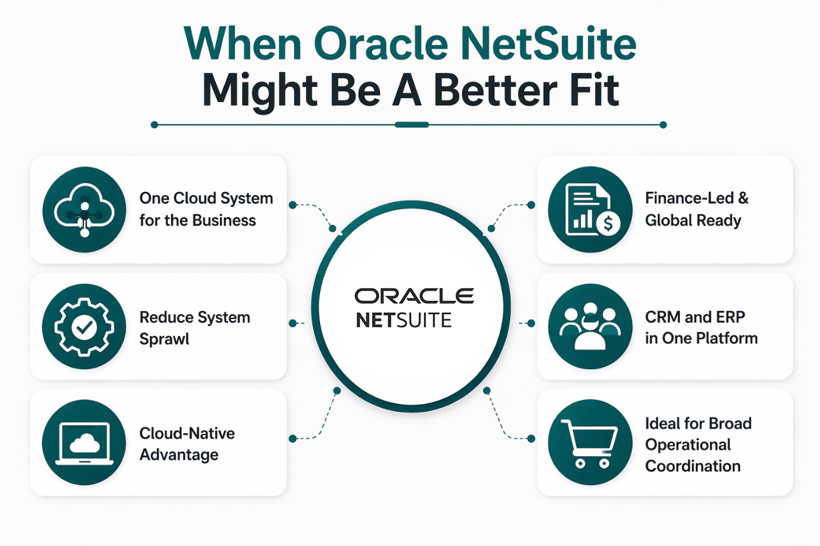
It also fits well in finance-led environments with multi-entity reporting, multiple subsidiaries, currencies, or cross-border operations. Businesses that want CRM and ERP in one platform often find that NetSuite reduces integration work by connecting customer data, sales, fulfillment, and billing in a single system. It is often a strong fit for retail, ecommerce, software, and service businesses where broad operational coordination matters more than deep manufacturing functionality.
Read Next:
When Epicor ERP Might Be A Better Fit
Epicor is often the better fit when manufacturing, warehouse operations, or supply chain complexity drive the ERP decision. It usually makes more sense when the business needs deeper support for production scheduling, work orders, capacity planning, shop-floor control, or distribution workflows.
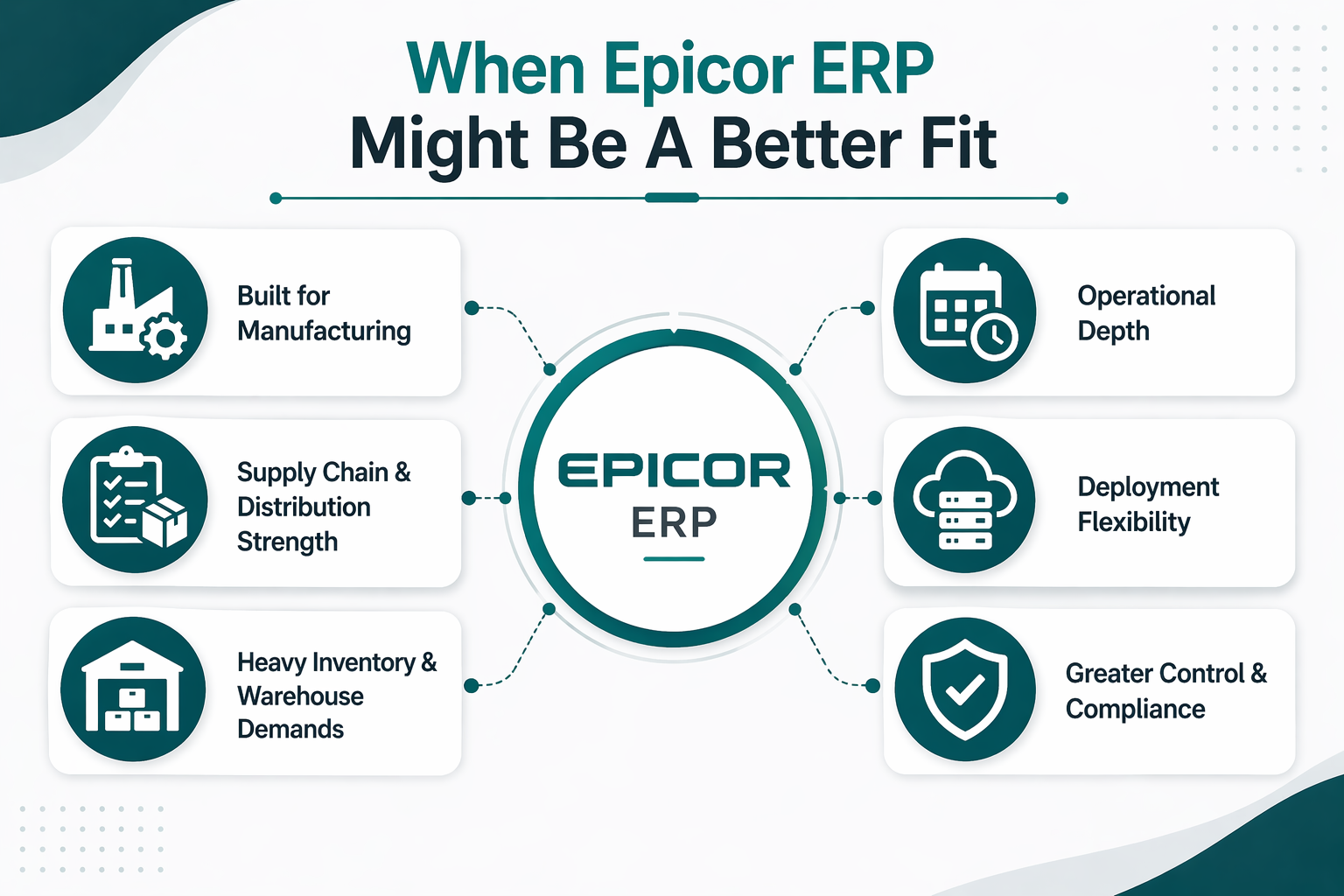
It can also be a stronger fit for businesses with heavy inventory and warehouse demands, especially when operational depth matters more than having CRM, finance, and operations unified in one cloud suite. Companies that need more deployment flexibility, including on-premises or hybrid options, may also find Epicor a better match when data control, regulatory, or infrastructure requirements make full SaaS less practical.
So, Which ERP Solution Should You Go With?
Both NetSuite and Epicor are evaluated when organizations are defining their ERP strategy, but they reflect different system priorities. The decision is less about feature comparison and more about whether the business needs a unified ERP system that connects the entire organization or a manufacturing-focused system built around production execution.
Start by identifying where operational complexity is concentrated. If the priority is consolidating financials, inventory, CRM, and operations into a single cloud ERP system with real-time visibility across the business, NetSuite is typically the more aligned platform. It is commonly used in environments where cross-functional standardization, multi-entity reporting, and reduced system fragmentation are key objectives.
If the primary requirement is manufacturing execution, production scheduling, and shop-floor operational control, Epicor is typically considered in environments where production workflows and plant-level processes define system requirements.
Key Takeaways:
-
Evaluate platform fit based on whether the main ERP pressure is cross-functional standardization and financial control, or manufacturing depth and operational complexity.
-
Review the total cost of ownership across implementation services, data migration, integration development, customization maintenance, and ongoing support rather than focusing only on software pricing.
-
Test both platforms with real data, real workflows, and real user roles before making a final decision to surface fit issues that feature comparisons do not reveal.
Businesses planning a move from Epicor to NetSuite or evaluating how to preserve historical data during ERP transition should review data extraction requirements early. Our NetSuite Implementation Services support structured exports, historical record preservation, and migration planning for businesses moving between ERP systems.
Book a strategy call to evaluate transition readiness and data continuity during platform selection.
FAQs
Is NetSuite Better Than Epicor For Manufacturing Companies?
Fit depends on production depth and whether manufacturing drives the ERP decision. Epicor emphasizes production scheduling and shop-floor control. NetSuite covers manufacturing but prioritizes broader business process standardization. Businesses where manufacturing is the primary ERP driver often find Epicor delivers stronger operational handling, while NetSuite may better streamline cross-functional operations.
How Do NetSuite And Epicor Differ In Cloud Deployment?
NetSuite operates as a cloud-native SaaS with automatic updates and no on-premises option. Epicor offers cloud solution, hybrid, and on-premises deployment flexibility. NetSuite removes infrastructure management from the business. Epicor allows businesses to deploy on-premises or in hybrid environments, increasing IT burden but providing control over update timing.
Which Platform Is Better For Multi-Entity Financial Management?
NetSuite is designed to support multi-entity financial management within a unified ERP system, enabling consolidated reporting, intercompany transactions, and real-time visibility across subsidiaries in a single platform.
Epicor supports core financial functions but is less commonly used as a primary system for multi-entity consolidation at scale, particularly in globally distributed organizations.
How Should Buyers Compare NetSuite And Epicor Beyond Pricing?
Total cost of ownership includes implementation services, data migration, integration development, customization maintenance, and internal IT resources beyond software subscription costs. Implementation complexity varies based on data quality, operational depth, and integration requirements. Businesses should evaluate the total cost of ownership across the full ERP lifecycle rather than focusing only on software pricing.
What Should A Business Review Before Migrating From Epicor To NetSuite?
Review data extraction, historical records, structured exports, testing, and transition planning early. Businesses should evaluate how to preserve historical data during migration, what data structures need mapping between systems, and how to maintain operational continuity. Testing should include data validation, integration verification, and user acceptance before go-live.