

17 min read


Moving from Sage 300 to NetSuite ERP makes sense when a growing multi-company organization needs a more unified way to manage subsidiaries, intercompany activity, currencies, and consolidated reporting. Sage 300 already supports multi-company accounting and consolidation, so the decision should come down to how efficiently the current ERP environment can support added complexity.
For CFOs and Controllers, that means evaluating the effort required to consolidate financials, reconcile intercompany transactions, manage multiple currencies, and report across entities. NetSuite OneWorld supports these requirements through a single account with a hierarchical subsidiary structure and consolidated reporting.
BARC’s 2025 Financial Consolidation & Group Accounting Survey of 453 participants worldwide found that more than half had moved their consolidation solutions to the cloud, up eight percentage points from the previous study. The research also found a broader shift toward bringing consolidation, planning, and reporting onto a common platform.
When Multi-Company Management Becomes Multi-Entity Complexity
Multi-company ERP management becomes harder when separate entities increasingly depend on one another for transactions, reporting, currencies, inventory, and shared financial processes. The number of companies matters, but the relationships between them often create more work.
A business with ten largely independent entities may be easier to manage than one with five subsidiaries that routinely share expenses, transact with one another, move inventory between locations, or operate in different currencies. As those connections increase, finance has more balances to reconcile, mappings to maintain, transactions to eliminate, and reporting requirements to coordinate.
Entity Count is Only Part of the Problem
Finance leaders should look beyond the number of legal entities and consider how much work each additional company creates. Useful questions include:
- How frequently do entities transact with one another?
- How much manual work is required for consolidation?
- Are account mappings maintained across different company structures?
- How many currencies does finance need to manage?
- Can management easily review both consolidated and entity-level performance?
- How difficult is it to incorporate a newly acquired company?
These questions often reveal more about ERP scalability than company count alone.
Intercompany Activity Can Increase Complexity Quickly
Intercompany transactions create additional dependencies between entities. One company may purchase inventory for another, corporate expenses may need to be allocated across several subsidiaries, or different entities may buy and sell from one another.
Sage 300 supports intercompany transactions and multicurrency processing. Finance should assess how much effort goes into managing routes, clearing accounts, reconciliations, eliminations, and exceptions as transaction volume grows. A process that works comfortably across three entities may require substantially more coordination when the organization expands to ten or fifteen.
Acquisitions and International Growth Add Another Layer
Acquired companies rarely arrive with identical charts of accounts, reporting structures, currencies, or financial processes. Bringing them into the group can require new mappings, intercompany relationships, reporting rules, and decisions about which processes should be standardized.
International operations introduce similar considerations. Subsidiaries may need to maintain financial statements in local currencies, while the headquarters requires consolidated reporting in another currency.
As these requirements accumulate, finance leaders should assess whether the current Sage 300 structure can still manage the organization efficiently as one growing business or whether a different multi-entity ERP model would reduce recurring complexity.
Sage 300 vs. NetSuite OneWorld for Multi-Company ERP Management
Sage 300 and NetSuite OneWorld can both support organizations with multiple companies, currencies, and intercompany activity. The comparison should focus on how each ERP system structures those requirements and how well that approach fits increasingly complex entity relationships.
Sage 300 supports multiple company ledgers, G/L consolidation, account mapping, multicurrency, and intercompany transactions. NetSuite OneWorld takes a different approach by managing subsidiaries within a hierarchical structure in a single NetSuite account, allowing finance teams to maintain entity-level financials while reporting across the consolidated organization.
For a relatively stable group of companies with established financial processes, Sage 300 may continue to meet the organization’s needs. The case for NetSuite OneWorld becomes stronger when subsidiaries are increasingly interconnected, acquisitions are frequent, international operations are expanding, or finance wants to manage more of the organization through a common ERP platform.
A multi-company ERP decision should be based on the operating model the business needs to support and the effort required to manage it.
Read More: Gartner Analysis: Why Companies Choose NetSuite
5 Signs Your Multi-Company ERP Model is Becoming Difficult to Scale
An ERP system can still function well while becoming harder to manage as a multi-company organization grows. The warning signs usually appear in the amount of manual work required to consolidate results, reconcile entities, maintain integrations, and incorporate new businesses.
These issues do not automatically mean a company has outgrown Sage 300. They indicate that finance should evaluate whether the current ERP structure is scaling efficiently.
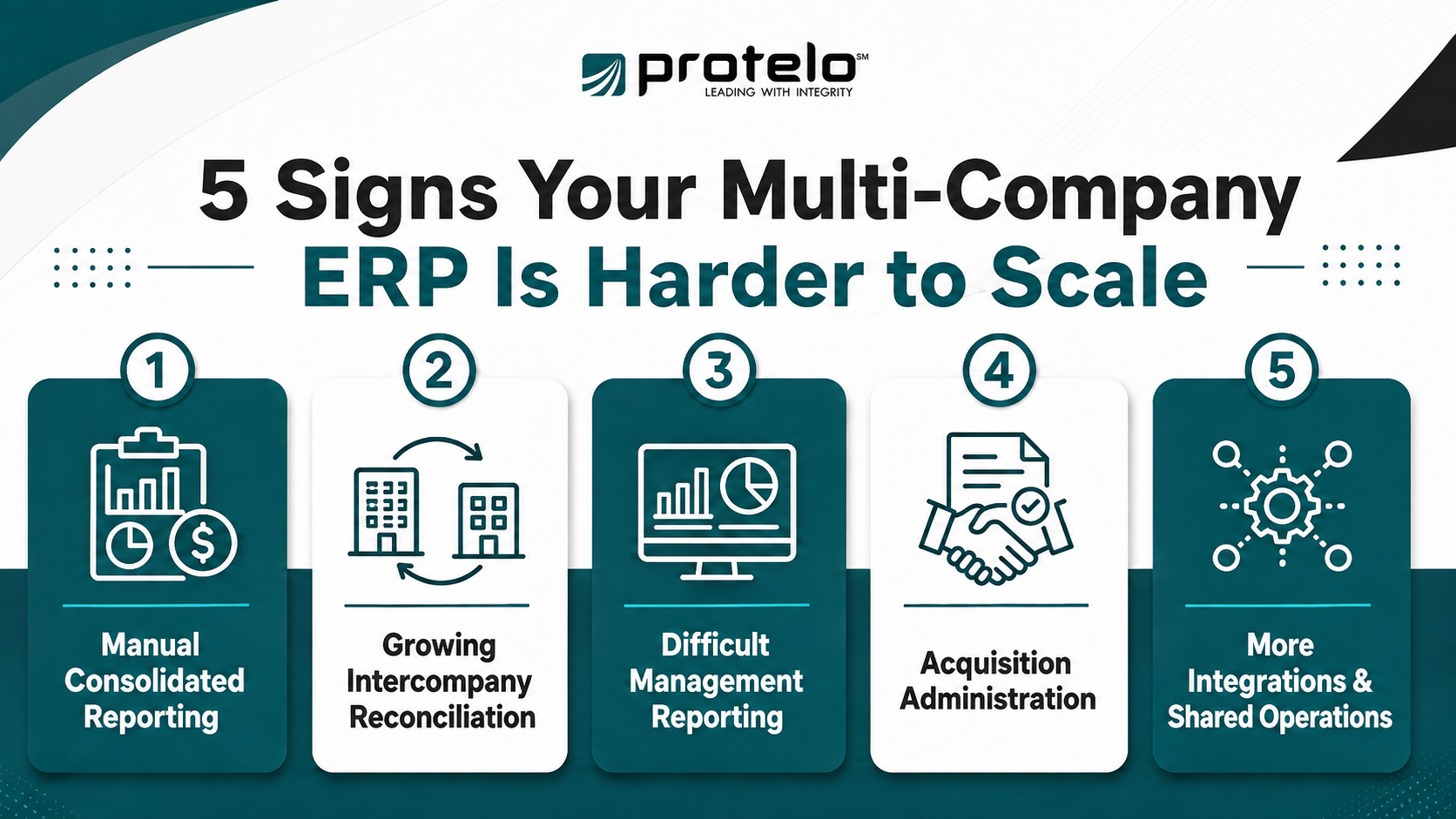
1. Consolidated Reporting Requires More Manual Work
Sage 300 supports consolidation across multiple companies, including different account structures and currencies. The concern is how much manual work develops around that process as complexity increases.
If finance relies on recurring spreadsheet adjustments, extensive account mapping, manual reconciliations, or several steps outside the ERP software to produce consolidated financials, reporting may be becoming harder to scale. A useful measure is whether each new entity adds materially more work to the close.
2. Intercompany Reconciliation Keeps Growing
Intercompany activity often increases faster than company count. Subsidiaries may share expenses, buy and sell from one another, move inventory between entities, or maintain recurring intercompany balances.
Sage 300 supports intercompany transactions and multicurrency processing. What finance leaders should evaluate is the effort required to reconcile those transactions and resolve exceptions. If intercompany work routinely delays the close or depends on manual processes, the current model may be creating unnecessary administrative burden.
3. Management Reporting is Difficult to Assemble
CFOs and Controllers need more than consolidated financial statements. They also need to compare subsidiaries, investigate variances, and move between group-level and entity-level performance.
When those business insights require data exports, spreadsheet manipulation, or information from several company environments, reporting can become slower and harder to trust. NetSuite OneWorld allows reporting at individual subsidiary and consolidated parent levels within the same ERP environment, making reporting structure an important area to compare when evaluating Sage 300 and NetSuite.
Read Next: Important Signs That Your Business is Ready to Upgrade to Cloud ERP
4. Acquisitions Add Another Layer of Administration
A newly acquired company can introduce a different chart of accounts, currency, reporting structure, integrations, and operating processes. Finance then has to incorporate that entity into consolidation while deciding which differences should remain. For fast-growing mid-market companies, a useful test is simple:
How difficult would it be to add another acquired business next quarter?
If every acquisition requires substantial new mappings, reconciliations, reports, and system configuration, the ERP structure may be adding friction to the growth strategy.
5. Integrations and Shared Operations Keep Multiplying
Complexity can also spread beyond finance. Subsidiaries may share CRM, ecommerce platforms, inventory management, order management, supply chain systems, or other applications.
As more entities share these systems, integrations must account for entity ownership, transaction routing, and financial impact. Finance and IT should evaluate how much integration complexity they must maintain as business operations expand.
For companies choosing the right ERP system, these warning signs provide a better basis for evaluation than company size alone. Close effort, reconciliation workload, reporting delays, acquisition onboarding, and integration maintenance show where multi-company growth is placing real pressure on the current environment.
Read More: What NetSuite Ecommerce Option is Right For Your Business?
How NetSuite ERP Changes Multi-Entity Financial Management
NetSuite OneWorld manages subsidiaries within a common ERP account, connecting entity-level financial management with group consolidation. Each subsidiary remains a distinct legal entity, while the hierarchy connects financial data, currencies, reporting, and intercompany activity across the organization.
Manage Multiple Entities Within a Common Hierarchy
In NetSuite OneWorld, each legal entity is represented as a subsidiary within a parent-child hierarchy. That structure supports both domestic and international operations while preserving entity-level financial data.
For finance teams, the hierarchy becomes part of the ERP design. Decisions about parent companies, subsidiaries, holding entities, and eliminations directly affect consolidation and reporting, so the structure should reflect how the business actually operates.
Improve Consolidated and Entity-Level Reporting
OneWorld allows finance teams to report at the subsidiary level or roll results into a parent or consolidated view. When subsidiaries use different base currencies, NetSuite applies consolidated exchange rates as amounts roll into the parent reporting currency. Protelo can help finance teams evaluate how NetSuite Financial Management fits their accounting, reporting, consolidation, and broader ERP requirements.
Bring Intercompany Processing Into the Same ERP Structure
NetSuite OneWorld supports intercompany sales and purchases, inventory transfers, cross-subsidiary fulfillment, and intercompany journal entries. Elimination subsidiaries and related entries help remove appropriate intercompany activity from consolidated financials.
This can reduce the amount of manual coordination required as intercompany volume grows, although finance teams still need clear policies, ownership, and reconciliation controls.
Support Multi-Currency and International Operations
Each subsidiary can maintain its own base currency while consolidated reporting translates results through the parent hierarchy. For organizations expanding into new countries or regions, this provides a consistent framework for managing local entity financials and group reporting within the same cloud ERP environment.
For organizations planning this transition, Protelo’s NetSuite Implementation Services can help design the subsidiary structure, consolidation model, intercompany processes, currencies, reporting, integrations, and migration requirements before configuration begins.
For companies evaluating Sage 300 and NetSuite, OneWorld becomes more relevant when multiple entities need to operate within a shared ERP model and finance wants consolidation, intercompany processing, currency management, and reporting to follow that same structure.
Read Next: NetSuite Beginner’s Guide for 2026
When Intercompany Activity Becomes an ERP Design Issue
Intercompany accounting becomes harder to manage as subsidiaries buy from one another, share expenses, transfer inventory, or operate across different currencies. The challenge is keeping both sides of each transaction aligned while ensuring balances reconcile and internal activity is properly eliminated from consolidated financials.
NetSuite OneWorld supports intercompany sales and purchases, inventory transfers, intercompany journal entries, reconciliation, and elimination processes within the same multi-entity ERP structure. This can reduce manual coordination, but only when entity relationships, accounts, and workflows are designed correctly.
Evaluate the Full Intercompany Process
Finance leaders should review the full intercompany process from transaction creation through consolidation.
For companies evaluating Sage 300 and NetSuite ERP, growing intercompany volume is an important signal to reassess the current model. If each additional entity creates materially more reconciliation, exception handling, and period-close work, the organization may benefit from an ERP design that manages more of that activity within a common multi-company structure.
Read More: Supply Chain Management: An Overview Guide
How Acquisitions Change the Sage 300-to-NetSuite Business Case
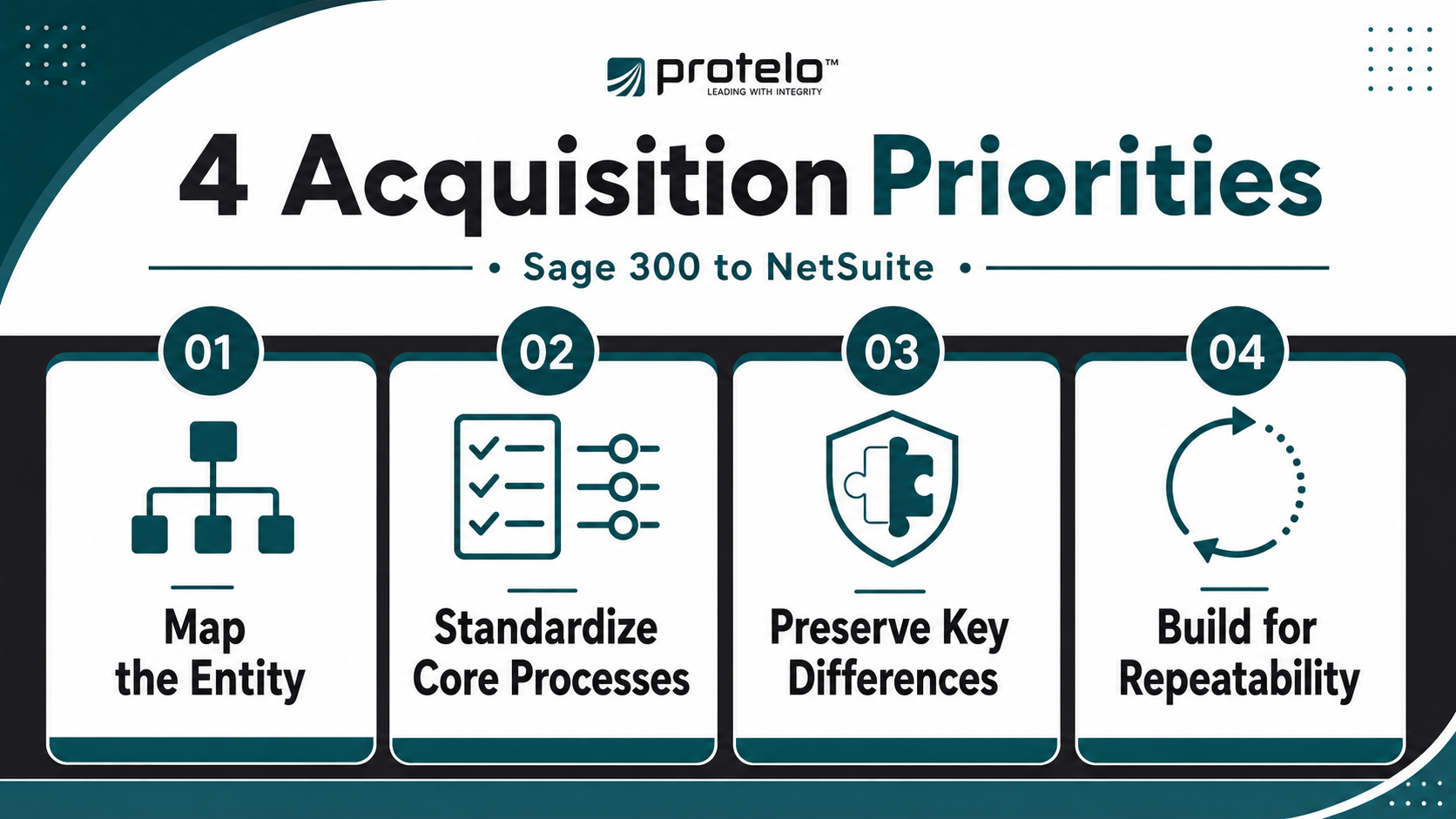
Acquisitions can put added pressure on a multi-company ERP because every new entity brings its own financial structures, processes, currencies, integrations, and reporting requirements. For acquisition-driven companies, the important question is how efficiently each new business can be incorporated into the broader organization. A practical approach is to evaluate four areas:
-
Map the acquired entity. Document its chart of accounts, reporting structure, base currency, integrations, approval workflows, and major operational differences.
-
Decide what should be standardized. Determine where a common chart of accounts, reporting dimensions, close process, or approval framework will improve consistency across the group.
-
Preserve legitimate differences. Legal entities may still require different currencies, tax treatments, local processes, or reporting requirements. Standardization should not come at the expense of necessary local controls.
-
Design for repeatability. If acquisitions are part of the growth strategy, the ERP model should make it easier to add the next entity without rebuilding mappings, reporting logic, and consolidation processes each time.
NetSuite OneWorld supports this approach by organizing subsidiaries within a common hierarchy while preserving entity-level financials and consolidated reporting. For fast-growing mid-market companies, acquisition readiness should be an important factor when evaluating Sage 300 and NetSuite ERP.
International Growth Changes the ERP Equation
International expansion can expose weaknesses in a multi-company ERP structure quickly. A new foreign subsidiary may bring a different base currency, local accounting requirements, new intercompany relationships, and additional reporting needs. Headquarters still needs a consistent consolidated view.
For example, a U.S.-based company expanding into Canada and the U.K. may need to maintain local financials in CAD and GBP, reconcile activity between entities, and translate results into USD for corporate reporting. NetSuite OneWorld supports this model by allowing subsidiaries to maintain their own base currencies while results roll through the corporate hierarchy for consolidation.
Sage 300 already supports multicurrency operations, so international growth alone does not justify a migration. A move becomes easier to justify when additional entities and currencies make financial management increasingly difficult to coordinate. Protelo’s NetSuite Data Extraction and Migration Services can help organizations prepare and move financial data into the new ERP structure as entities transition to NetSuite.
When Does Moving from Sage 300 to NetSuite Make Sense?
Moving from Sage 300 to NetSuite ERP becomes worth considering when multi-company growth is adding more consolidation work, intercompany activity, currency complexity, and reporting effort than the current ERP structure can manage efficiently.
Sage 300 can still be a strong fit for organizations with stable entity structures and established financial processes. The case for NetSuite OneWorld becomes stronger when acquisitions, international operations, and increasingly connected subsidiaries make it harder for finance to maintain visibility and control across the business.
For CFOs and Controllers, the decision should come down to whether the current environment can support the organization’s next stage of growth without adding disproportionate manual work, reconciliation effort, or administrative complexity.
Protelo can help evaluate those multi-entity requirements and determine whether moving to NetSuite OneWorld is the right path forward. Ready to assess your multi-entity ERP requirements? Speak with a Protelo advisor.
Read Next: Top Reasons Why Rapid Growth Companies Outgrow QuickBooks
Frequently Asked Questions
What matters most in a NetSuite vs Sage 300 evaluation for multi-company businesses?
The most important factor is how efficiently the ERP system supports the organization’s operating model. Sage 300 provides strong accounting, multicurrency, intercompany, and consolidation capabilities. NetSuite OneWorld may be a better fit when multiple entities need to share more business operations, reporting, and financial processes within a common ERP platform. Mid-market companies should compare recurring finance workload, integration complexity, growth plans, and the effort required to add new entities rather than choosing based on feature count alone.
When should a company consider Sage 300 instead of moving to NetSuite?
Companies should consider Sage 300 when their existing multi-company structure remains manageable, and the ERP continues to meet financial and operational requirements without excessive manual work. An organization with relatively stable entities, established reporting processes, and limited intercompany complexity may not gain enough value from changing ERP systems to justify a migration. Choosing the right ERP should reflect actual business requirements, not an assumption that every growing company needs to replace its current system.
How does NetSuite’s cloud-native ERP model differ from Sage 300 deployment?
NetSuite is a cloud-native, multi-tenant ERP platform. Sage 300 supports different deployment approaches, including on-premises and hosted environments. For finance and IT leaders, the practical differences include infrastructure responsibility, upgrades, system administration, customization options, and how integrations are maintained. Deployment should be one part of the evaluation alongside financial management, reporting, scalability, and business operations.
Can NetSuite integrate with other systems used across multiple entities?
Yes. NetSuite can integrate with CRM, ecommerce platforms, inventory systems, supply chain applications, payroll, and other business software. A multi-company implementation should first determine which system owns important records and how transactions move between entities before integrations are designed. A move to a cloud-based ERP does not require replacing every external application. In many cases, the better approach is to retain specialized systems where they add value and integrate them cleanly with the new ERP environment.
What should companies plan before a multi-company NetSuite implementation?
Planning should begin with the future subsidiary hierarchy, chart of accounts, currencies, intercompany relationships, reporting requirements, integrations, and data migration scope. Companies should also decide which Sage 300 processes should be retained, redesigned, or retired before system configuration starts. For multi-entity NetSuite implementations, resolving those decisions early can reduce unnecessary customization and make it easier to add new subsidiaries as the organization grows.