

18 min read

Launching a new ERP system like NetSuite is a high-stakes milestone for any organization. In fact, when ERP projects run longer than planned, 43% of companies cite technical issues as the primary cause, while another 40% point to scope expansion as the reason for delays.
The difference between a successful NetSuite implementation and a costly misstep often comes down to how well you manage the go-live process and what happens in the weeks that follow.
This guide covers:
- The critical factors that drive a successful NetSuite go-live and how to execute them
- How to assess readiness, select the right partner, and avoid common pitfalls
- Metrics and frameworks to track, optimize, and sustain your NetSuite investment
- Proven strategies for ongoing support, user adoption, and long-term ERP success
P.S. A successful NetSuite go-live is never an accident. It’s the result of disciplined planning, clear ownership, and expert guidance at every step. Protelo’s NetSuite Implementation Services are designed to help you configure, optimize, and support your ERP system for measurable business impact. Our team brings decades of experience, industry best practices, and a commitment to ongoing support to ensure your NetSuite journey delivers results from day one.
If you’re ready to make your NetSuite implementation a game-changer for your business, schedule a consultation with our NetSuite experts.
TL;DR: Your NetSuite Go-Live Playbook
| Success Factor | What to Execute and How to Validate |
|---|---|
| Executive Sponsorship | Assign a sponsor with decision authority; require weekly standup attendance; review escalation logs for bottlenecks. |
| Data Migration | Map, cleanse, and test data; run UAT on migrated records; sign off before cutover to avoid reporting errors. |
| Integration | Inventory all systems; define sync scope; assign connector ownership; validate with test transactions pre-launch. |
| User Training & Adoption | Deliver role-based training; appoint super users; track adoption metrics; gather feedback for continuous improvement. |
| Change Management | Set a communication cadence; address resistance early; document feedback; escalate unresolved issues to leadership. |
| Testing & Cutover Planning | Run UAT and parallel runs; use a detailed cutover checklist; define rollback criteria and go/no-go decision points. |
| Ongoing Support & Optimization | Establish a support structure; schedule quarterly reviews; prioritize enhancements based on business impact. |
| Partner Selection | Evaluate methodology, references, and post-go-live services; verify upgrade safety and industry experience. |
7 NetSuite Go-Live Success Factors
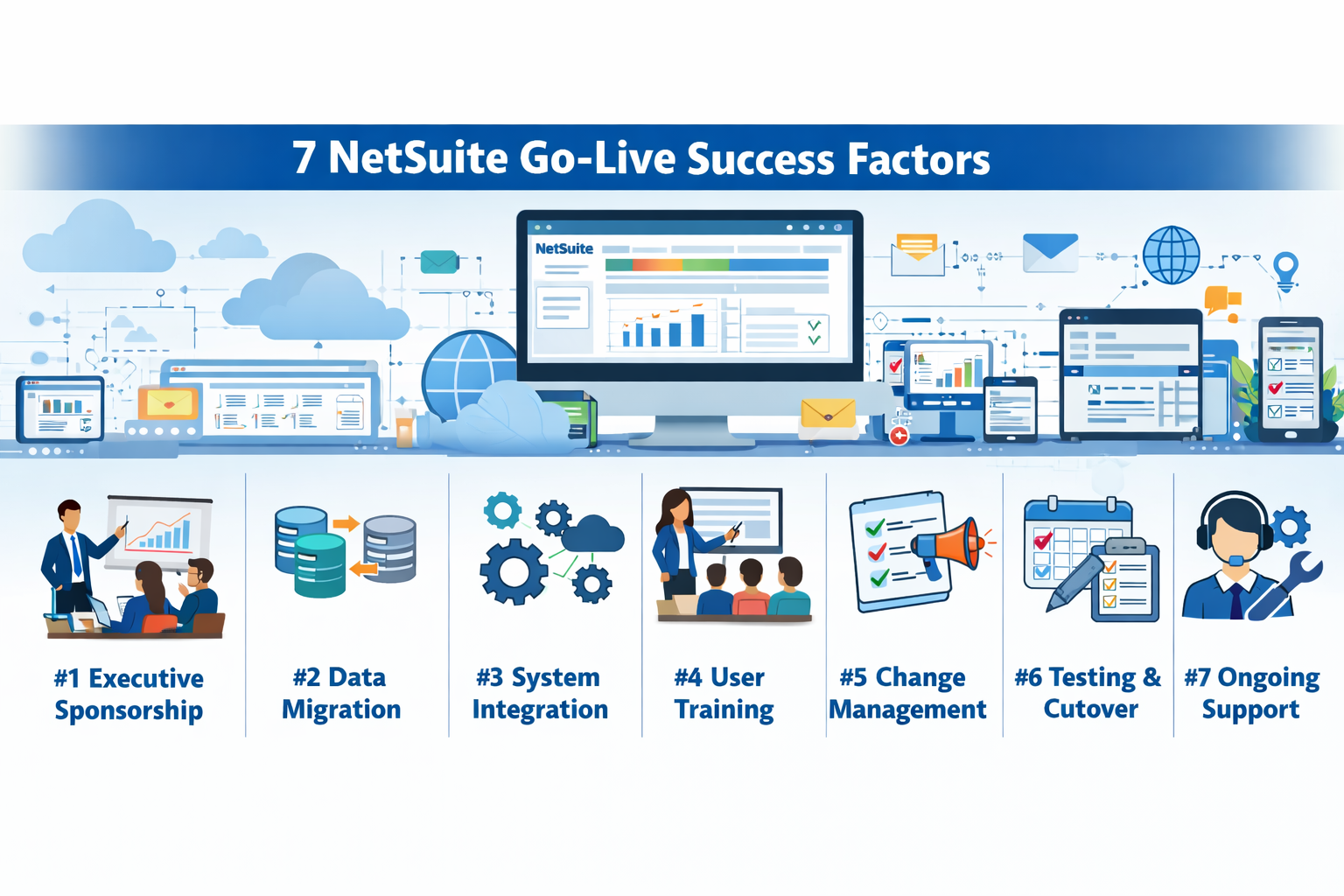
A successful NetSuite go-live is the result of many moving parts working together. Each factor below is a proven driver of ERP implementation success, and each requires careful attention from your implementation team.
#1) Executive Sponsorship and Stakeholder Alignment
Securing executive sponsorship is the foundation of every successful NetSuite implementation. When a project has a named sponsor with real decision authority, it gains the momentum and visibility needed to resolve issues quickly and keep the implementation on track. Sponsors should be present at key meetings, approve scope changes, and champion the project across departments.
Stakeholder alignment is equally important. Bringing department heads, including IT and finance, together early ensures that business processes are mapped accurately and that everyone understands the goals of the new system.
Misalignment at this stage often leads to scope creep, missed requirements, and delayed adoption. Regular check-ins and transparent communication help maintain alignment as the project evolves.
When executive sponsorship and stakeholder alignment are strong, teams move faster, make better decisions, and are more likely to achieve the metrics that define a successful NetSuite ERP implementation.
#2) Data Migration and Validation
Data migration is one of the most complex and risk-prone aspects of any ERP implementation. Inaccurate or incomplete data can undermine trust in the new system and disrupt business operations.
- Data mapping discipline: Document every data source, field, and transformation required for migration. Assign ownership for each data set and validate mapping logic with business users before any records are moved. Skipping this step leads to mismatched records and reporting errors.
- Cleansing and deduplication: Cleanse legacy data to remove duplicates, outdated records, and inconsistencies. Use automated tools where possible, but always review results manually. Poor data quality at go-live can cause immediate operational issues.
- Test migrations and UAT: Run multiple test migrations using real data, then conduct user acceptance testing on the migrated records. Require sign-off from business owners before final cutover. Without thorough testing, hidden data issues can surface after launch and disrupt critical workflows.
#3) Integration with Other Systems
Integrating NetSuite with other business systems is essential for a seamless ERP implementation. Each integration point introduces risk, complexity, and ongoing maintenance requirements.
The most successful NetSuite implementations involve early integration, defining the scope of data synchronization, and assigning clear ownership for connector maintenance and upgrade testing.
When integration is handled proactively, teams avoid the common pitfalls of lost data, broken workflows, and delayed shipments. Test transactions should be run before launch to validate that all systems communicate as expected.
For more on integration strategies, see Simplifying the Suite: NetSuite Integrations.
#4) User Training and Adoption
User adoption is a critical driver of ERP implementation success. Even the most robust NetSuite system will fall short if users are not confident, engaged, and equipped to use new workflows. NetSuite training must be tailored, ongoing, and reinforced by clear ownership. Below is a framework for structuring and validating user adoption:
| Adoption Area | What to Execute | How to Validate/Measure | Why It Matters / Risk if Skipped |
|---|---|---|---|
| Role-Based Training | Develop training modules for each user group’s daily tasks, using hands-on workshops and real scenarios | Track completion rates, quiz results, and user feedback | Generic training leads to confusion, resistance, and errors |
| Super User Program | Appoint super users in each department to provide peer support and escalate issues | Monitor support requests and peer-to-peer help rates | Without super users, adoption bottlenecks escalate to IT and slow down resolution |
| Adoption Metrics | Track login rates, transaction volumes, and error rates by user group | Review weekly in the first 90 days, adjust training as needed | Ignoring adoption metrics allows small issues to become systemic problems |
| Feedback Loops | Collect feedback through surveys and regular check-ins | Analyze feedback trends and address recurring issues | Lack of feedback leads to disengagement and missed improvement opportunities |
#5) Change Management and Communication
Change management is often underestimated in ERP projects, but it is critical to ensure a smooth transition to a new ERP like NetSuite. Effective change management starts with a clear communication plan that sets expectations, addresses concerns, and keeps all team members informed throughout the implementation process.
Leaders should establish a regular cadence for project updates, highlight quick wins, and provide a forum for users to voice concerns. Addressing resistance early, whether it’s fear of new workflows or uncertainty about job roles, prevents disengagement and workarounds that can undermine the system’s value.
When communication is transparent and two-way, users feel invested in the success of the new ERP system. This drives higher adoption rates, reduces errors, and accelerates the realization of business benefits.
#6) Testing and Cutover Planning
Testing and cutover planning are the final checkpoints before your NetSuite system goes live. Rushed or incomplete testing is a leading cause of post-launch disruptions.
- Comprehensive UAT: Involve end users in user acceptance testing for all critical workflows, including edge cases. Require sign-off before proceeding to cutover. Skipping UAT leads to missed requirements and operational surprises.
- Parallel runs and cutover checklist: Run parallel processes in both the old and new systems to validate results. Use a detailed cutover checklist to track every task, owner, and deadline. Overlooking checklist items can delay go-live or cause data loss.
- Rollback and go/no-go criteria: Define clear rollback procedures and go/no-go decision points. Assign authority for final approval. Without a rollback plan, teams may be forced to go live with unresolved issues.
#7) Ongoing Support and Optimization
Ongoing support and optimization are essential for realizing the full value of your NetSuite investment. Once your system goes live, the real work of continuous improvement begins.
The most successful organizations establish a dedicated support structure, schedule regular reviews, and maintain a living roadmap of enhancements and integrations.
This approach ensures that your NetSuite solution evolves with your business and continues to deliver measurable results.
Support Structure:
Establish a dedicated support team with clear escalation paths for issues. Document common problems and solutions in a knowledge base. Lack of support leads to user frustration and declining adoption.
Quarterly Reviews:
Schedule regular reviews of system performance, user feedback, and business metrics. Use these sessions to identify areas for improvement and prioritize enhancements. Without reviews, optimization opportunities are missed.
Enhancement Roadmap:
Maintain a prioritized list of enhancements, integrations, and new features to deploy post-go-live. Assign ownership and track progress. Neglecting the roadmap causes the system to stagnate and lose value.
For organizations that want expert guidance beyond go-live, Protelo’s NetSuite Support Services provide ongoing technical support, optimization planning, and strategic enhancements to help your system continuously evolve with your business.
Advanced Readiness Assessment
A thorough readiness assessment is the foundation of your NetSuite implementation plan. It uncovers hidden risks, clarifies business processes, and ensures your team is prepared for every phase of the implementation project.
- Business process review: Map out all core workflows, such as procure-to-pay, order-to-cash, and inventory management. Identify manual bottlenecks, duplicate steps, and automation opportunities. This step ensures your NetSuite solution is configured to streamline business processes and maximize ROI.
- Workflow documentation: Use tools like NetSuite’s Business Process Questionnaire (BPQ) to document workflows in detail. Involving department leads and IT to capture every requirement and risk. Incomplete documentation leads to missed requirements and costly rework.
- Ownership and accountability: Assign clear ownership for each process, data set, and integration point. Owners are responsible for validation, sign-off, and ongoing optimization. Without ownership, issues linger, and accountability is lost.
How to Evaluate and Select an Experienced NetSuite Partner

Selecting an experienced NetSuite consultant is one of the most important decisions in your ERP journey. The right partner accelerates your implementation, helps you avoid costly mistakes, and provides ongoing support that ensures your system evolves with your business. The wrong partner can lead to missed requirements, scope creep, and a lack of post-go-live optimization.
Assessing Implementation Methodology
Start by examining each partner’s implementation methodology. Look for a structured, configuration-first approach that prioritizes industry best practices and upgrade-safe customizations. Ask for documentation and references to verify their process. A partner with a proven methodology will help your implementation stay on track and avoid unnecessary complexity.
Evaluating Industry Experience
Industry experience is another critical factor. Partners who have worked with organizations similar to yours will understand your unique requirements and can offer insights that accelerate your go-live. Request client references and case studies to confirm their expertise.
Reviewing Post-Go-Live Services
Post-go-live services are equally important. Review each partner’s support SLAs, enhancement logs, and approach to ongoing optimization. A partner who offers robust support and continuous improvement will help you maximize your NetSuite investment for years to come.
Communication and Ownership Structure
Finally, assess their communication style and ownership structure. Meet the project manager and review escalation processes to ensure you have clear points of contact and accountability.
For more on partner evaluation, see How to Choose the Best NetSuite Partner for a Successful ERP Implementation.
Phased Rollout and Module Selection: Building for Long-Term Success
A phased rollout strategy can be a powerful way to reduce risk, accelerate time-to-value, and ensure your NetSuite implementation delivers results at every stage. Rather than launching every module and feature at once, many organizations benefit from prioritizing core functionality and adding advanced capabilities in later implementation phases.
If your business operates across multiple entities or regions, consider phasing your rollout by subsidiary or geography. This approach prevents teams from becoming overwhelmed and allows you to address unique requirements in each area.
For organizations with high customization needs, starting with core modules and adding advanced features later can help you avoid delays and budget overruns. Limited internal resources are another trigger for a phased approach. By focusing on must-have modules in phase one, you can drive adoption and build momentum before expanding the system.
Regulatory deadlines may also dictate your rollout strategy. Deploy compliance-critical modules first to mitigate risk and ensure audit readiness. Throughout the process, maintain a clear roadmap and communicate priorities to all stakeholders.
Metrics to Track After NetSuite Go-Live
Tracking the right metrics after your NetSuite system goes live is essential for long-term success. These metrics provide early warning signs of adoption issues, process bottlenecks, and missed ROI targets. A disciplined approach to measurement helps you identify areas for improvement and sustain momentum after launch.
Adoption and Usage Metrics
Adoption metrics such as login frequency, transaction volumes, and error rates by user group reveal how well your team is embracing the new system. High adoption rates indicate effective training and change management, while low rates signal the need for additional support or process adjustments.
Monitoring these metrics weekly in the first 90 days helps you identify and address issues before they become systemic. In some organizations, tracking adoption by department or location can uncover pockets of resistance or training gaps that might otherwise go unnoticed.
Process Efficiency and Business Impact
Process efficiency metrics, such as order-to-cash cycle time, inventory accuracy, and monthly close duration, show whether your NetSuite implementation is delivering on its promise to streamline operations. Compare these metrics to pre-implementation baselines to quantify improvements and justify your investment in NetSuite.
Regularly reviewing these KPIs with department heads ensures accountability and continuous optimization. Over time, you may want to expand your metrics to include customer satisfaction, on-time delivery rates, or other business-specific outcomes that reflect the broader impact of your ERP system.
Support and Optimization Metrics
Support metrics, including the number and type of help desk tickets, average resolution time, and user satisfaction scores, provide insight into ongoing challenges and areas for improvement.
Tracking enhancement requests and completed optimizations helps you prioritize future investments and maintain momentum after go-live. Some organizations also track the time to resolve critical issues or the percentage of enhancements delivered on schedule as part of their ongoing optimization strategy.
For more on post-go-live metrics, see Measuring Success: Key Metrics to Track After NetSuite Go-Live.
Risk Management Frameworks
Proactive risk management is essential for a successful go-live implementation. The following are some of the most common risks and how to address them before they escalate.
Insufficient Executive Buy-In
When executive sponsors are disengaged or miss key meetings, projects lose momentum and decisions stall. Assign a backup sponsor and escalate to leadership if engagement drops. Regularly review project status with executives to maintain visibility and authority.
Inadequate Training and Onboarding
Low adoption and frequent errors are often signs that users haven’t received enough training. Increase training frequency, appoint super users, and provide hands-on workshops to build confidence. Monitor adoption metrics and adjust your approach as needed.
Data Migration Errors
Incomplete mapping or skipped UAT can lead to reporting issues and compliance risks. Run multiple test migrations, require business sign-off, and validate data accuracy before cutover. Assign clear ownership for each data set to ensure accountability.
Integration Failures
Unclear ownership or missed testing can disrupt workflows and result in lost data. Assign an integration lead, inventory all systems, and validate with test cases before launch. Document responsibilities and escalation paths for ongoing maintenance.
Partner Misalignment
Poor communication or unclear roles can cause missed deadlines and budget overruns. Hold weekly status reviews, clarify escalation processes, and ensure your partner provides a named project manager.
For more on rescuing troubled projects, see Off-track ERP project? Steps to rescue a NetSuite implementation.
Post-Go-Live Optimization Roadmap
Optimization and implementation are ongoing processes that drive long-term value from your NetSuite investment. The most successful organizations treat optimization as a continuous project, not a one-time event.
- Quarterly KPI reviews: Schedule quarterly reviews to assess adoption, efficiency, and business impact. Use these sessions to identify areas for improvement and set new targets. Without regular reviews, optimization opportunities are missed.
- Enhancement prioritization: Maintain a living roadmap of enhancements, integrations, and new features. Prioritize based on business impact and user feedback. Assign clear ownership for each initiative to ensure accountability.
- Continuous training and support: Offer ongoing training and support to ensure users stay current with new NetSuite features and best practices. Regularly update documentation and provide refresher workshops. Neglecting ongoing training leads to declining adoption and missed ROI.
Common Go-Live Pitfalls and How to Avoid Them
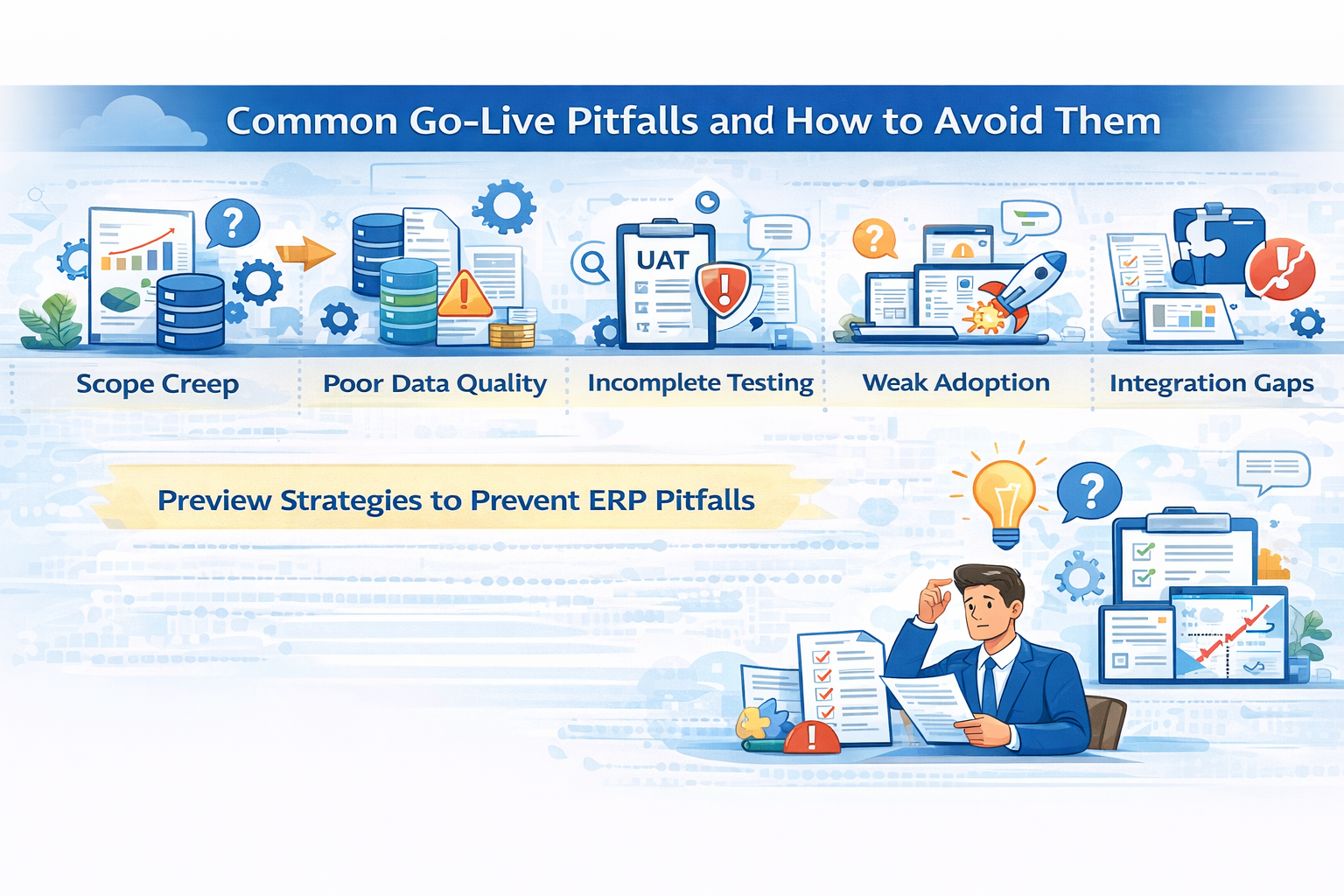
Every NetSuite implementation faces challenges, but the most common pitfalls can be anticipated and addressed with the right strategies.
| Pitfall | Scenario/Trigger | Impact If Unmanaged | Solution/Action to Prevent or Fix |
|---|---|---|---|
| Scope Creep | Uncontrolled change requests, unclear requirements | Budget overruns, delayed go-live | Implement formal change control, require executive sign-off, document all changes, and review the project baseline regularly |
| Poor Data Quality | Skipped cleansing, rushed mapping, legacy data issues | Inaccurate reporting, user distrust | Cleanse all legacy data, run multiple test migrations, require business sign-off, and assign data owners for validation |
| Incomplete Testing | Rushed UAT, skipped edge cases, limited user involvement | Post-launch disruptions, missed requirements | Conduct comprehensive UAT, run parallel processes, establish a rollback plan, and assign authority for go/no-go decisions |
| Weak Adoption | Insufficient training, unclear roles, lack of super users | Low usage, workarounds, resistance | Deliver role-based training, appoint super users, gather regular feedback, monitor adoption metrics, and adjust as needed |
| Integration Gaps | Missed systems, unclear ownership, and late integration planning | Broken workflows, lost data | Inventory all integrations early, assign clear connector ownership, validate with test transactions, document responsibilities for ongoing maintenance, and escalation |
Make Every Go-Live Count—Own the Outcome
A successful NetSuite go-live is the result of operational discipline, clear ownership, and relentless focus on execution. Every decision you make before, during, and after launch shapes the long-term value of your ERP system.
- Assign executive sponsors and process owners with real authority to drive accountability and resolve issues quickly.
- Validate data, integrations, and user readiness through rigorous testing and sign-off before cutover.
- Schedule quarterly reviews and maintain an enhancement roadmap to ensure your NetSuite solution evolves with your business.
Protelo’s NetSuite Implementation Services are built on these principles, with a proven track record of helping organizations achieve measurable results. If you want to ensure your NetSuite implementation delivers ongoing success, schedule a consultation with our experts today.
FAQs
Where do hidden NetSuite go-live risks usually show up first?
Hidden risks often surface during data migration, integration testing, or user acceptance testing. Issues like incomplete data mapping, missed integration points, or low user adoption can disrupt operations if not addressed before go-live.
What are the most important metrics to track after go-live?
Key metrics include user adoption rates, process efficiency (such as order-to-cash cycle time), error rates, support ticket volume, and business impact KPIs like inventory accuracy and monthly close duration.
How does change management impact NetSuite implementation success?
Effective change management ensures users are informed, engaged, and confident in the new system. It reduces resistance, accelerates adoption, and helps teams realize the full value of NetSuite features.
What is the role of user acceptance testing in go-live?
Acceptance testing validates that the system meets business requirements and that users can perform their daily tasks. It is the final checkpoint before cutover and helps prevent post-launch disruptions.
How can ongoing support improve NetSuite adoption?
Ongoing support provides users with timely answers, troubleshooting, and training. It helps resolve issues quickly, maintains high adoption rates, and ensures the system continues to deliver value.
What should you look for in a NetSuite implementation partner?
Look for a partner with a proven methodology, relevant industry experience, strong post-go-live support, and a balanced approach to configuration and NetSuite customization. Verify references and ensure clear communication and ownership throughout the project.