

15 min read

Companies evaluating enterprise software often compare NetSuite and Workday because both support financial management for growing organizations. The key difference is how each platform extends beyond accounting. NetSuite connects financials with operations, customer relationships, inventory, and supply chain within a single system. Workday is primarily focused on financial planning and human capital management, supporting workforce and organizational planning within enterprise environments.
Both platforms support core accounting, but they differ in how they extend into the business. NetSuite extends into operational processes such as inventory, order management, and customer data, while Workday extends into workforce planning and organizational structure. The decision often comes down to whether operational execution or workforce planning is the primary driver of the system.
This guide covers:
-
How NetSuite and Workday differ in operational scope, financial tools, workforce management, and ERP implementation approach
-
Cost structure differences between NetSuite subscription pricing and Workday enterprise licensing without unsupported estimates
-
Which business types benefit from NetSuite's operational breadth or Workday's finance and HR functionality
P.S. Moving from legacy systems or consolidating platforms requires structured data migration and planning. Protelo provides NetSuite Implementation Services to help businesses transfer financial, operational, and customer data into NetSuite.
Schedule a consultation to review migration scope and implementation readiness.
TL;DR: Workday vs NetSuite ERP
NetSuite vs Workday: The Core Differences That Actually Matter
Workday and NetSuite can both support finance teams, but they are built around different centers of gravity. That difference affects how each platform fits into the rest of the business, what teams rely on it most, and where companies may need additional tools. For buyers comparing the two, the real question is not whether both can handle accounting. It is in which system aligns better with the operational model of the business.
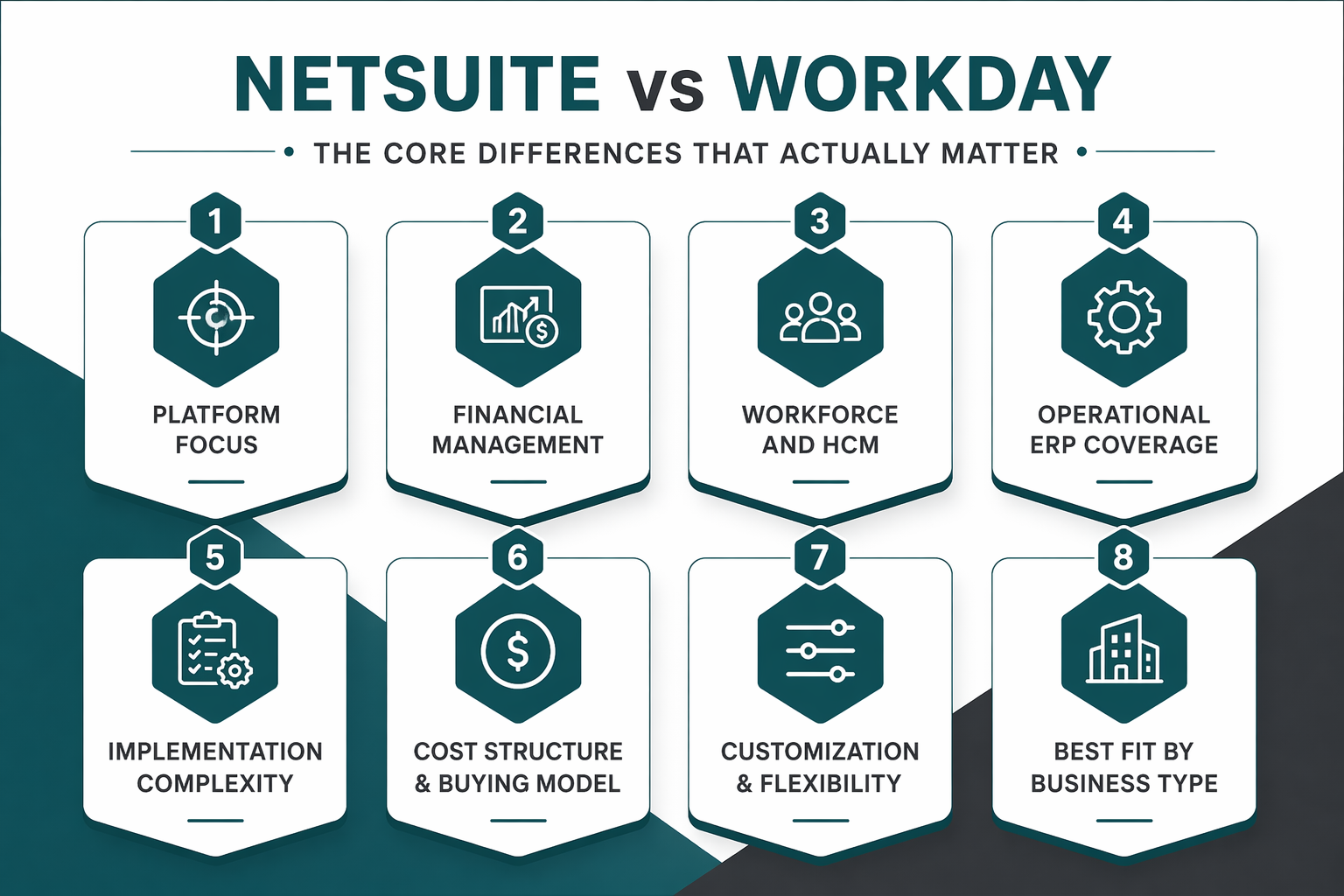
Platform Focus
NetSuite is built as a cloud ERP platform designed to run end-to-end business operations across finance, inventory, CRM, procurement, and supply chain within a unified system. It provides a single source of truth across operational and financial data, which is particularly valuable for companies managing products, customers, and fulfillment in real time.
Workday is built around human capital management and financial planning, with a strong emphasis on workforce structure, compensation planning, and enterprise HR processes. It is commonly used in organizations where workforce data is central to financial planning and organizational decision-making.
The difference is crucial to evaluate because these platforms do not extend in the same direction. NetSuite reaches further into operational execution, while Workday reaches further into people management and planning. As a result, a company may find that one platform covers a core business need directly, while the other requires added tools or integrations to fill the gap.
Financial Management
Finance teams typically evaluate ERP systems based on how financial data connects to the broader organization, including operations, workforce planning, and reporting structure. NetSuite and Workday both handle core accounting, but they differ in what other systems they unify financial data with.Most finance teams evaluate ERP systems based on reporting speed, multi-entity consolidation, and how accounting connects to the rest of the business. NetSuite ERP and Workday both handle core accounting, but they connect financial data to different systems.
NetSuite:
-
Multi-Entity Consolidation: Supports intercompany accounting, multi-currency transactions, and real-time reporting across subsidiaries without manual reconciliation.
-
Operational Integration: Financial data flows from inventory, orders, and customer records automatically, eliminating batch imports or middleware.
-
Revenue Recognition and Billing: Includes tools for subscription billing, deferred revenue, and compliance with ASC 606 for businesses with recurring revenue.
NetSuite connects accounting to operations. Businesses managing products, fulfillment, or customer transactions benefit from having financial and operational data in the same system.
Workday:
-
Financial Planning and Analysis: Ties budgeting to workforce planning, so headcount changes, compensation adjustments, and organizational shifts update financial forecasts automatically.
-
Enterprise Governance: Supports approval workflows, audit trails, and compliance reporting for large enterprises with formal financial controls.
-
Workforce-Linked Budgeting: Financial plans reflect employee costs in real time, which matters when payroll represents a large portion of operating expenses.
Workday connects accounting to workforce management. Enterprises with complex HR structures and formal governance benefit from having finance and workforce data in the same system.
Workforce and HCM
HR complexity shapes software decisions when workforce size, global operations, or talent management become central to how the business runs. NetSuite and Workday take different approaches to workforce management.
NetSuite:
-
Basic HR and Payroll: Includes employee records, time tracking, and payroll processing to support operational workflows, but is not designed as the primary HR system.
-
Operational Workforce Tracking: Connects employee time and labor costs to projects, manufacturing orders, and service delivery for better cost allocation.
Workday:
-
Enterprise HCM: Provides talent acquisition, performance management, succession planning, and learning management for large enterprises with formal HR processes.
-
Global Workforce Management: Supports multi-country payroll, localized compliance, and global organizational structures for businesses managing employees across jurisdictions.
-
Workforce Planning and Analytics: Ties workforce data to financial planning, so scenario analysis reflects headcount changes, compensation adjustments, and organizational restructuring.
The decision depends on whether workforce management is central to the business or secondary to operations. Workday delivers enterprise HR. NetSuite delivers operational ERP with supporting HR tools.
Operational ERP Coverage
The gap in operational coverage is the biggest structural difference. NetSuite provides a comprehensive ERP solution for businesses managing products and customers, whereas Workday requires separate systems for operations.
NetSuite:
-
Native CRM: Includes sales automation, lead tracking, opportunity management, and customer service tools, so customer data flows directly into accounting and fulfillment.
-
Inventory and Order Management: Supports multi-location inventory, lot and serial tracking, demand planning, and warehouse management with real-time visibility into stock and orders.
-
Supply Chain Management: Handles procurement, purchase orders, vendor management, and shipping integration, connecting supply chain processes with accounting and inventory.
Workday:
-
Limited Operational Scope: Does not include CRM, inventory management, or supply chain tools. Businesses needing these capabilities must integrate third-party systems.
-
Finance and Workforce Focus: Strength lies in financial planning and human capital management, not operational processes.
Implementation Complexity
Implementation difficulty depends on what's being rolled out, how much data needs to move, and how many departments are involved. NetSuite and Workday projects face different complexity drivers.
NetSuite:
-
Cross-Functional Rollout: Complexity grows when rolling out finance, CRM, inventory, and supply chain together. More departments mean more data migration, integration, and training.
-
Operational Data Migration: Moving product data, customer records, transaction history, and inventory balances from legacy systems requires planning and validation.
-
Integration Count: Businesses replacing multiple systems with NetSuite often need to connect e-commerce platforms, logistics providers, and specialized tools.
Workday:
-
Finance and Workforce Transformation: Projects focus on financial planning, organizational structures, and HR processes. Rollout involves organizational change management, especially when replacing legacy HR and payroll systems.
-
Global Workforce Considerations: Implementing across multiple countries requires localized payroll configuration, compliance validation, and coordination with regional HR teams.
-
Standardized Workflows: Workday uses best-practice workflows with limited customization. Businesses with unique processes may need to adapt operations to fit Workday's structure.
Cost Structure and Buying Model
Understanding the full investment requires separating software costs from implementation services, integration work, and ongoing support. Subscription pricing alone doesn't show the total cost of ownership.
Note: All pricing figures are directional estimates, not fixed rates. Total cost depends on factors such as modules, number of users or employees, integrations, and implementation complexity. Both NetSuite and Workday typically require custom pricing based on business requirements.
Buyers should compare the cost structure by separating the Year 1 investment from recurring costs. NetSuite pricing reflects operational breadth and module selection. Workday investment reflects enterprise licensing and workforce-focused rollout. Both platforms require implementation services, integration work, and ongoing support beyond the software subscription.
Customization & Flexibility
NetSuite supports process changes through configuration, custom fields, workflows, and SuiteScript development. Businesses with unique operational requirements can adapt NetSuite to fit specific workflows without replacing core functionality.
Customization is common in industries with specialized inventory tracking, complex billing models, or non-standard approval processes. However, excessive customization increases implementation cost, testing burden, and upgrade complexity. Buyers should evaluate whether process variation is necessary or whether standard workflows meet specific needs.
Workday uses standardized workflows with limited customization outside core financial and HR modules. The platform is built around best-practice processes, and businesses are expected to adapt operations to fit Workday's structure. Customization is available through Workday Studio and third-party extensions, but it's less common and more tightly controlled than in NetSuite.
Enterprises with formal governance and standardized processes often benefit from Workday's structure. Businesses requiring significant process flexibility may find Workday's constraints limiting.
The fit depends on whether the business prioritizes process adaptability or standardized workflows. NetSuite offers greater flexibility for operational customization. Workday offers greater structure for financial and workforce governance.
Best Fit by Business Type
Company size doesn't settle the comparison. The better fit depends on what the business manages and where operational or workforce complexity creates the biggest challenges.
Product-Centric and Distribution Operations:
NetSuite fits businesses managing physical products, inventory, and fulfillment. Companies in wholesale distribution, manufacturing, retail, and e-commerce benefit from NetSuite's native inventory management, order processing, and supply chain tools. The integration of CRM, financials, and operations reduces reliance on third-party systems.
Service-Heavy and Workforce-Heavy Organizations:
Workday fits businesses where workforce costs, talent management, and organizational structure drive financial planning. Professional services firms, consulting organizations, and large enterprises with complex HR processes benefit from Workday's depth in human capital management and workforce analytics.
Large Enterprises with Formal Governance:
Both platforms serve large enterprises, but the better fit depends on priorities. Enterprises prioritizing operational breadth, multi-location inventory, and customer relationship management lean toward NetSuite. Enterprises prioritizing financial planning, global workforce management, and HR governance lean toward Workday.
Multi-Entity and Global Operations:
NetSuite supports multi-entity consolidation, intercompany transactions, and multi-currency financials, making it a strong fit for businesses managing subsidiaries, international operations, and cross-border transactions. Workday supports global workforce management and localized payroll, making it a strong fit for enterprises managing employees across multiple countries.
Mixed Cases:
Some large enterprises evaluate both platforms and choose based on whether the primary pain point is operational fragmentation or workforce complexity. Businesses managing both products and large workforces may implement NetSuite for operations and integrate Workday for HR, though this increases integration complexity and cost.
The better fit depends on whether the business prioritizes operational ERP coverage or finance and workforce alignment.
Read Next: Top 14 NetSuite Competitors for ERP Buyers in 2026
Choose NetSuite If:
Your business manages products, inventory, or customer relationships and needs an ERP system that connects finance, CRM, and supply chain in one platform. NetSuite fits companies in distribution, manufacturing, retail, ecommerce, and professional services where operational processes drive business performance. The platform supports multi-location inventory, order management, warehouse management, and demand planning, reducing reliance on third-party systems. NetSuite provides real-time visibility into operational and financial data, enabling faster decisions and reducing manual reconciliation.
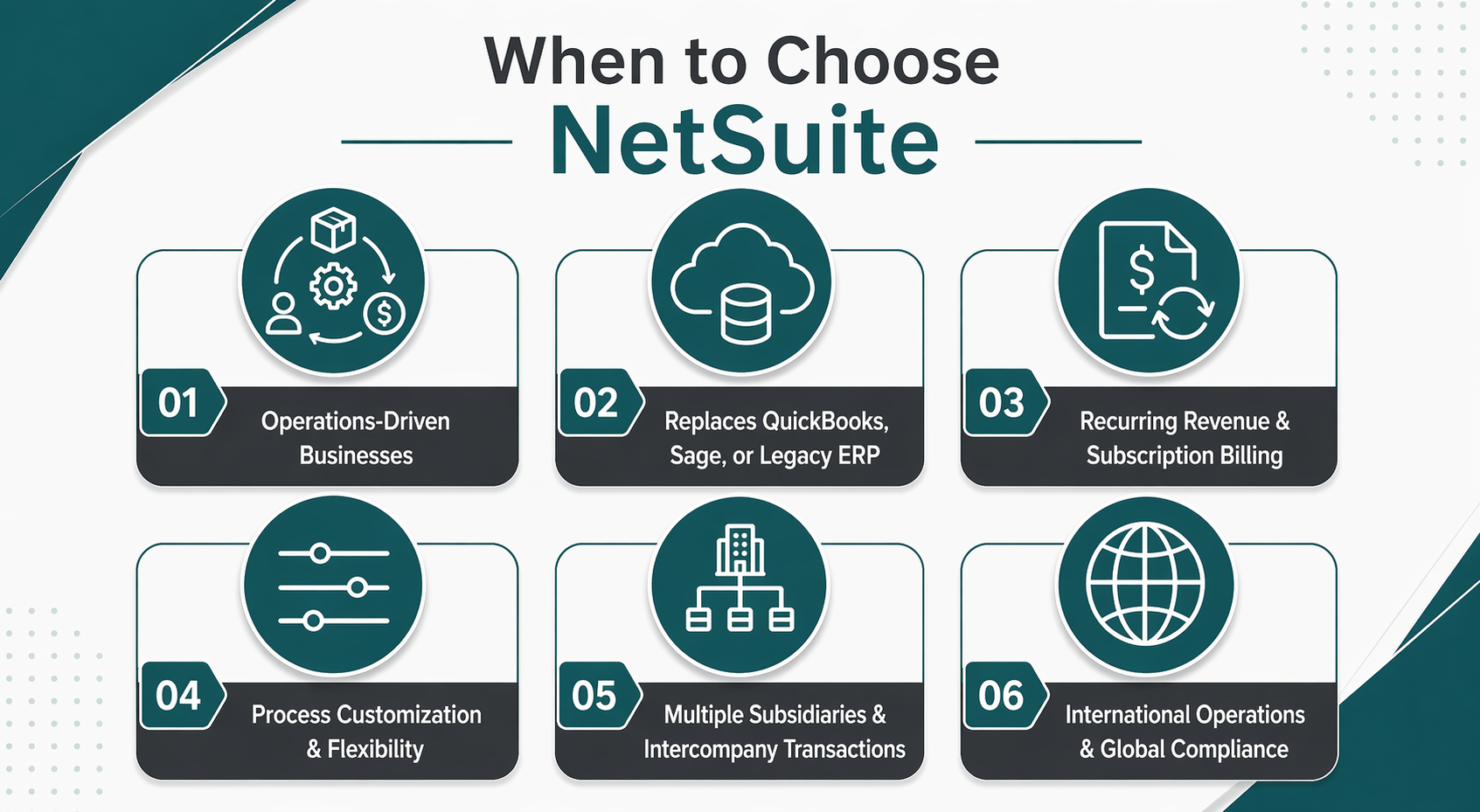
NetSuite is the better choice when operations matter more than workforce depth. Businesses replacing QuickBooks, Sage, or legacy ERP systems benefit from NetSuite's ability to consolidate financials, CRM, and inventory into one cloud-based ERP system.
Companies with recurring revenue models, subscription billing, or complex revenue recognition requirements benefit from NetSuite's financial management and native billing capabilities. NetSuite offers flexibility for process customization, making it a better fit for businesses with unique workflows or industry-specific requirements.
Additionally, NetSuite fits businesses managing multiple subsidiaries, intercompany transactions, or international operations. The platform supports multi-currency financials, multi-entity consolidation, and global tax compliance, reducing the complexity of managing cross-border operations.
Read Next:
Choose Workday If:
Workday is typically considered by organizations where human capital management and workforce planning are the primary drivers of the business system. It is most often used by large, global enterprises with highly structured HR processes, complex organizational hierarchies, and a strong focus on talent management, compensation planning, and workforce analytics.
Workday is well-suited for environments where finance and HR are tightly connected and where planning is centered around headcount, compensation, and organizational modeling. Its strength lies in providing depth in workforce-related insights and standardized processes that support governance and consistency across large teams.
However, because Workday is primarily designed around HR and financial planning, many organizations rely on additional systems to manage operational areas such as order management, inventory, supply chain, and customer relationships. This can result in a more distributed application landscape where core business functions are managed across multiple platforms.
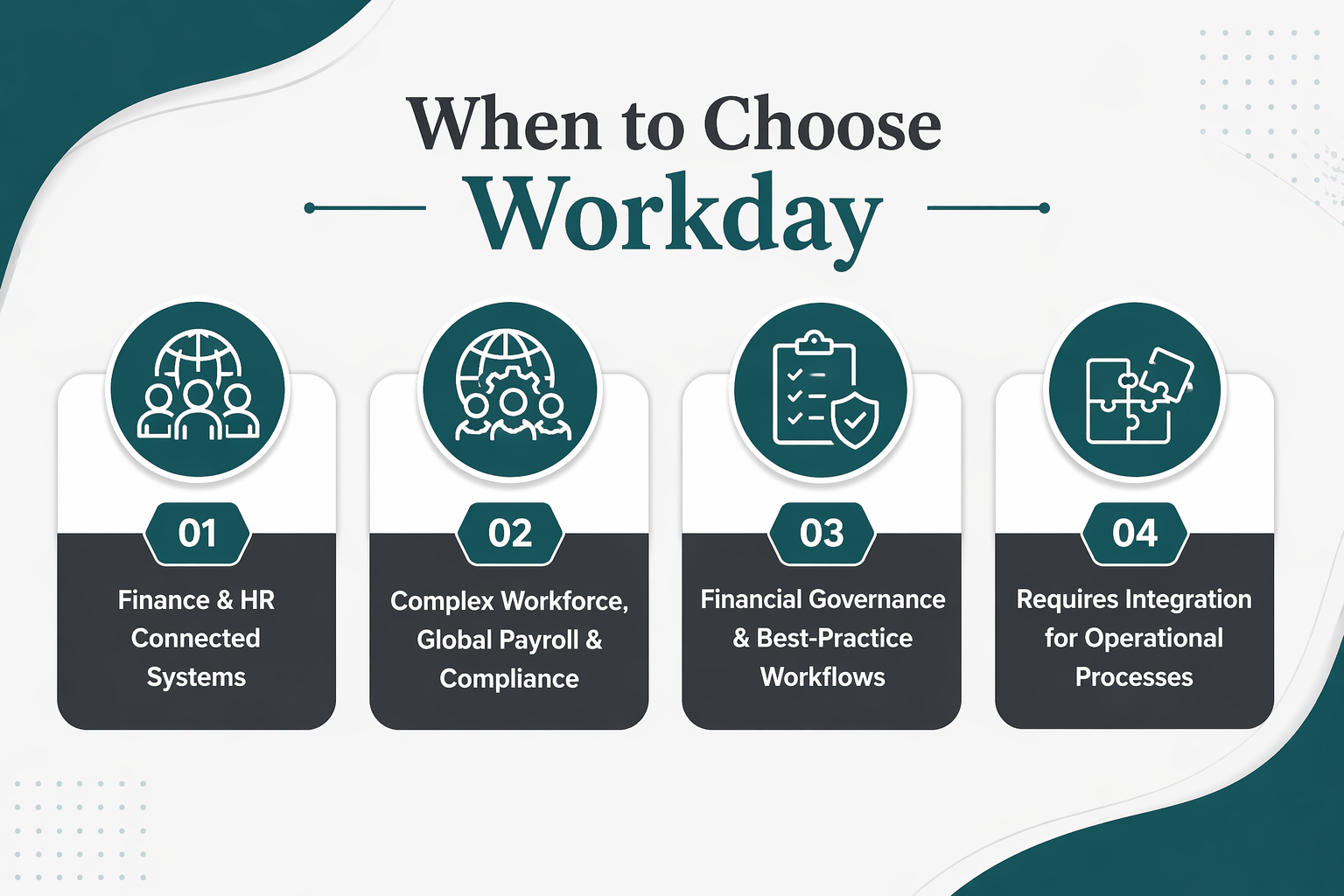
For organizations where workforce management is the central strategic focus, Workday can be a strong fit. For businesses that require a more unified approach—connecting financials, operations, and customer data in a single system—other ERP platforms such as NetSuite are often evaluated as part of a broader operational strategy.
Your business prioritizes financial planning and human capital management, and workforce complexity drives the software decision. Workday fits large enterprises with thousands of employees, global operations, and formal HR processes. The platform excels in workforce planning, talent management, succession planning, and organizational analytics, providing depth in human resource management. Workday ties financial planning directly to workforce data, enabling scenario modeling that reflects headcount changes, compensation adjustments, and organizational restructuring in real time.
Which Platform Delivers Better Long-Term Fit?
NetSuite typically serves as the operational system of record, while Workday is often part of a broader enterprise application landscape focused on workforce planning. The better long-term fit depends less on feature overlap and more on what the business needs the system to anchor. Since both platforms offer core financial management capabilities, the more important distinction is where each one extends and how well that matches the company’s operating model, growth plans, and internal structure.
Key Takeaways:
-
NetSuite provides operational breadth for businesses managing products, inventory, and customer relationships; Workday provides workforce depth for enterprises prioritizing HR and financial planning.
-
Implementation complexity scales with operational scope for NetSuite and workforce complexity for Workday; cost structure depends on modules, integration requirements, and organizational change.
-
Choosing the right ERP depends on whether the business prioritizes operational integration or finance and workforce alignment.
Businesses evaluating NetSuite and Workday often face data migration, system consolidation, and integration planning challenges. Protelo provides NetSuite Implementation Services to help businesses move financial, operational, and customer data into NetSuite.
Schedule a consultation to evaluate platform fit and implementation planning.
Read Next: Top 14 NetSuite Competitors Compared
FAQs
What is the main difference between NetSuite and Workday?
NetSuite is a cloud ERP that serves as the operational system of record across finance, CRM, inventory, and supply chain. Workday is primarily focused on financial planning and human capital management, supporting workforce planning and enterprise HR. NetSuite provides end-to-end operational and financial visibility in a single system, while Workday is typically used in organizations where workforce planning is the central focus.
Can Workday replace NetSuite for operational processes?
Workday does not include native CRM, inventory, or supply chain capabilities, and these functions are typically managed through separate systems that integrate with the platform. This creates a more distributed application environment for organizations with operational requirements beyond HR and financial planning.Workday does not include native CRM, inventory management, or supply chain tools. Businesses requiring these capabilities must integrate third-party systems, increasing implementation complexity and cost. NetSuite provides comprehensive operational ERP coverage in a single platform.
Which platform is better for large enterprises?
Both platforms serve large enterprises, but the better fit depends on business priorities. Enterprises prioritizing operational breadth, multi-location inventory, and customer relationship management lean toward NetSuite. Enterprises prioritizing financial planning, global workforce management, and HR governance lean toward Workday.
Does NetSuite offer HR and payroll functionality?
NetSuite offers basic HR modules for employee records, time tracking, and payroll processing, but these are designed to support operational workflows rather than serve as the primary HCM system. Workday provides enterprise-grade human capital management with depth in talent management, succession planning, and global workforce management.
Which platform is easier to implement?
Implementation complexity depends on project scope. NetSuite implementations scale with operational breadth, including data migration for products, customers, and inventory. Workday implementations focus on finance and workforce transformation, involving organizational change management and global rollout coordination. Both require structured planning and partner support.