

17 min read


Choosing between Sage Intacct and NetSuite often comes down to a single question: does your business need a finance-first accounting system with surrounding integrations, or a broader ERP platform that manages operations, inventory, CRM, and financials in one environment? NetSuite and Intacct are cloud-based ERP software solutions with strong reputations, but they serve different operational models.
NetSuite integrates financials, operations, CRM, e-commerce, inventory, and supply chain into one platform. Sage Intacct focuses primarily on financial management and accounting, with integrations to handle surrounding business processes.
The wrong choice can lead to integration sprawl, higher total cost of ownership, or a system that doesn't scale with your business.
This comparison guide covers:
-
How NetSuite and Sage Intacct differ in financial management, operations, and ERP scope
-
Pricing models, implementation complexity, and total cost of ownership for both platforms
-
When each system is the better fit based on process scope and growth plans
P.S. Comparing NetSuite and Sage Intacct requires understanding how each platform fits your operational model and growth trajectory. Protelo is an award-winning NetSuite Partner with 500+ successful ERP projects and 500,000+ hours of NetSuite consulting experience, providing NetSuite Implementation Services, customization, post-go-live support, and long-term optimization to help businesses deploy and scale cloud ERP solutions.
Migrate to NetSuite to unify financials, operations, and growth planning in one platform.
Sage Intacct vs NetSuite: Comparison Highlights
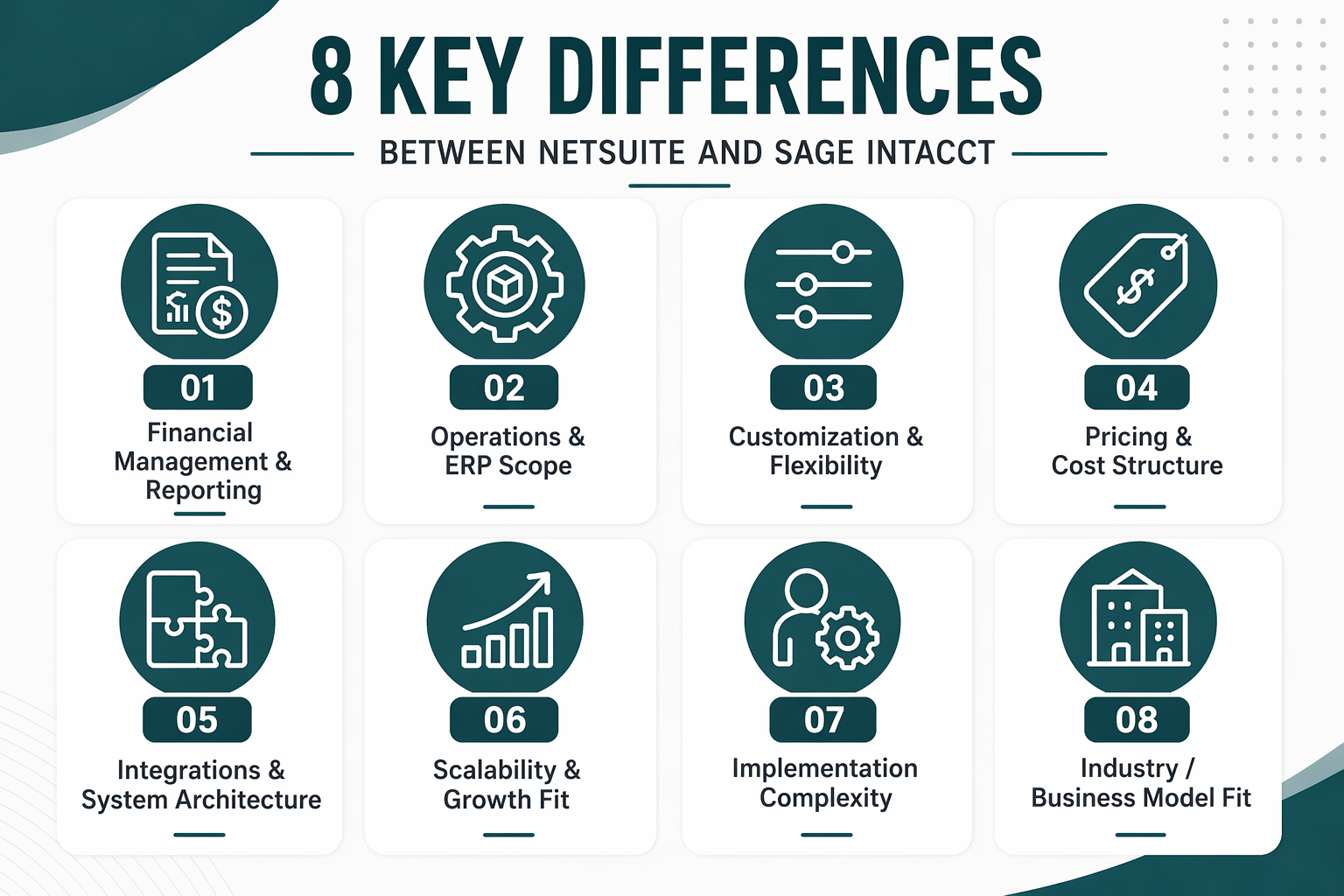
8 Key Differences Between NetSuite and Sage Intacct
Both Sage Intacct and Oracle NetSuite offer strong financial management capabilities, but NetSuite extends into broader enterprise resource planning while Sage Intacct remains focused on accounting and financial reporting. Understanding the core differences helps businesses avoid choosing a system that either carries unnecessary complexity or requires too many integrations to support daily operations.
#1) Financial Management & Reporting
Both Intacct and NetSuite deliver strong financial management capabilities, but they approach accounting depth and operational integration differently. Sage Intacct is designed primarily as a best-in-class accounting software platform with deep financial reporting, multi-entity consolidation, and dimension-based tracking.
It handles general ledger, accounts payable, accounts receivable, cash management, and financial close processes with flexibility that appeals to finance-led organizations. Sage Intacct offers strong support for project accounting, revenue recognition, and subscription billing, making it a solid fit for service-based businesses and nonprofits that prioritize accounting-system depth over broader operational coverage.
NetSuite, on the other hand, provides comprehensive financial management as part of a broader ERP solution. It includes general ledger, accounts payable, accounts receivable, fixed assets, revenue recognition, and multi-currency support, but it also connects those financials directly to inventory, order management, CRM, and supply chain workflows. The platform delivers real-time data across departments, which reduces the need for manual reconciliation between systems. For businesses that need financial visibility tied to operational activity, such as manufacturers tracking cost of goods sold or distributors managing landed costs, NetSuite's integrated approach reduces data silos and improves accuracy.
The decision often turns on whether financial reporting alone drives the ERP purchase or whether the business needs financials to work seamlessly with inventory, fulfillment, and customer data.
#2) Operations & ERP Scope
The most significant difference between NetSuite and Sage Intacct lies in operational scope. NetSuite is a full ERP system that manages business processes across finance, operations, inventory, CRM, and e-commerce. Sage Intacct focuses on financial management and relies on third-party integrations to handle non-financial workflows.
NetSuite:
-
Inventory Management: Tracks inventory across multiple locations, supports lot and serial tracking, manages reorder points, and integrates with warehouse management and fulfillment workflows.
-
Order Management: Handles sales orders, purchase orders, drop shipments, and order fulfillment natively within the ERP system.
-
CRM: Includes customer relationship management, sales pipeline tracking, opportunity management, and marketing automation as part of the core platform.
-
E-commerce: Offers SuiteCommerce for integrated online storefronts that sync inventory, pricing, and customer data in real time.
-
Supply Chain: Manages procurement, vendor relationships, demand planning, and supply chain visibility without requiring external systems.
Businesses using NetSuite can manage order-to-cash and procure-to-pay processes within one system, reducing the need for connectors and manual data transfers.
Sage Intacct:
-
Financial Management Focus: Delivers core accounting, general ledger, accounts payable, accounts receivable, and cash management without native inventory or order management capabilities.
-
CRM Integration: Relies on third-party CRM systems like Salesforce for customer relationship management, sales pipeline tracking, and opportunity management.
-
E-commerce Integration: Connects to e-commerce platforms like Shopify or BigCommerce through integrations rather than offering native online storefront capabilities.
-
Inventory Integration: Requires third-party inventory management tools for warehouse operations, stock tracking, and fulfillment coordination.
-
Best-Of-Breed Model: Allows businesses to keep existing operational tools while upgrading financial management, which works well for organizations with established toolsets.
Sage Intacct's approach works well for businesses that already use specialized tools and want to keep their existing operational stack while upgrading financial management.
Read Next: Top 14 NetSuite Competitors for ERP Buyers in 2026
#3) Customization & Flexibility
Customization needs vary based on how closely a business's workflows align with standard ERP processes. NetSuite delivers extensive customization capabilities through SuiteScript, SuiteFlow, and SuiteBuilder, which allow businesses to automate workflows, create custom fields, build approval routing logic, and modify forms and records without leaving the platform.
NetSuite's customization tools support complex business rules, multi-step approval processes, and automated notifications, which make it a strong fit for businesses with unique operational requirements.
Sage Intacct also provides customization through its platform, but deeper workflow automation often requires third-party tools or custom development. Intacct supports custom dimensions, user-defined fields, and configurable dashboards, which work well for financial reporting and accounting flexibility.
However, businesses that need to automate cross-functional workflows, such as routing purchase orders based on department, project, and approval thresholds, may find that Sage Intacct's native customization options are more limited than NetSuite's.
#4) Pricing Model & Cost Structure
Understanding how software licensing, implementation services, and ongoing system maintenance costs differ between the two platforms helps businesses budget accurately and avoid underestimating long-term expenses.
Sage Intacct:
-
Annual subscription: $15,000–$30,000 (mid-sized organizations)
-
Implementation costs: $10,000–$75,000 (average $30,000–$50,000)
NetSuite:
-
Annual cost: $30,000–$55,000 (small businesses, 1–10 users), $60,000–$150,000+ (mid-market, 10–100 users), $150,000–$300,000+ (enterprise, 100+ users)
-
Implementation costs: $25,000–$45,000 (small businesses, 1–10 users), $50,000–$100,000 (mid-market, 10–100 users), $100,000–$200,000+ (enterprise, 100+ users)
Sage Intacct typically carries lower upfront software licensing costs, especially for smaller organizations focused primarily on financial management. However, NetSuite's pricing reflects its broader ERP scope and includes access to financials, CRM, inventory, order management, and other operational modules.
Read Next: NetSuite Price in 2026: Oracle NetSuite Pricing Guide, Implementation Cost & Cost Breakdown
#5) Integrations & System Architecture
How NetSuite and Sage Intacct handle system architecture determines how many external tools a business must maintain and how much effort goes into keeping data synchronized across platforms.
Oracle NetSuite handles financials, inventory, CRM, order management, and ecommerce within one platform, which means businesses manage fewer external connections and avoid the complexity of syncing data between separate financial, operational, and customer management systems.
When a sales order is created in NetSuite, inventory levels update automatically, financial records reflect the transaction in real time, and customer data remains consistent across sales, service, and billing workflows. Businesses still integrate NetSuite with external systems, such as payment processors, shipping carriers, or third-party logistics providers, but the core business processes run within one environment.
In contrast, Sage Intacct takes a different architectural approach. It provides strong financial management and integrates with third-party applications to handle inventory, CRM, e-commerce, and operations. Intacct provides pre-built connectors to popular tools like Salesforce, Shopify, and various inventory management systems, which makes it easier to connect existing tools.
However, businesses using Sage Intacct must manage multiple integrations, monitor data flow between systems, and troubleshoot sync issues when updates or configuration changes occur. For example, when a sales order is created in an external order management system, the data must flow correctly into Sage Intacct for financial recording, which requires maintaining the connector and ensuring that updates in one system do not break the integration.
#6) Scalability & Growth Fit
Scalability depends on how a business expects to grow and whether that growth involves adding entities, expanding into new markets, increasing transaction volume, or broadening operational complexity. NetSuite is built to scale across all of these dimensions without requiring re-platforming or major system changes.
NetSuite:
-
Multi-Entity Management: NetSuite OneWorld supports 27 languages and multiple currencies, making it a strong fit for businesses expanding internationally or managing multiple subsidiaries.
-
Operational Expansion: As businesses add inventory, e-commerce, or field service operations, NetSuite can absorb those workflows without requiring new systems or integrations.
-
Transaction Volume: NetSuite handles high transaction volumes across financials, orders, and inventory without performance degradation, which supports growing distributors, manufacturers, and retailers.
-
Cross-Functional Growth: Businesses that start with financials and later need CRM, project accounting, or advanced inventory management can expand within NetSuite rather than switching platforms.
NetSuite's scalability makes it a strong fit for businesses that expect to grow beyond financial management into broader operational coordination.
Sage Intacct:
-
Financial Scalability: Sage Intacct scales well for businesses that need to add entities, consolidate financials across multiple locations, or increase reporting complexity while keeping operational workflows in external systems.
-
Stable Operational Toolsets: Businesses that already use specialized tools for inventory, CRM, or ecommerce and do not plan to replace those systems can scale Sage Intacct's financial management without disrupting existing workflows.
-
Service-Based Growth: Sage Intacct fits businesses that grow by adding clients, projects, or service lines rather than expanding into product-based operations or complex supply chains.
Read Next: NetSuite ERP: Tailored Solutions for Every Business Size
#7 Implementation Complexity
Implementation complexity for NetSuite and Sage Intacct depends on how many business processes the ERP system must support and how much cross-functional coordination the rollout requires.
NetSuite:
-
Cross-Functional Setup: NetSuite implementations involve configuring financials, inventory, CRM, order management, and other operational modules, which requires input from multiple departments.
-
Data Migration: Migrating data from legacy systems into NetSuite often includes customer records, vendor records, inventory data, transaction history, and financial balances, which increases migration complexity.
-
Integration Testing: Because NetSuite handles more processes natively, integration testing focuses on external systems like ecommerce platforms, payment processors, or third-party logistics providers rather than connecting every operational workflow.
-
User Training: Training must cover finance, operations, sales, and customer service teams, which extends the training timeline and requires role-based instruction.
NetSuite implementations take longer and require more consulting hours, but they result in a unified system that reduces the need for ongoing integration maintenance.
Sage Intacct:
-
Finance-Focused Rollout: Sage Intacct implementations center on accounting workflows, which limits the number of departments involved and simplifies project management.
-
Integration Setup: Because Sage Intacct relies on third-party tools for inventory, CRM, and operations, implementation includes configuring connectors and ensuring data flows correctly between systems.
-
Faster Go-Live: Businesses that already use operational tools and only need to upgrade financial management can go live faster with Sage Intacct than with a full ERP replacement.
-
Lower Consulting Costs: Narrower scope reduces implementation services costs, but businesses must budget for integration setup and ongoing connector maintenance.
The decision depends on whether the business wants a faster, finance-focused implementation or a longer, more comprehensive rollout that unifies financials and operations in one platform.
Read Next: How to Choose the Best NetSuite Partner for a Successful ERP Implementation
#8) Industry / Business Model Fit
Industry fit often determines which platform aligns better with a business's operational model. Both Oracle NetSuite and Sage Intacct serve a wide range of industries, but they fit different business models more naturally.
NetSuite:
-
Product-Based Businesses: NetSuite fits distributors, wholesalers, manufacturers, and retailers that need to manage inventory, track cost of goods sold, and coordinate order fulfillment across multiple channels.
-
E-commerce: Businesses selling online benefit from NetSuite's integrated e-commerce platform, which syncs inventory, pricing, and customer data in real time.
-
Manufacturing: NetSuite supports work orders, bill of materials, production scheduling, and shop floor visibility, making it a strong fit for discrete and batch manufacturers.
-
Multi-Channel Operations: Businesses that sell through direct channels, distributors, and online marketplaces benefit from NetSuite's unified order management and inventory tracking.
NetSuite is ideal for growing businesses that need to unify financials and operations as they scale.
Sage Intacct:
-
Service-Based Businesses: Sage Intacct fits consulting firms, professional services organizations, and agencies that prioritize project accounting, time tracking, and billing over inventory management.
-
Nonprofits: Intacct's fund accounting, grant tracking, and donor management capabilities make it a strong fit for nonprofit organizations.
-
Finance-Led Organizations: Businesses that operate with light inventory or outsource fulfillment and want to focus on financial reporting and accounting depth often prefer Sage Intacct.
-
Subscription-Based Models: Intacct supports recurring revenue recognition and subscription billing, which fits SaaS companies and membership-based organizations.
When NetSuite Is The Better Fit
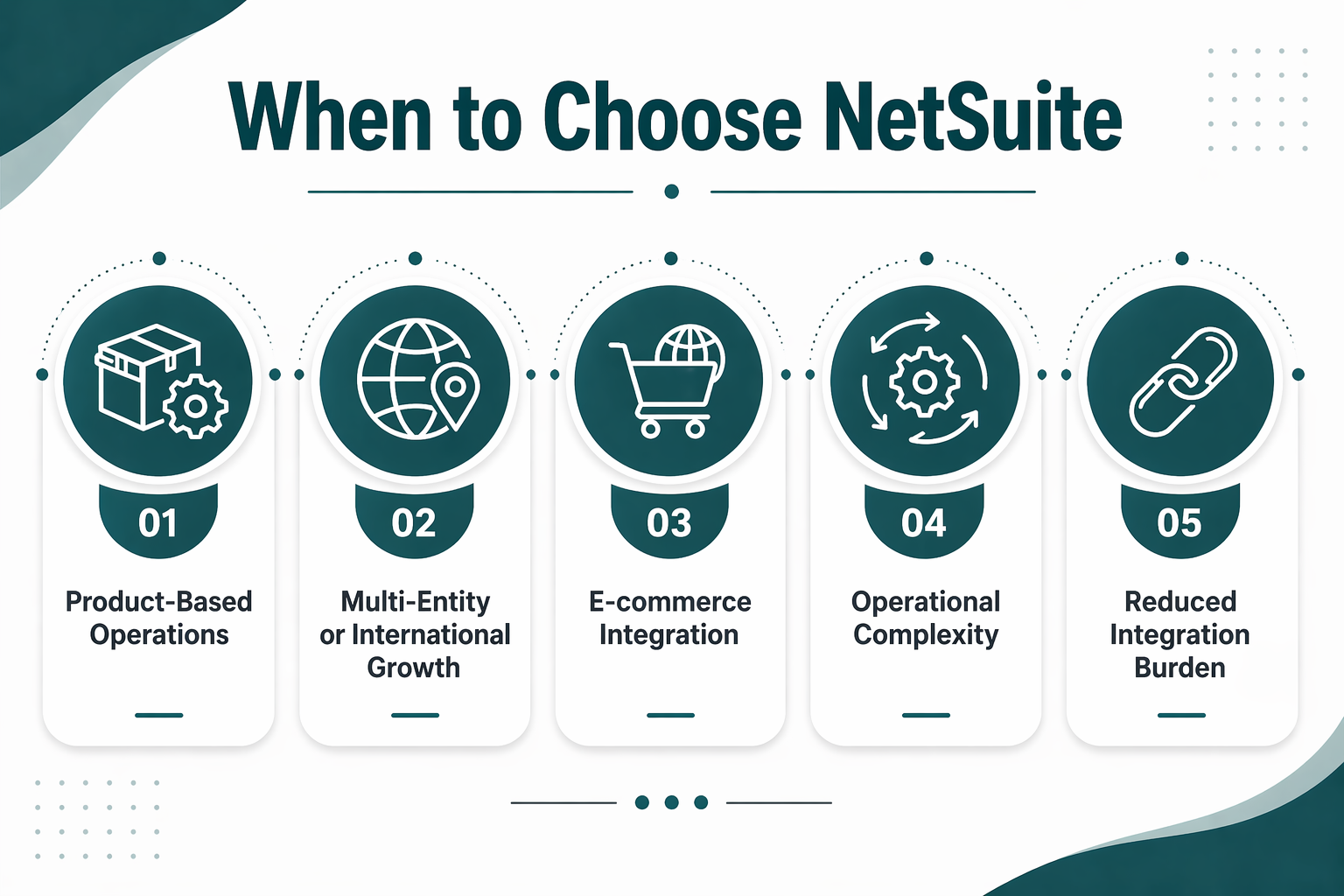
NetSuite is the better fit when a business needs to manage financials, operations, inventory, and customer relationships in one platform rather than connecting multiple systems through integrations.
Businesses that operate in product-based industries, manage inventory across multiple locations, or coordinate order fulfillment across channels benefit from NetSuite's unified ERP architecture. The platform reduces integration complexity, improves data accuracy, and supports cross-functional workflows without requiring external connectors for core business processes.
-
Product-Based Operations: Distributors, wholesalers, manufacturers, and retailers that need to track inventory, manage cost of goods sold, and coordinate order fulfillment across multiple channels benefit from NetSuite's native inventory and order management capabilities.
-
Multi-Entity or International Growth: Businesses expanding into new markets, managing multiple subsidiaries, or operating in multiple currencies benefit from NetSuite OneWorld's multi-entity and multi-currency support without requiring separate systems for each location.
-
E-commerce Integration: Businesses selling online through their own storefronts or third-party marketplaces benefit from NetSuite's integrated e-commerce platform, which syncs inventory, pricing, and customer data in real time.
-
Operational Complexity: Businesses that need to coordinate workflows across finance, sales, operations, and customer service benefit from NetSuite's unified platform, which reduces the need for manual data transfers and integration maintenance.
-
Reduced Integration Burden: Businesses that want to minimize the number of systems they manage and avoid the ongoing cost of maintaining connectors between financial, inventory, and CRM tools benefit from NetSuite's all-in-one architecture.
NetSuite fits businesses that expect to grow beyond financial management into broader operational coordination and want to avoid re-platforming as they scale.
When Sage Intacct Is The Better Fit
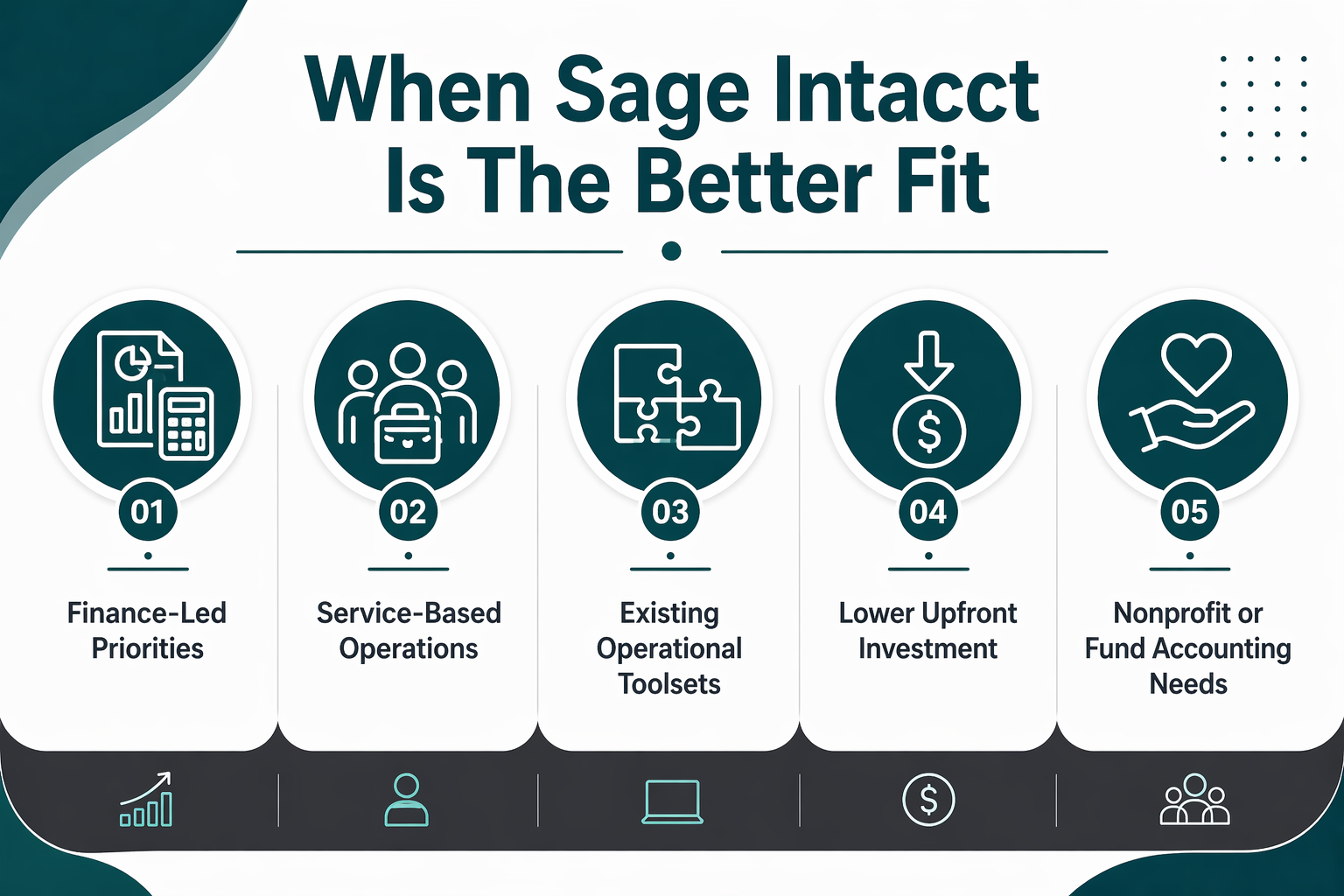
Sage Intacct may be a better fit when financial management is the primary buying driver and the business prefers to keep existing operational tools rather than replacing them with a unified ERP. Businesses that operate in service-based industries, prioritize accounting depth and reporting flexibility, or already use specialized tools for CRM, inventory, or e-commerce often find that Sage Intacct delivers the financial management capabilities they need without adding unnecessary ERP complexity.
-
Finance-Led Priorities: Businesses that prioritize accounting depth, financial reporting, and multi-entity consolidation over broader operational coordination benefit from Sage Intacct's focus on financial management.
-
Service-Based Operations: Consulting firms, professional services organizations, agencies, and nonprofits that need project accounting, time tracking, and billing without inventory management benefit from Sage Intacct's service-oriented design.
-
Existing Operational Toolsets: Businesses that already use Salesforce for CRM, Shopify for ecommerce, or specialized inventory management tools and do not want to replace those systems benefit from Sage Intacct's integration-friendly architecture.
-
Lower Upfront Investment: Businesses that want to upgrade financial management without the upfront cost and implementation complexity of a full ERP replacement benefit from Sage Intacct's narrower scope and faster rollout.
-
Nonprofit or Fund Accounting Needs: Nonprofits that need fund accounting, grant tracking, and donor management benefit from Sage Intacct's purpose-built capabilities for nonprofit financial management.
Final Verdict: Which ERP System Should You Go With?
The final decision between NetSuite and Sage Intacct depends on whether your business needs a financial management system with surrounding integrations or a unified ERP that handles financials, operations, inventory, and customer relationships in one platform. Choosing the wrong system category leads to either unnecessary complexity or excessive integration burden, both of which increase the total cost of ownership and reduce operational efficiency.
The right platform depends on how many business processes the ERP must support and whether the business prefers to manage one unified system or maintain a best-of-breed toolset with Sage Intacct as the financial hub.
- Choose NetSuite if: Your business manages inventory, coordinates order fulfillment, operates ecommerce channels, or needs to unify financials and operations in one platform. NetSuite fits product-based businesses, distributors, manufacturers, and retailers that want to reduce integration count and avoid re-platforming as they grow.
- Choose Sage Intacct if: Your business prioritizes financial management, operates in a service-based industry, or already uses specialized tools for CRM, inventory, and operations that you do not want to replace. Sage Intacct fits finance-led organizations, nonprofits, and businesses that prefer to keep operational workflows in external systems.
Before making a final decision, verify that the platform you choose supports your current operational model and can scale with your business without requiring a system replacement in two to three years. Evaluate the total cost of ownership, including software licensing, implementation services, integration and maintenance, and ongoing support, rather than comparing software costs alone.
Businesses comparing NetSuite and Sage Intacct benefit from working with certified ERP consultants who understand both platforms and can help evaluate fit based on process scope, growth plans, and system ownership preferences. Protelo provides ERP evaluation, free software demonstrations, licensing guidance, and NetSuite Implementation Services to help businesses choose and deploy the right cloud ERP solution.
Migrate to NetSuite to unify financials, operations, and customer data in one scalable platform.
Read Next: How to Choose the Right ERP for Your Business: A Step-by-Step-Guide
FAQs
Is Sage Intacct a Cloud ERP Software Or An Accounting System?
Sage Intacct is primarily a financial management and accounting system with ERP-like capabilities for multi-entity consolidation, project accounting, and revenue recognition. It handles core accounting workflows well but relies on third-party integrations for inventory, CRM, and order management. NetSuite is a true cloud ERP system that manages financials, operations, inventory, and customer relationships natively within one platform.
Which Is Better For Multi-Entity Reporting: NetSuite Or Sage Intacct?
Both platforms support multi-entity reporting, but they approach it differently. Sage Intacct excels at financial consolidation and reporting across multiple entities, making it a strong fit for businesses that prioritize accounting depth. NetSuite provides multi-entity reporting as part of a broader ERP platform that also manages operational data, inventory, and customer relationships across entities, which fits businesses that need unified financial and operational visibility.
Does NetSuite Usually Carry A Higher Total Cost Of Ownership Than Sage Intacct?
NetSuite typically carries higher upfront software licensing and implementation costs because it includes financials, CRM, inventory, and operations in one platform. However, NetSuite's unified architecture can reduce total cost of ownership by eliminating the need for separate CRM, inventory, and e-commerce systems and reducing integration maintenance expenses. Sage Intacct often has lower software costs, but businesses must budget for third-party applications, integration tools, and ongoing connector maintenance.
Which Platform Is Better For Project Accounting And Revenue Recognition?
Both platforms support project accounting and revenue recognition, but they fit different business models. Sage Intacct is designed for service-based businesses and offers strong project accounting, time tracking, and billing capabilities. NetSuite provides project accounting as part of a broader ERP system that also manages inventory, order management, and supply chain workflows, making it a better fit for product-based businesses that need project accounting alongside operational coordination.
Is Oracle NetSuite Too Broad For A Finance-First Organization?
NetSuite can be too broad for businesses that only need financial management and do not require inventory, CRM, or order management capabilities. Finance-first organizations that operate with light inventory, outsource fulfillment, or prefer to keep existing operational tools may find that Sage Intacct delivers the accounting depth they need without adding unnecessary ERP complexity. However, businesses that expect to expand into product-based operations or need tighter coordination between financials and operations benefit from NetSuite's unified platform.
When Does A Best-Of-Breed Software Stack Make More Sense Than One Unified ERP?
A best-of-breed software stack makes sense when a business already uses specialized tools for CRM, inventory, or e-commerce and does not want to replace those systems. Sage Intacct fits this model by providing strong financial management while integrating with third-party applications for non-financial workflows. A unified ERP like NetSuite makes more sense when a business wants to reduce integration count, improve data accuracy, and avoid the ongoing cost of maintaining connectors between multiple systems.