

17 min read


An ERP decision has lasting consequences for how a business manages reporting, operations, system administration, and growth. The right platform needs to support current requirements without creating avoidable complexity later. For companies, an ERP system is a pivotal part of long-term planning because it shapes reporting structure, operational visibility, and how teams scale over time.
SAP and NetSuite are both established ERP options used by growing businesses to manage finance, inventory, purchasing, and other core processes. What makes the choice more important is how each platform handles expansion, reporting structure, deployment, and long-term ownership once the system becomes central to daily operations.
This guide covers:
-
How to identify the right ERP solution for your business needs
-
Core platform differences across deployment, financial reporting, operations, customization, and scalability
-
How implementation complexity and ongoing administration burden differ between the two ERP systems
-
Which business profiles and growth paths align better with each platform's strengths
P.S. Companies evaluating a move from SAP Business One to NetSuite often need help preserving historical data during the transition. Protelo provides NetSuite Implementation Services to support structured exports, record preservation, and data continuity across ERP systems.
Migrate to NetSuite to gain unified cloud ERP coverage with automatic updates and native multi-entity support.
Quick Comparison: SAP Business One vs NetSuite
NetSuite vs SAP Business One: Primary Core Differences
Both SAP Business One and NetSuite can support core ERP needs, but they shape day-to-day operations in different ways. A better way to compare NetSuite and SAP Business One is not just to look at the features, but also to consider how each platform handles reporting, deployment, administration, and cross-functional work as the business grows.
Those differences matter most when companies need better visibility across entities, more connected operations, and a system their team can manage without added complexity while supporting business growth.
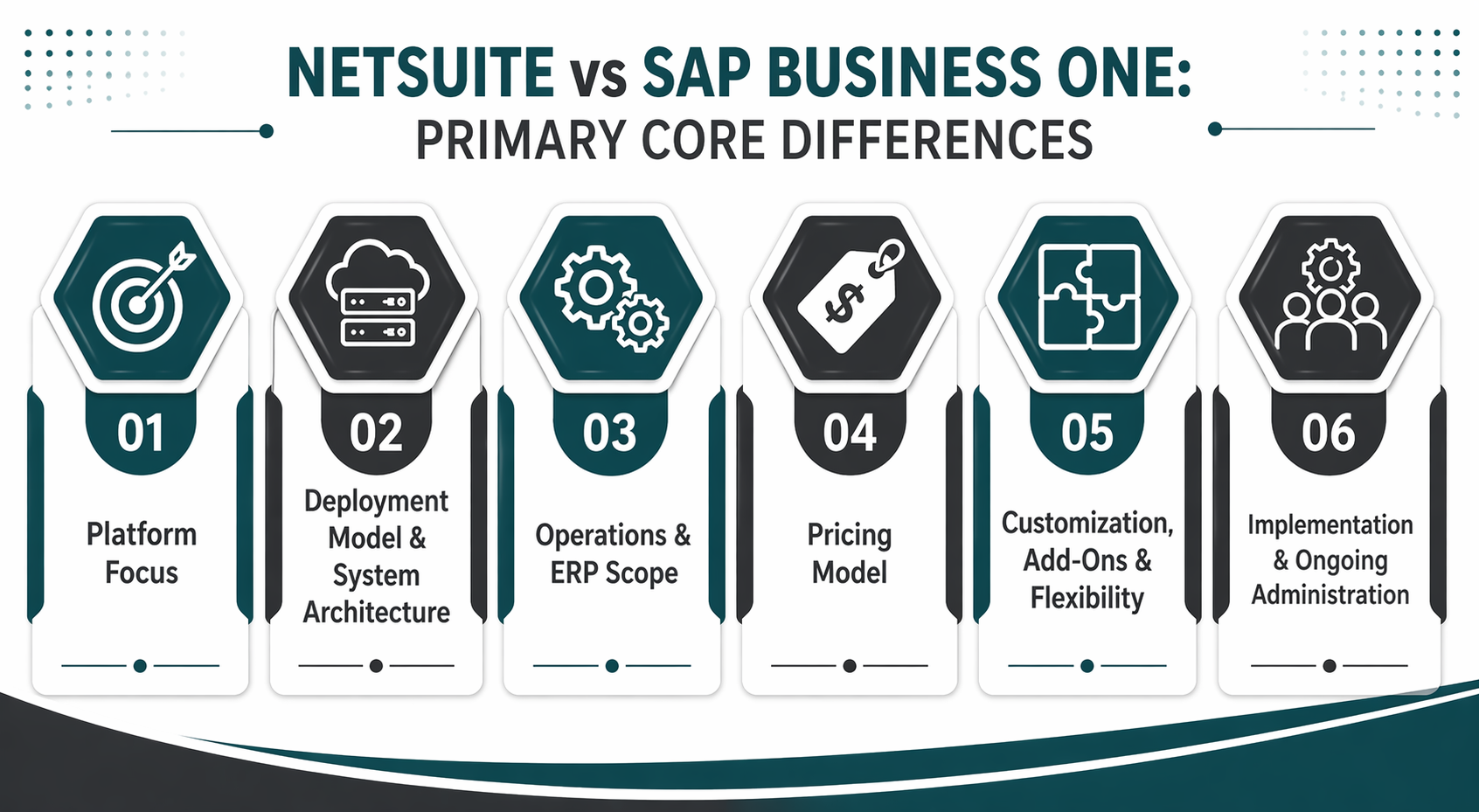
Platform Focus
The most significant difference between Oracle NetSuite and SAP Business One lies in platform orientation and target operating model. NetSuite offers a single unified cloud ERP platform that combines financial management, CRM, inventory, order management, ecommerce, and professional services automation in one system. SAP Business One is an ERP solution for small and midsize businesses seeking broad functionality with deployment flexibility and partner-shaped implementation.
NetSuite:
-
Unified Cloud ERP Platform: Combines finance, CRM, inventory, operations, and ecommerce in one cloud-native system without requiring separate software products or extensive integrations.
-
Cloud-First Operating Model: Assumes cloud-first operations with automatic updates, managed infrastructure, and security delivered as part of the subscription model.
-
Operational Breadth: Delivers broader native functionality across customer-facing operations, financial management, and supply chain processes without relying on partner-built extensions.
-
Standardized Updates: All customers run on the same version with bi-annual automatic updates, eliminating version lock and reducing internal IT coordination.
-
Integrated Business Management: Sales orders flow directly into inventory fulfillment, customer records connect to financial transactions, and project data ties to billing without requiring middleware.
SAP Business One:
-
Broad ERP Basics: Provides comprehensive ERP functionality across finance, sales, purchasing, inventory, and production, suitable for small and midsize businesses.
-
Deployment Flexibility: Offers on-premise, hosted, and cloud deployment options, allowing businesses to choose infrastructure ownership and control level.
-
Partner-Shaped Implementation: Relies more heavily on partner-led setup, add-on shaping, and third-party extensions to tailor ERP coverage to specific business requirements.
-
SMB-Oriented Design: Often evaluated by companies seeking ERP coverage without committing to a fully cloud-native operating model or broader unified platform.
-
Add-On Ecosystem: Achieves extended functionality through partner-developed add-ons and SDK-based customizations rather than native platform breadth.
Deployment Model & System Architecture
The choice between cloud-native standardization and deployment flexibility depends on whether the business values reduced IT ownership or prefers greater control over system environment and update timing.
Companies moving toward cloud-first operations typically favor NetSuite's managed infrastructure. Businesses with established IT teams or specific deployment requirements may prefer SAP Business One's flexibility. This is often the point where companies decide between a cloud ERP solution and a model that preserves more direct control over infrastructure.
Operations & ERP Scope
Operational scope inside the ERP software determines how much cross-functional coordination happens natively versus through integrations or add-ons. NetSuite integrates financial management, CRM, inventory management, order management, warehouse management, ecommerce, and professional services automation within one platform.
Sales orders flow directly into inventory fulfillment, customer records connect to financial transactions, and project data ties to billing without requiring separate systems. This unified structure reduces data silos and simplifies reporting across departments by keeping critical business data connected in one environment.
SAP Business One covers core ERP operations, including financials, sales, purchasing, inventory, production, and CRM. The platform provides broad functionality suitable for manufacturing, distribution, and service businesses.
However, deeper capabilities in areas such as advanced warehouse management, e-commerce integration, or professional services automation often require partner-developed add-ons or third-party integrations. Companies with straightforward operational needs may find SAP Business One's native scope sufficient, while business leaders requiring tighter integration across more functions may need additional extensions.
The difference becomes visible when cross-functional workflows depend on real-time data sharing. For example, a business that needs ecommerce orders to trigger inventory allocation, update customer records, and generate financial entries simultaneously benefits from NetSuite's native integration. A business with simpler workflows or a willingness to manage integrations may find SAP Business One's core operations adequate with selective add-ons and business intelligence support.
Pricing Model
Pricing structure affects total cost of ownership differently depending on whether a business prioritizes predictable cloud subscription costs or prefers greater control over licensing and infrastructure investment. NetSuite operates on an annual subscription model based on user count, selected modules, and business complexity, while SAP Business One also offers both perpetual licensing and cloud subscription options shaped by partner pricing and deployment choice.
Understanding the cost components beyond base licensing helps businesses budget accurately for implementation services, ongoing support, and long-term administration.
Customization, Add-Ons & Flexibility
The customization model determines where non-standard requirements get handled and who owns long-term maintenance responsibility. NetSuite uses native workflows, scripting tools, and a certified marketplace for extensions. SAP B1 relies more heavily on partner-developed add-ons, SDK-based development, and third-party integrations to extend functionality beyond core ERP capabilities.
NetSuite:
-
Native Workflows: Uses SuiteFlow for workflow automation, saved searches for custom reporting, and custom fields for data capture without requiring external development tools.
-
SuiteScript Development: Provides JavaScript-based scripting (SuiteScript) for custom business logic, validation rules, and automated processes that remain upgrade-safe when built to NetSuite standards.
-
SuiteTalk Integration: Supports web services integration (SuiteTalk) for connecting external systems, third-party applications, and custom-built tools to NetSuite data.
-
Certified SuiteApp Marketplace: Offers pre-built extensions for industry-specific needs, functional gaps, and specialized workflows tested for compatibility with NetSuite updates.
SAP Business One:
-
Partner-Developed Add-Ons: Relies more heavily on partner-built extensions and third-party add-ons to extend functionality beyond core ERP capabilities.
-
SDK-Based Development: Offers a software development kit allowing SAP and its partners to build custom functionality tailored to specific business requirements using SAP Business One's development framework.
-
Third-Party Extensions: Achieves extended capabilities through ecosystem partners rather than native platform development, introducing variability in add-on quality and maintenance responsibility.
-
Customization Coordination: Customizations may require coordination during version upgrades, and businesses must manage add-on dependencies with partner support.
-
Flexible Implementation: Allows partners to shape ERP coverage through selective add-ons and custom development, appealing to businesses comfortable with partner-led customization.
ERP Implementation Complexity & Ongoing Administration
The difference between implementation effort and ongoing ownership determines the total cost of ownership beyond initial software licensing. NetSuite requires a structured implementation with ongoing cloud administration managed by Oracle for infrastructure and updates. SAP Business One implementation varies by partner and deployment model, with administration burden depending on whether the business chooses on-premise, hosted, or cloud deployment.
Implementation Effort:
-
NetSuite: Structured implementation involves discovery, configuration, data migration, integration setup, testing, training, and go-live support. Implementation complexity depends on business size, data quality, customization requirements, and integration scope.
-
SAP Business One: Implementation varies significantly by partner. Some partners deliver rapid deployments focused on core functionality, while others provide comprehensive implementations including customizations and integrations. Implementation quality depends heavily on partner expertise, and businesses should evaluate partner experience carefully before committing to a deployment approach.
Ongoing Administration:
-
NetSuite: Requires ongoing administration for user management, workflow adjustments, reporting updates, and system optimization. Oracle manages infrastructure, security, and version updates automatically. Businesses can handle administration internally or work with partners for ongoing NetSuite support, system audits, and optimization services.
-
SAP Business One: Administration burden depends on the deployment model. On-premise deployments require internal IT resources for server management, database maintenance, and version upgrades. Hosted or cloud deployments shift some infrastructure responsibility to partners, but businesses still coordinate updates and manage system configuration.
Post-Go-Live Ownership:
-
NetSuite: Lower internal IT burden after go-live due to managed cloud infrastructure and automatic updates. Businesses focus on user training, workflow optimization, and business process refinement rather than infrastructure maintenance.
-
SAP Business One: Higher variability in post-go-live ownership depending on deployment choice and partner relationship quality. On-premise deployments require ongoing IT resources, while cloud deployments depend on partner support, responsiveness, and service quality.
-
Support Model Differences: NetSuite's cloud-native model reduces coordination burden for version updates and security patches. SAP Business One's flexibility introduces more variability in long-term administration depending on deployment choice and partner relationship quality.
Read Next: Top 14 NetSuite Competitors for ERP Buyers in 2026
Why NetSuite Might Be A Better Fit
NetSuite becomes the stronger choice when business requirements align with cloud-first operations, multi-entity growth, and unified operational scope inside one ERP system. The following conditions signal that NetSuite's architecture and native functionality better support long-term business needs.
-
Multi-Entity Reporting Is Required: Businesses managing multiple subsidiaries, intercompany transactions, or consolidated financial reporting benefit from NetSuite's native multi-entity architecture without requiring separate consolidation tools.
-
Cloud-First Operations Are Preferred: Companies that want to eliminate internal server management, reduce IT infrastructure burden, and rely on automatic updates favor NetSuite's cloud-native model over deployment flexibility.
-
Broader Operational Scope Inside One System Matters: Organizations needing finance, CRM, inventory, ecommerce, and professional services automation tightly integrated within one platform find NetSuite's unified structure reduces data silos and simplifies cross-functional workflows.
-
International Expansion Is Planned: Businesses anticipating growth across currencies, languages, or regulatory environments benefit from NetSuite's global capabilities, including multi-currency management, tax compliance, and localized reporting.
-
Lower Long-Term Administration Burden Is Valued: Companies preferring managed infrastructure, automatic version updates, and reduced internal IT dependence after go-live favor NetSuite's cloud ERP model over partner-coordinated administration.
-
Unified Customer and Financial Data Is Critical: Organizations that need customer records, sales orders, inventory fulfillment, and financial transactions connected in real time benefit from NetSuite's integrated CRM and ERP functionality.
Read Next:
- NetSuite ERP: Tailored Solutions for Every Business Size
- Gartner Analysis: Why Companies Choose NetSuite
SAP Business One Might Be A Better Fit If
SAP Business One becomes the stronger choice when business requirements prioritize deployment flexibility, partner-shaped ERP coverage, and simpler entity structures. The following conditions signal that SAP Business One's model better supports current operational needs.
-
Deployment Flexibility Is Required: Companies with existing IT infrastructure, specific data residency requirements, or preferences for on-premise or hosted environments benefit from SAP Business One's deployment options over cloud-native standardization.
-
Simpler Entity Structure Exists: Businesses operating within a single legal entity or managing straightforward multi-location operations without complex intercompany reporting may find SAP Business One's core functionality sufficient.
-
Partner-Led Implementation Is Preferred: Organizations comfortable with partner-driven setup, add-on shaping, and coordinated support may appreciate SAP Business One's flexibility in tailoring ERP coverage to specific business requirements.
-
Core ERP Operations Are Sufficient: Companies needing broad ERP basics across finance, sales, purchasing, inventory, and production without requiring extensive native integration across CRM, ecommerce, or professional services automation may find SAP Business One adequate.
-
Greater Control Over System Environment Is Valued: Businesses that want more control over server configuration, database management, and update timing prefer SAP Business One's deployment flexibility over managed cloud infrastructure.
-
Limited Multi-Entity Growth Is Expected: Organizations that do not anticipate significant acquisition activity, international expansion, or complex multi-subsidiary reporting may find SAP Business One's simpler architecture aligns with current and near-term needs.
Final Verdict: Which Is the Best ERP System?
For teams choosing the right ERP, the more useful question is not simply NetSuite or SAP, but which platform is the ideal ERP solution for current needs and future growth.
The choice between NetSuite and SAP Business One depends on whether a business prioritizes cloud-first operational breadth or deployment flexibility shaped by partner expertise. NetSuite fits better when multi-entity reporting, unified operational scope, and lower long-term administration burden matter most. The platform delivers finance, CRM, inventory, e-commerce, and professional services automation inside one cloud ERP system with automatic updates and managed infrastructure.
The SAP Business Technology Platform fits better when deployment flexibility, simpler entity structures, and partner-led ERP shaping align with current business requirements. The platform offers broad ERP coverage across core operations with greater control over the deployment model and system environment.
Businesses considering a transition from SAP Business One or legacy ERP to NetSuite can work with experienced partners to preserve historical data and maintain operational continuity. Protelo provides NetSuite Implementation Services to support structured exports, record preservation, and data migration planning.
Migrate to NetSuite to access a unified cloud ERP with native multi-entity support and automatic infrastructure management.
FAQs
Is NetSuite Better Than SAP Business One For Growing Companies?
Oracle NetSuite typically fits growing companies better when multi-entity reporting, international expansion, or broader operational scope inside one system becomes critical. The platform supports multi-subsidiary management, multi-currency transactions, and consolidated financial reporting natively. SAP Business One fits better when growth remains within a single entity or simpler organizational structures without complex intercompany requirements.
What Is The Main Difference Between NetSuite And SAP Business One?
The main difference lies in platform architecture and operational scope. NetSuite is a cloud-based ERP solution integrating finance, CRM, inventory, e-commerce, and professional services automation in one system with automatic updates. SAP Business One offers deployment flexibility and broad ERP basics shaped by partner-led implementation and add-on extensions.
Which ERP Platform Is Better For Multi-Entity And Global Operations?
NetSuite handles multi-entity and global business operations better through native multi-subsidiary management, intercompany accounting, multi-currency support, and consolidated reporting. The platform manages cross-entity transactions and global financial management without requiring separate consolidation tools. SAP Business One fits simpler entity structures better and may require additional configuration or migration to other SAP products as multi-entity complexity increases.
Can SAP Business One Be A Good Fit For Smaller Businesses?
SAP Business One can fit smaller businesses well when deployment flexibility, partner-shaped ERP coverage, and core operational functionality align with business requirements. The platform provides broad ERP basics across finance, sales, purchasing, inventory, and production. Companies with straightforward entity structures and limited multi-entity reporting needs may find SAP Business One adequate without requiring cloud-native infrastructure.
How Do NetSuite And SAP Business One Differ In Implementation And Administration?
NetSuite implementation involves structured discovery, configuration, data migration, and training with ongoing cloud administration managed by Oracle for infrastructure and updates. SAP Business One implementation varies by partner and deployment model, with administration burden depending on whether the business chooses on-premise, hosted, or cloud deployment. NetSuite reduces internal IT burden after go-live, while SAP Business One introduces more variability in long-term administration depending on deployment choice.
How Should Businesses Choose Between NetSuite And SAP Business One?
Businesses should evaluate current requirements against near-term growth expectations by comparing multi-entity reporting needs, deployment preferences, operational scope requirements, and long-term administration burden. Companies anticipating multi-entity expansion, international operations, or tighter cross-functional integration should favor NetSuite's native architecture. Organizations preferring deployment control, simpler structures, and partner-shaped coverage may find SAP Business One adequate for current needs.